
An agile project management checklist is a short list you tick off to make sure your agile project starts on solid ground and stays healthy. It covers the product vision, the backlog, who plays which role, the sprint events, the definition of done, stakeholder involvement, a few simple metrics and the habit of improving. Use it before sprint 1, then revisit it every few sprints.
Most agile projects that struggle do not fail because of Scrum or Kanban. They fail because something basic was missing at the start: no real product owner, no shared idea of “done”, or stakeholders who never come to reviews. A checklist catches these gaps early. Below you get the checklist by stage, how to use it, and the setup mistakes I see most.
If you want to understand agile itself first, its values, principles and frameworks, read my agile guide. This page is a working tool: a checklist you can use to start an agile project and keep it on track.
What should an agile project management checklist include?
Agile means delivering in small steps, getting feedback and adjusting. That flexibility only works if the basics are clear: who decides priorities, what the team is building and how you know a piece of work is finished.
Starting is the hard part. Teams often jump into sprints because it feels like progress. Spend a few hours on the checklist first. It is much cheaper than discovering in sprint 4 that nobody agreed what “done” means.
Before sprint 1: a starting checklist you can use today
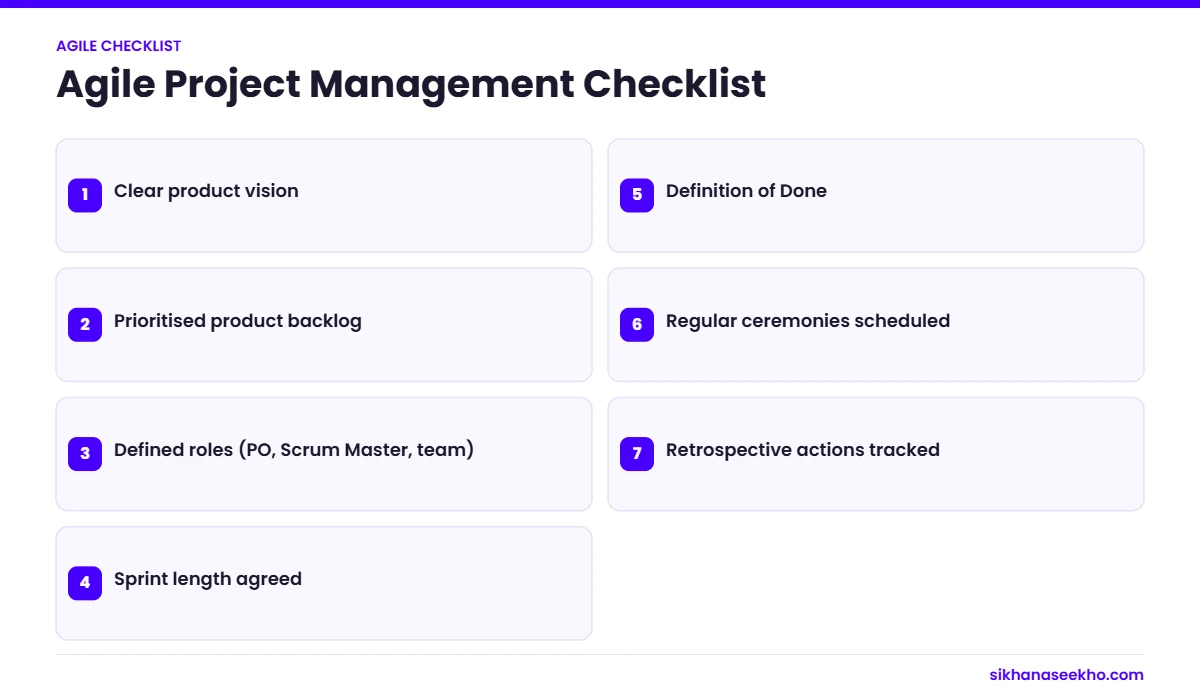
- One sentence product vision that the sponsor and team both agree with.
- A named product owner who has the time and the authority to say yes and no.
- A team of about 10 people or fewer, with all the skills needed to finish the work.
- A first backlog with the top items small and clear enough for one sprint.
- A written definition of done, for example “tested, reviewed and accepted by the product owner”.
- Sprint length agreed, with dates for planning, review and retrospective in everyone’s calendar.
- Key stakeholders invited to the first sprint review.
- A visible board, physical or digital, that everyone can see.
If you cannot tick the first two, stop and fix them. Everything else can improve during the sprints. Without a clear vision and a real product owner, the team will be busy but not useful.
The agile checklist by stage
| Stage | Check | Done? |
|---|---|---|
| Set-up | Product vision and goal written and shared | Yes / No |
| Set-up | Product owner, Scrum Master and developers named | Yes / No |
| Set-up | Product backlog created and ordered | Yes / No |
| Set-up | Definition of done agreed | Yes / No |
| Each sprint | Sprint goal agreed at planning | Yes / No |
| Each sprint | Daily Scrum held, 15 minutes or less | Yes / No |
| Each sprint | Increment reviewed with stakeholders | Yes / No |
| Each sprint | Retrospective produces 1 or 2 actions | Yes / No |
| Ongoing | Backlog refined regularly | Yes / No |
| Ongoing | Burndown or burnup chart up to date | Yes / No |
| Ongoing | Impediments logged and removed | Yes / No |
Based on the Scrum Guide (2020). Adapt items to your framework.
Agile Audit Checklist
An agile audit checklist looks at a team that is already running. It asks whether the team really follows agile practices or just uses agile words, and it shows where to improve first.
An agile readiness checklist comes before the project. It asks whether the organisation can support agile at all: is there a product owner with time and authority, will stakeholders join reviews, and can the team work together most days?
How should companies incorporate Agile methodology into their initiatives?
Some organisations also keep a deliverables list. In agile this should be light: a product roadmap or release plan that shows the main outcomes and rough timing, not a fixed list of every feature.
So how should a company start using agile on its projects? First, check readiness. Use the readiness questions above, honestly, with the sponsor in the room.
Next, agree the outcomes you want and a rough timeline. A one-page roadmap is enough to start.
Then set up the team and the way of working. Form a cross-functional team, pick a framework such as Scrum or Kanban, write the first user stories and run the first sprint.
Agile is not one size fits all. Tailor it. Many organisations, especially in construction and engineering, run a hybrid: predictive for contracts, approvals and site work, agile for design or software parts of the project.
How do you use the checklist?
Use it at 3 moments. At the start of the project, work through the set-up items with the team and product owner, and do not start the first sprint until each one is in place. During each sprint, use the sprint items as a quick health check at the retrospective. Every 3 or 4 sprints, review the ongoing items to spot drift.
Keep it light. The aim is a 10-minute conversation, not a bureaucratic audit. If an item is consistently missing, ask why: it may be a sign that the team needs coaching, that the product owner lacks time, or that the organisation is getting in the way.
Adapt it to your context. Teams using Kanban may replace sprint events with flow metrics and regular replenishment meetings; hybrid projects may add stage-gate approvals or a risk review.
Common agile setup mistakes
The most common is starting sprints without a real product owner. If nobody has the authority to order the backlog and accept work, the team ends up guessing priorities.
The second is a vague definition of done. Without clear criteria for testing, documentation and deployment, work that looks finished keeps coming back.
The third is treating the retrospective as optional. Teams that skip it when busy lose the main way agile has of getting better. With many teams now hybrid or remote, short regular retrospectives matter even more.
Agile in non-software projects
The same checklist works outside IT with small changes. A marketing team might define done as approved, published and measured; a construction design team might run 2-week design sprints with a client review at the end of each. The principles of the 2001 Agile Manifesto still apply: frequent delivery, close collaboration and responding to change.
Signs your agile project is healthy
The team meets its sprint goal in most sprints, stakeholders attend sprint reviews and give feedback, the backlog is ordered and ready 1 to 2 sprints ahead, impediments are removed within days rather than weeks, and each retrospective leads to at least 1 change the team can see. If 3 or more of these are missing, use the checklist above to find the cause.
Checklist for agile leaders
Leaders support agile teams by protecting them from constant priority changes, making a product owner available for at least several hours a week, funding teams rather than individual projects where possible, and asking about outcomes rather than activity. A 15-minute monthly conversation between the Scrum Master and the sponsor, using the checklist as an agenda, keeps leadership engaged without micromanaging.
How to introduce the checklist to a team
Do not hand it over as an audit. Run a 30-minute session where the team scores each item together and picks the 2 or 3 gaps that hurt most. Fix those first, then revisit the checklist in 4 to 6 weeks. Teams adopt checklists they helped shape, and ignore ones imposed on them.
Over time, the team may outgrow some items and add new ones, such as automated testing coverage or deployment frequency. That is a good sign: the checklist should evolve with the team.
Keep each version, so you can see how the team has matured over 6 or 12 months. That history is also useful when you report agile progress to sponsors and leadership.
Key takeaway
A short, shared checklist keeps an agile project honest. Use it to set up well, check health every sprint and fix the few gaps that matter most, rather than chasing perfect compliance with every item.
If you want a ready-made starting point, adapt the stages and items in the table above into a shared document or board column, and assign a named owner for each gap you decide to fix. Review the owners and progress at the next retrospective.
How often should you review the checklist?
Review the set-up items once, before sprint 1, and do not start until they are in place. Then use the sprint items as a quick check at every retrospective, and do a fuller review every three or four sprints. Agile is about inspecting and adapting, and that applies to your checklist too: keep what helps, drop what does not, and add items as the team learns. You can find more agile practices explained in my video.
Agile checklist: common questions
Is there an official agile checklist?
No. Checklists like this are practical tools based on the Scrum Guide and agile principles. Adapt them to your team.
How often should a team review its checklist?
Briefly at each retrospective and in more depth every 3 or 4 sprints.
Who owns the checklist?
Usually the Scrum Master or agile project manager, but the whole team should help keep it honest.
Keep learning
- Agile Project Management: Complete Guide for 2025
- Scrum Guide 2026: Roles, Ceremonies & Artifacts
- Waterfall Project Management: When to Use It & How
- Agile vs Waterfall 2026: Which Should You Choose?
- Hybrid Project Management: The Complete Guide for 2026
- 12 Agile Principles Explained with Real Examples