
An agile project management certification is a credential that shows you can plan and deliver work using agile methods such as Scrum, Kanban or SAFe. The right one depends on your role: PMI-ACP for experienced project managers, CSM or PSM for Scrum Masters, and SAFe for large enterprises.
Agile methodologies remain a driving force in project management throughout 2025, prompting organizations to prioritize professionals with an agile project management certification 2025 who can thrive in fast-paced, adaptive environments and deliver continuous value. Whether you’re new to Agile or a seasoned Scrum Master, choosing the right agile project management certification 2025 can elevate your career.
This guide explores the best certifications for Agile professionals, comparing benefits, cost, and suitability for different career levels. Let’s dive into the most in-demand Agile certifications this year.
Agile methodologies continue to lead the project management landscape in 2025. Organizations are on the lookout for certified experts capable of thriving in dynamic environments and achieving iterative success. Whether you’re beginning your Agile career or are a seasoned Scrum Master, opting for the right agile project management certification in 2025 can significantly advance your professional journey.
This guide evaluates the top certifications for Agile professionals, comparing their benefits, costs, and suitability across various career stages. Let’s explore the most sought-after Agile certifications of the year.
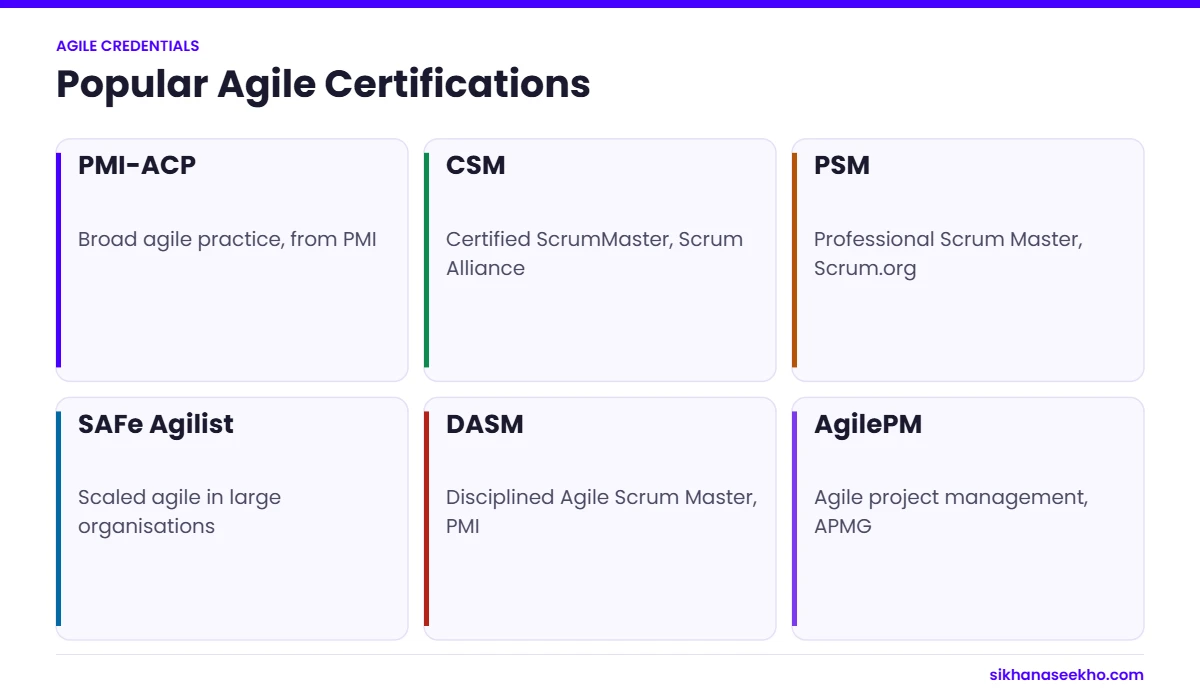
Agile certifications compared at a glance
| Certification | Awarding body | Best for | Course required? |
|---|---|---|---|
| PMI-ACP | PMI | Project managers using several agile methods | Agile training hours required |
| Certified ScrumMaster (CSM) | Scrum Alliance | New Scrum Masters who want a taught course | Yes, a 2-day course |
| Professional Scrum Master (PSM I) | Scrum.org | Self-starters who prefer a tougher online exam | No |
| SAFe Agilist (SA) | Scaled Agile | Leaders in large organisations using SAFe | Yes |
| Disciplined Agile Scrum Master (DASM) | PMI | Teams mixing agile and traditional delivery | Yes |
| ICAgile Certified Professional (ICP) | ICAgile | A broad agile foundation | Yes |
Check each awarding body for current fees and exam rules.
How do you choose the right agile certification?
Start with the job you want. Scrum Master adverts usually ask for CSM or PSM, while project manager adverts in organisations moving to agile more often mention PMI-ACP alongside PMP.
Next, look at cost and renewal. CSM requires renewal every 2 years with a fee and continuing education, while PSM I does not expire. PMI-ACP needs 30 PDUs every 3 years.
Finally, consider how you learn. If you want structure and a cohort, a taught course such as CSM suits you. If you can study alone, PSM I is cheaper and well respected.
What does each agile certification cost in time?
The certifications in this guide differ more in time than in price. CSM and SAFe Agilist are built around a 2-day taught course, usually 14 to 16 hours of class, followed by an online exam. PSM I has no required course, so most candidates spend 20 to 30 hours reading the Scrum Guide and practising questions before sitting the exam.
PMI-ACP takes longer because it expects real agile experience as well as training, and its exam covers several methods, not just Scrum. Plan for 6 to 10 weeks of steady study if you work full time.
Whichever you choose, read the Scrum Guide first. It is under 20 pages, free, and it underpins most of the exam questions across CSM, PSM and much of the PMI-ACP.
If your employer pays for training, ask which certification its agile coaches hold. Matching the organisation’s language makes the credential more useful from day 1.
Which agile certification should you take first?
If you are new to agile, start with a Scrum certification. CSM is the gentler entry because the course does most of the teaching; PSM I is the better choice if you want a harder exam that employers know cannot be passed without real understanding.
If you already manage projects and hold the PMP, PMI-ACP is the natural next step, because it builds on the same PMI framework and shows you can lead in both predictive and agile settings.
If your organisation runs SAFe, the SAFe Agilist course is often paid for by the employer and gives you the shared vocabulary used in planning events across large programmes.
How do you keep an agile certification active?
Each body has its own renewal rules. Scrum Alliance certifications such as the CSM renew every 2 years with a fee and a set number of Scrum Education Units. PMI-ACP renews every 3 years with 30 PDUs. PSM I from Scrum.org does not expire. Plan renewal into your learning budget from the start, and log learning as you go so you are not chasing units in the final month.
1. PMI Agile Certified Practitioner (PMI-ACP)
The PMI-ACP remains an elite agile project management certification in 2025. Provided by the Project Management Institute (PMI), this credential confirms your grasp of Agile principles and your proficiency in applying them across projects.
Why Choose It:
- Globally recognized.
- Covers diverse Agile methodologies: Scrum, Kanban, XP, and Lean.
- Requires practical Agile experience.
Best For:
Mid-to-senior-level project managers seeking to boost credibility in hybrid or Agile settings.
2. Certified ScrumMaster (CSM)
If you’re embarking on your Agile journey, the Certified ScrumMaster from Scrum Alliance serves as a fantastic initial step. It emphasizes Scrum fundamentals and team facilitation skills.
Why Choose It:
- Beginner-friendly.
- Highly regarded in Agile communities.
- Interactive training with hands-on exercises.
Best For:
Aspiring Scrum Masters, Agile team members, and project coordinators.
3. SAFe Agilist (SA)
The Scaled Agile Framework (SAFe) is tailored for large organizations implementing Agile across multiple teams. The SAFe Agilist certification enables you to spearhead Agile transformations on a grand scale.
Why Choose It:
- Designed for enterprise-level Agile.
- Focuses on Lean-Agile leadership and collaboration.
- Favored by Fortune 500 companies.
Best For:
Leaders, managers, and consultants facilitating Agile at scale.
4. Disciplined Agile Scrum Master (DASM)
The DASM certification represents PMI’s commitment to the changing Agile landscape. It teaches a variety of Agile and Lean practices, enabling you to customize your approach according to the context.
Why Choose It:
- Versatile toolkit, not a one-size-fits-all.
- Covers Scrum, Kanban, SAFe, and additional methodologies.
- No prior Agile experience required.
Best For:
New Agile professionals looking for flexibility in frameworks.
5. ICAgile Certified Professional (ICP)
ICAgile offers several certifications, beginning with the ICP, which highlights an Agile mindset and foundational skills instead of a specific framework.
Why Choose It:
- Focuses on values and mindset.
- Framework-agnostic.
- Beneficial for professionals in career transition.
Best For:
Individuals moving into Agile roles or those seeking broader Agile insights.
6. Professional Scrum Master (PSM)
Provided by Scrum.org, the PSM certification is well-respected and enables you to demonstrate your Scrum knowledge via rigorous examination.
Why Choose It:
- No mandatory training (self-study is an option).
- Multiple levels of certification (PSM I, II, III).
- Valid for a lifetime.
Best For:
Self-driven learners and Scrum practitioners looking for validation.
7. AgilePM Foundation and Practitioner
Created by APMG International, AgilePM blends conventional project frameworks with Agile adaptability.
Why Choose It:
- Merges project governance with Agile execution.
- Grounded in DSDM (Dynamic Systems Development Method).
- Widely utilized in the UK and Europe.
Best For:
Project managers operating in regulated or structured settings.
How to Select the Best Agile Project Management Certification in 2025
To determine the most suitable agile project management certification in 2025, consider:
- Your current position: Are you a team member, Scrum Master, or project manager?
- Career aspirations: Are you looking to lead large Agile transformations or specialize in Scrum?
- Time and budget: Some certifications may be more expensive or require extensive preparation.
- Framework preference: Do you prefer Scrum, SAFe, or hybrid methodologies?
As the Agile landscape evolves swiftly, maintaining certification is essential for your career progression, not just an enhancement to your résumé.
FAQs: Agile Project Management Certification 2025
1. Which agile project management certification is ideal for beginners in 2025?
The Certified ScrumMaster (CSM) and Disciplined Agile Scrum Master (DASM) are perfect for newcomers.
2. Is PMI-ACP still relevant in 2025?
Absolutely. PMI-ACP ranks as one of the most all-encompassing certifications, particularly for hybrid Agile roles.
3. How many agile project management certifications should I pursue?
Start with one tailored to your current role. As your career advances, consider adding others like SAFe or PMI-ACP to widen your expertise.
4. What is the average cost of agile project management certification in 2025?
Costs vary from $400 (PSM) to over $1,200 (PMI-ACP or SAFe), depending on training and examination fees.
5. Do agile project management certifications have expiration dates?
Some certifications, like CSM, require renewal every two years, while others, like PSM, remain valid for life.
Keep learning
- Certifications That Offer the Highest ROI in Project Management
- Certifications for Construction Project Managers in the UK and USA
- Healthcare Project Management Certifications for Medical Project Managers
- How to Become a Disciplined Agile Scrum Master
- Top 5 Free Project Management Courses Worth Taking
- How to Pass Google Project Management Certificate in 3 Months