Project Communications Management (PMBOK Knowledge Area 10) is the collection of three processes that ensure timely and appropriate planning, collection, creation, distribution, storage, retrieval, management, monitoring and disposal of project information. It covers Plan Communications Management (determining who needs what information, when they need it, and how it will be delivered), Manage Communications (creating, collecting, distributing, storing and retrieving project information), and Monitor Communications (ensuring the information needs of the project and its stakeholders are met). The key insight is that communication is not just about sending information. It is about ensuring the right information reaches the right person in the right format at the right time, and that the message received is the message intended. Approximately 90% of a project manager's time is spent communicating, making this the knowledge area most directly connected to daily PM practice.
✦
From my experience: On my UAE projects I worked with people from more than 20 nationalities, and most of the problems I saw started with communication, not technical issues. That is why I spend real time on this knowledge area with my PMP students.
Communication is simultaneously the most practised and the least formally managed aspect of project management. Ask any PM what they spend most of their time on and the answer is invariably some form of communication: meetings, status reports, emails, stakeholder briefings, team conversations, escalation calls. Yet ask the same PM whether they have a formal communications management plan and the answer is frequently no.
This gap between communication volume and communication planning is the root of many project failures. Stakeholders receive information they did not need while missing information they did. Status reports go to large distribution lists where the wrong level of detail lands with the wrong audience. Critical decisions are made without key parties being consulted. Project issues surface in executive briefings because they were never formally reported through defined channels.
The three PMBOK processes in Communications Management exist to close this gap: to transform communication from an ad-hoc activity into a planned, structured, monitored component of project delivery. This guide covers all three processes with full ITO breakdowns, the communication model, the channels formula, communication methods (interactive, push, pull), communication dimensions, common barriers to effective communication, and how communications management operates across Agile, waterfall and hybrid environments.
Foundational Concepts
The Foundations of Project Communication
Before examining the three processes, three foundational concepts underpin everything in communications management: the communication model, the communication channels formula, and the distinction between communication methods.
Match the method to the message and the audience.
The Communication Model: How Information Flows
Basic Communication Model: Sender → Message → Receiver
Sender
Encodes message
→
Transmission
Medium / Channel
⚡ NOISE ⚡
Reception
Message received
→
Receiver
Decodes message
→
Feedback
Acknowledges
Encode
The sender translates thoughts into a message: choosing words, format, tone and medium. The encoding is influenced by the sender's knowledge, culture, experience and assumptions about the receiver.
Noise
Any interference that distorts the message between sender and receiver. Can be physical (poor audio), semantic (different terminology), psychological (preconceptions), cultural (different norms), or environmental (distractions). Noise causes messages to be received differently from how they were intended.
Decode
The receiver interprets the message: translating words, tone and context into meaning. Decoding is influenced by the receiver's knowledge, culture, experience and assumptions. The decoded message may differ from the encoded message even without deliberate distortion.
Medium
The channel through which the message travels: email, meeting, phone call, written report, presentation, instant message. The choice of medium significantly affects how the message is received. Rich media (face-to-face) carry more contextual information than lean media (email).
Feedback
The receiver's response that confirms the message was received and understood. Feedback closes the communication loop: without it, the sender cannot verify that the intended message was actually received. Absence of feedback is not confirmation of understanding.
Acknowledgement
Confirmation that a message was received: distinct from feedback indicating the message was understood or agreed with. A team member who acknowledges an email may not have read it carefully; feedback confirming understanding is a higher standard than simple acknowledgement.
✦
The sender's responsibility: In PMBOK, the sender is responsible for ensuring the message is clear, complete, and understood. The receiver confirms understanding through feedback. A message that was sent but not understood is a communication failure, and it is the sender's responsibility to address it. PMs who say "I sent that email three weeks ago" when a stakeholder claims not to have received critical information are describing a communication failure, not a stakeholder failure.
Communication Channels Formula
Communication Channels: The Formula and Its Implications
Channels = n × (n − 1) / 2
Where n = number of stakeholders. The formula calculates the total number of potential communication channels between all pairs of stakeholders. As team and stakeholder numbers grow, the number of channels grows exponentially: making communication planning increasingly critical and communication management increasingly complex.
2
stakeholders
1 channel
5
stakeholders
10 channels
10
stakeholders
45 channels
20
stakeholders
190 channels
The formula reveals why adding one stakeholder to a project of 10 people (going from 10 to 11 stakeholders) increases channels from 45 to 55, a 22% increase in communication complexity from a single addition. Large projects with 50+ stakeholders have over 1,200 potential channels: making structured communication planning essential, not optional.
Communication Methods
The Three Communication Methods: Interactive, Push, Pull
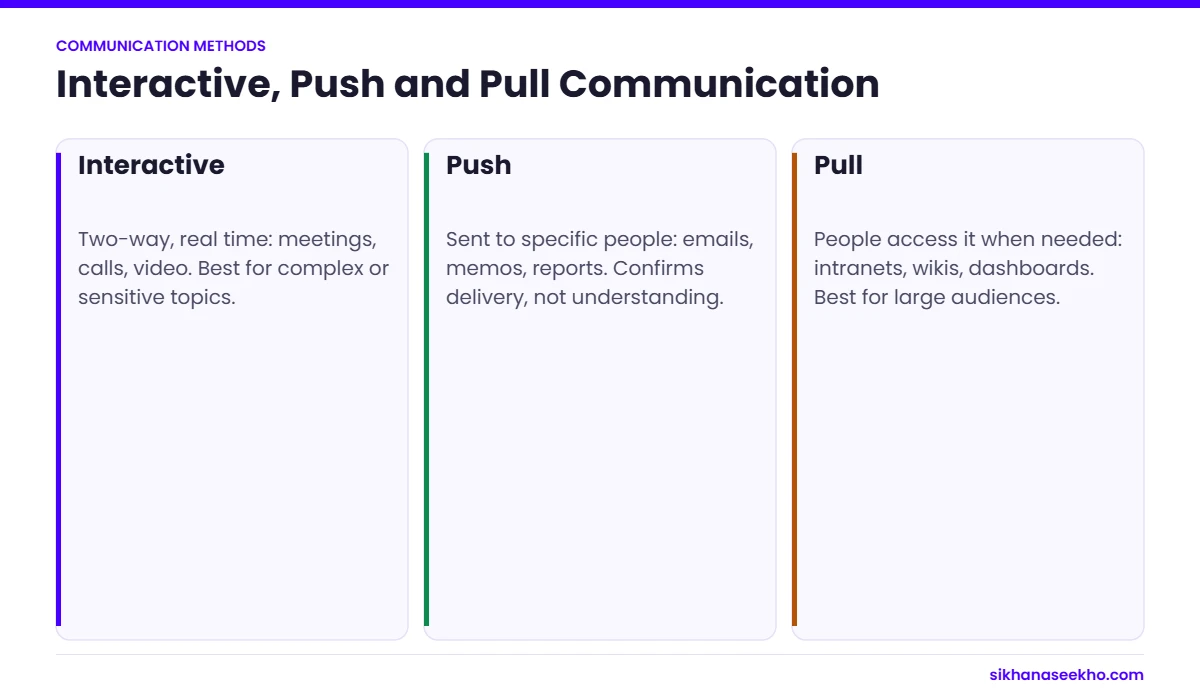
PMBOK categorises all project communication methods into three types. The choice of method affects whether communication is synchronous or asynchronous, whether feedback is immediate or deferred, and whether the PM can verify that information was received and understood.
Interactive Communication
Real-time, multi-directional exchange between two or more parties. Allows immediate feedback, clarification and confirmation of understanding. The richest form of communication. It carries tone, context, non-verbal cues (in person) and enables real-time course correction.
Information sent to specific recipients who need to know. One-directional, the sender pushes the message to receivers without requiring immediate response. Ensures information reaches the target audience but does not confirm whether it was read or understood.
Email communications
Status reports distributed to stakeholders
Letters, memos and formal correspondence
Meeting minutes distributed post-session
Press releases and announcements
Voicemail messages
Routine updates, wide distribution, information that doesn't require immediate response, formal notifications
Pull Communication
Information stored in a central repository that recipients access on demand. The receiver pulls information when they need it rather than having it pushed to them. Most appropriate for large volumes of information or complex reference material where not everyone needs everything at the same time.
Project intranet or SharePoint sites
Document management systems
Knowledge bases and wikis
Lessons learned repositories
Project portals and dashboards
Online training and e-learning modules
Reference documentation, large file distributions, self-service information access, project archives
The Three Processes
Project Communications Management: The 3 PMBOK Processes
10.1
Plan Communications Management
Planning Process Group · Develops an appropriate approach and plan for project communications based on stakeholder information needs
+
Plan Communications Management is the process of developing an appropriate approach and plan for project communications activities based on the information needs of each stakeholder, available organisational assets, and the needs of the project. Its primary output is the Communications Management Plan: the definitive reference for all project communication: who gets what, when, in what format, through what channel, and from whom.
The process starts from the Stakeholder Register. Every stakeholder identified has information needs that must be understood and planned for. Different stakeholders need different information: the project sponsor needs exception reports and financial performance data; the delivery team needs detailed task assignments and technical specifications; the steering group needs milestone summaries and risk status; external stakeholders may need regulatory compliance updates. One communication format for all audiences is rarely appropriate and often counterproductive.
Key decisions in the Communications Management Plan:
What: The specific information to be communicated: project status, risks, issues, decisions, milestones, financial performance, change requests
Who: The sender and the intended audience for each communication type
When: The frequency and timing: weekly status report, monthly steering group, exception reports on trigger
Format: The structure and level of detail: dashboard, narrative report, presentation, data extract
Channel: The medium: email, meeting, project portal, formal written report
Escalation procedures: The path for escalating issues and exceptions beyond the PM's authority
Glossary: Consistent terminology to ensure common understanding across stakeholder groups
Communication requirements analysis is the primary analytical technique: systematically identifying the information needs of each stakeholder group and mapping them to communication deliverables. This avoids both under-communication (stakeholders missing information they need) and over-communication (information overload that causes important messages to be ignored).
Inputs
Project Charter
Project Management Plan (Resource, Stakeholder Engagement Plans)
Executing Process Group · Creates, collects, distributes, stores, retrieves and manages project information
+
Manage Communications is the executing process that implements the Communications Management Plan: producing and distributing the actual communications described in the plan. It is the process of putting communications into action: writing the status reports, running the stakeholder meetings, publishing the project dashboard, distributing meeting minutes, managing the project document repository, and ensuring information is accessible to those who need it.
The process also covers communication skills and techniques that go beyond the mechanical distribution of information. Active listening: genuinely attending to what stakeholders are saying rather than waiting for a turn to speak: is explicitly identified as a key skill. Non-verbal communication (body language, eye contact, tone of voice) carries as much or more meaning than words in many face-to-face and video interactions. Communication styles vary by culture, seniority, professional background and personality: effective PMs adapt their communication style to their audience rather than applying a single default approach.
Information management systems are the technical infrastructure that supports project communication: email platforms, collaboration tools (Microsoft Teams, Slack), document management systems (SharePoint, Confluence), project management platforms, virtual meeting tools and project portals. The choice of information management systems should align with the Communications Management Plan and the technical capabilities of the stakeholder audience.
Key challenges in Manage Communications:
Information overload: Sending too much information to too many people: causing important messages to be missed in a flood of irrelevant content
Inconsistent messaging: Different stakeholders receiving different versions of project status, leading to confusion and loss of trust
Informal channel bypass: Important decisions or changes being communicated informally (hallway conversations, informal emails) without being captured in the formal project record
Cultural and language barriers: Misunderstandings arising from different cultural communication norms or language differences in international projects
Monitoring & Controlling Process Group · Ensures information needs of project and stakeholders are met throughout the project lifecycle
+
Monitor Communications is the monitoring and controlling process that ensures the information needs of the project and its stakeholders are met throughout the project lifecycle. It assesses whether the Communications Management Plan is being executed effectively, whether the communications being produced are meeting their intended purpose, and whether the communications approach needs to be adjusted as the project evolves.
Monitoring communications effectiveness is inherently challenging. It requires more than checking whether reports were sent. The PM must assess whether stakeholders are actually informed, whether communication is influencing stakeholder engagement appropriately, whether information is reaching those who need it in a useful form, and whether any communication gaps or overloads are creating problems. Feedback from stakeholders (formal and informal) is the primary mechanism for this assessment.
Communication effectiveness indicators to monitor:
Stakeholder engagement levels changing over time: are key stakeholders becoming less engaged, suggesting communications are not meeting their needs?
Recurring questions or misunderstandings about the same topics: suggesting the relevant communications are unclear or not reaching the right audience
Stakeholders surfacing issues in escalation channels that should have been managed through normal status reporting: suggesting reporting is not effective
Team members not aware of decisions or changes: suggesting internal communication is breaking down
Information technology issues preventing access to project communications or documentation
When monitoring reveals communication failures or gaps, the PM initiates changes to the Communications Management Plan: updating distribution lists, changing report formats, increasing or decreasing communication frequency, or adopting different channels. These updates are processed through the integrated change control system.
Dimensions of Communication: What the PM Must Plan For
Effective communication planning requires understanding the multiple dimensions along which any communication can vary. Each dimension presents choices that must be consciously made rather than defaulted to.
✦Internal vs External
Internal communication flows within the project team and the sponsoring organisation: status updates, team meetings, internal escalations, steering group reports. External communication flows outside the organisation: to clients, suppliers, regulators, media and the public. External communications typically require higher levels of review, approval and sensitivity. Many organisations have specific policies governing external communications that must be incorporated into the project's Communications Management Plan.
✦Formal vs Informal
Formal communication follows defined channels with defined formats: project reports, meeting minutes, change request forms, contract correspondence. It creates an auditable record. Informal communication is unstructured and ad hoc: conversations, quick messages, informal check-ins. Informal communication is often faster and more effective for relationship-building but does not create a record. Critical decisions or commitments that arise in informal conversations must be confirmed through formal channels to be contractually and governance-effective.
✦Vertical vs Horizontal
Vertical communication flows up and down the organisational hierarchy: upward (progress reports, escalations, requests for decisions) and downward (instructions, objectives, priorities, feedback). Horizontal communication flows between peers at the same organisational level: cross-functional coordination, peer-to-peer problem solving, team collaboration. Both are necessary for effective project delivery; most communication planning focuses on vertical (reporting) but horizontal (team coordination) communication is equally important.
✦Official vs Unofficial
Official communication is sanctioned and endorsed by the project governance framework. It carries the authority of the PM or the project board. Unofficial communication includes rumours, informal hallway discussions and speculation. Unofficial communication is inevitable in any project environment, particularly during periods of uncertainty or change. Effective PMs manage this by ensuring official communication is sufficiently frequent, honest and transparent that the rumour network is not filling a vacuum left by insufficient official communication.
✦Written vs Oral
Written communication (emails, reports, documentation) creates a record, allows precise wording, and can be reviewed multiple times, but is slower, less nuanced and can be misinterpreted without tone. Oral communication (meetings, calls) is faster, richer, and allows immediate feedback, but leaves no record unless minutes or notes are taken. Critical conversations should be confirmed in writing. Complex technical or contractual matters are almost always better addressed in written form first, discussed orally, then confirmed in writing again.
✦Synchronous vs Asynchronous
Synchronous communication happens in real time: all parties participate simultaneously (meetings, calls). Asynchronous communication is time-shifted: parties engage at different times (email, message platforms, recorded presentations). Synchronous communication is richer but requires scheduling alignment and is less efficient for routine information exchange. Distributed and global teams rely heavily on asynchronous communication but must invest in periodic synchronous touchpoints to maintain relationships and resolve complex issues.
Communication Barriers
Common Barriers to Effective Project Communication
Communication barriers: what prevents messages from being received as intended
Cultural Differences
Different cultures have different norms for directness, hierarchy, disagreement, silence and non-verbal cues. What is considered clear and direct in one culture may be perceived as rude or aggressive in another. High-context cultures (where meaning is implied by context) vs low-context cultures (where meaning is explicit) create significant misunderstanding in international projects.
Language and Technical Jargon
Technical terminology that is clear to one audience is opaque to another. Project managers often communicate across functional boundaries where jargon differs. IT terminology to business stakeholders, financial language to technical teams. The PM must translate between domains without assuming shared vocabulary. This is also the most common barrier in multi-language international projects.
Information Overload
Sending too much information overwhelms receivers and causes important messages to be missed. Stakeholders who receive status reports containing 40 pages of detail when they need 2 paragraphs learn to stop reading. Calibrating communication volume to audience attention capacity is as important as the content itself. More communication is not always better communication.
Physical Distance and Time Zones
Geographically distributed teams face communication barriers that co-located teams do not: delayed responses across time zones, poor audio quality on international calls, absence of body language in voice calls, and the erosion of relationship quality without face-to-face interaction. These barriers require deliberate mitigation through communication planning.
Perceptual Filters and Assumptions
Receivers interpret messages through the filter of their own experience, expectations and biases. A stakeholder who expects bad news may interpret a neutral status update negatively. A team member who has a poor relationship with the PM may read criticism into routine feedback. The PM must account for these filters by crafting messages that explicitly address likely misinterpretations.
Organisational Politics
Organisational dynamics influence what information gets shared, with whom, and in what form. Stakeholders may withhold information for competitive reasons, share selectively to advance their agenda, or filter messages passing through them. PMs operating in politically complex environments must develop multiple communication channels and verify that information is flowing accurately rather than assuming it is.
Poor Listening
Communication failure is as often a listening failure as a speaking failure. Stakeholders who are distracted, forming responses while the PM is still speaking, or filtering input through strong preconceptions may miss key messages entirely. Active listening techniques, summarising, paraphrasing, asking clarifying questions, help ensure messages are actually received rather than superficially acknowledged.
Inappropriate Channel Selection
Using the wrong communication medium for the message type creates barriers to effective communication. Delivering critical negative feedback by email removes the tone and body language that soften difficult messages and prevent misinterpretation. Holding a 30-person meeting to share information that could be an email wastes time and signals poor communication judgment. Channel selection should match message complexity, emotional sensitivity and the need for immediate feedback.
Interrelation to Other Knowledge Areas
How Communications Management Connects to Every Other Knowledge Area
✦KA01: Integration Management
The Communications Management Plan is a subsidiary component of the Project Management Plan. Every change to the project, scope, schedule, cost, risk, must be communicated through defined channels. Change requests require communication to obtain approvals; approved changes must be communicated to all affected parties to prevent teams continuing to work to obsolete plans. The project manager's leadership role, their most impactful integration activity, is exercised primarily through communication. Status reporting, the primary mechanism of project control, is a communications management activity.
✦KA02: Scope Management
Requirements gathering is fundamentally a communication activity: eliciting, documenting and validating scope requires clear communication between PMs, business analysts and stakeholders. Scope baseline documents must be communicated to all parties doing the work: work performed against an undefined or miscommunicated scope is a leading cause of rework. Validate Scope (customer acceptance) requires formal communication of what has been delivered for review and sign-off. Scope changes must be communicated to all affected team members before implementation.
✦KA03: Schedule Management
The project schedule is one of the most frequently communicated project artefacts. Different stakeholders need different schedule views: a detailed Gantt for the PM, milestone summaries for the steering group, sprint plans for Agile teams. Schedule variances must be communicated to relevant stakeholders promptly: particularly when critical path activities are delayed. The Communications Management Plan defines what schedule information goes to whom and in what format, preventing both under-reporting (surprises) and over-reporting (noise).
✦KA04: Cost Management
Cost performance information, CPI, EAC, VAC, budget vs actual, must be communicated accurately and appropriately to different audiences. A CPI of 0.83 communicated to a finance director requires different framing than the same figure communicated to the project team. Financial reporting has regulatory and governance dimensions that impose formal requirements on format, accuracy and timeliness. Cost forecasts that are not communicated promptly when they deteriorate allow cost overruns to compound before corrective action is taken.
✦KA05: Quality Management
Quality reports, audit findings, non-conformance notices and test results are all formal communications governed by the Communications Management Plan. Quality metrics must be communicated clearly to be actionable: a defect density figure without context (trend direction, comparison to target, root cause analysis) does not enable decision-making. Poorly communicated quality information, ambiguous RAG status, missing context, inconsistent definitions, is itself a quality failure in the project management process.
✦KA06: Resource Management
Team development depends on effective communication infrastructure. Virtual teams require deliberate communication planning, collaboration tools, meeting cadences, asynchronous norms, to compensate for absent face-to-face interaction. Conflict (a Manage Team activity) often originates in communication failures: unclear expectations, misunderstood feedback, information withheld between team members. The Team Charter (a Resource Management output) defines communication norms within the team. Performance feedback is a communication activity with significant impact on team morale and development.
✦KA08: Risk Management
Risk communication is one of the most sensitive and consequential communications in the project. Under-communicating risks (to protect a relationship or avoid difficult conversations) allows risks to compound unmanaged. Over-communicating risks (presenting unfiltered risk registers to all stakeholders) creates anxiety and political exposure without enabling useful decisions. The Communications Management Plan must specify how risks are reported: to whom, at what level of detail, with what contextual framing. Risk escalation paths must be clearly defined and triggered appropriately.
✦KA09: Procurement Management
Supplier communications must be carefully managed: informal communications that could be interpreted as instructions create contractual exposure. The contract defines formal communication channels: who can instruct the supplier, in what format, with what authority. Bidder conferences (during Conduct Procurements) require equal communication with all potential suppliers. Contract performance reporting (Control Procurements) is governed by the contractual communication requirements. Disputes often arise from informal communications that created contractual expectations without formal approval.
✦KA10: Stakeholder Management
Stakeholder management and communications management are so intertwined they use some of the same tools and the Stakeholder Register is a direct input to Plan Communications Management. The distinction is: Stakeholder Management focuses on understanding and influencing stakeholder attitudes and behaviour; Communications Management focuses on delivering the right information to the right people. The two plans must be developed together, the stakeholder engagement plan informs communication needs; the communications plan is how those needs are met. Stakeholder engagement levels are partly influenced by the quality of communications they receive.
Agile and Hybrid Approaches
Communications Management in Agile, Waterfall and Hybrid Environments
Communications in Waterfall
Traditional waterfall communications follow the full three-process PMBOK model with formal communication artefacts:
Formal Communications Management Plan developed during planning
Structured weekly/monthly status reports to defined distribution lists
Formal stage gate reporting packages for steering group review
Exception reports triggered by defined variance thresholds
Formal change communication processes: approved changes distributed to all affected parties
Project records maintained in formal document management systems
Meeting minutes as official project record for all governance meetings
Escalation paths formally defined in governance documentation
Strength: Clear governance and auditability. Every communication is planned and recorded. Challenge: Can become bureaucratic: communication overhead grows disproportionately in large, complex projects.
Communications in Agile
Agile favours face-to-face communication and working software over comprehensive documentation:
Daily standups: 15-minute daily synchronisation: what was done, what will be done, what is blocked. Real-time team communication replacing written status updates
Sprint reviews: Demonstration of working software to stakeholders every sprint: "working software over comprehensive documentation"
Sprint retrospectives: Team communication about process improvement: how communication itself can be improved
Information radiators: Kanban boards, burn-down charts, velocity charts visible to all: passive broadcast communication replacing formal reports
Product backlog: The living priority list as a communication artefact: what the team is working on, what comes next
Colocation (physical or virtual) to maximise informal communication bandwidth
Product owner as the communication bridge between business stakeholders and the delivery team
Strength: High-bandwidth, low-latency communication creates rapid feedback loops. Challenge: Informal communication is harder to audit and may not satisfy governance requirements in regulated environments.
Hybrid Communications
Hybrid environments maintain formal governance communications (steering group reporting, exception management, formal change communication) at the programme level, while using Agile communication practices (standups, sprint reviews, information radiators) within delivery teams. The PM bridges both worlds: translating sprint velocity and burn-down data into formal programme-level status reports, and translating programme-level decisions into sprint backlog priorities for the delivery team.
Exam Tips
Communications Management: 7 Exam Tips for PMP and APM PMQ
1
Know the communication channels formula cold: n(n−1)/2. This is one of the most reliably tested calculation questions on the PMP exam. Common scenarios: "A project adds 3 team members going from 7 to 10. How many additional channels are created?" (45 − 21 = 24 additional channels). Practise the formula with different n values until it is reflexive.
2
The sender is responsible for clarity and confirmation of understanding, not just transmission. A common PMP trap: the sender who claims to have communicated because they sent an email. PMBOK places the responsibility for clear communication on the sender. If the message was not understood, the sender must address it: regardless of whether the email was sent and received.
3
Know the three communication methods and when each is appropriate. Interactive (real-time, two-way: meetings, calls) for complex decisions and sensitive topics. Push (one-way to defined recipients: email, reports) for routine status updates. Pull (self-service repository: SharePoint, project portal) for reference documentation. Exam scenarios describe a communication need: match it to the most appropriate method.
4
90% of a PM's time is spent communicating. This figure is cited in PMP preparation materials and is worth knowing. It reinforces the PMP's positioning of communication as the PM's primary activity. When exam questions ask about the most important skill or activity for a PM, communication is almost always the correct answer: above technical skills, scheduling expertise or other domain knowledge.
5
Noise in the communication model is not just sound. It is any interference distorting the message. Noise includes semantic noise (different vocabulary), psychological noise (preconceptions), cultural noise (different norms), and physical noise (technical problems). Exam scenarios describing misunderstandings or miscommunications are asking about noise and barriers, the answer involves addressing the root cause of the distortion, not just repeating the message.
6
Communications Management and Stakeholder Management are related but distinct. Stakeholder Management focuses on engagement and influence: understanding and managing stakeholder attitudes. Communications Management focuses on information delivery: ensuring the right information reaches the right people. The exam frequently tests the distinction: a question about a disengaged stakeholder is primarily a Stakeholder Management issue; a question about a stakeholder not receiving important information is primarily a Communications Management issue.
7
The Communications Management Plan must be updated when stakeholders change. Adding a new stakeholder changes the channel count, the information requirements and potentially the communication methods. A static communications plan that is not updated as the stakeholder landscape evolves will quickly become inadequate. Monitor Communications (10.3) explicitly watches for these gaps, the exam tests whether candidates understand that the plan is a living document requiring maintenance throughout the project.
Apply This Knowledge Area in Your PMP or APM PMQ Exam
Communications management, including the channels formula, communication model, methods and the distinction between Plan, Manage and Monitor Communications: is examined in both PMP and APM PMQ. The APM PMQ tests communication within its broader stakeholder engagement and leadership learning outcomes.
The three PMBOK processes in Project Communications Management (Knowledge Area 10) are: (1) Plan Communications Management (Planning Process Group): identifying stakeholder information needs and developing the Communications Management Plan that defines what information goes to whom, when, in what format and through what channel. (2) Manage Communications (Executing Process Group): implementing the Communications Management Plan by creating, collecting, distributing, storing and retrieving project information and communications. Key outputs are Project Communications and updates to project documents. (3) Monitor Communications (Monitoring and Controlling Process Group): assessing whether the information needs of the project and stakeholders are being met, identifying communication gaps or inefficiencies, and updating the Communications Management Plan accordingly. Monitor Communications produces Work Performance Information and Change Requests when communication approaches need adjustment.
The communication channels formula is n × (n − 1) / 2, where n is the number of stakeholders. It calculates the total number of potential bilateral communication channels between all stakeholder pairs. For example: 5 stakeholders have 5 × 4 / 2 = 10 channels; 10 stakeholders have 10 × 9 / 2 = 45 channels; 20 stakeholders have 20 × 19 / 2 = 190 channels. The formula illustrates why communication management becomes exponentially more complex as project size grows: adding a single stakeholder to a project of 10 people increases channels from 45 to 55, a 22% increase in communication complexity. This exponential growth is why structured communications planning is essential on medium and large projects. The formula is one of the most commonly tested calculation questions on the PMP exam.
Interactive communication involves real-time, multi-directional exchange between parties: meetings, phone calls, video conferences and instant message conversations. It allows immediate feedback and confirmation of understanding, making it the richest communication method but also the most demanding on participants' time. It is most appropriate for complex decisions, sensitive messages and topics requiring immediate clarification. Push communication sends information to specific recipients without requiring immediate response: emails, status reports, meeting minutes and formal correspondence. It efficiently reaches large audiences but cannot confirm whether recipients read or understood the information. Pull communication stores information in a central repository that recipients access when they need it: SharePoint sites, project portals, knowledge bases and document management systems. It is most appropriate for large volumes of reference material where different stakeholders need different content at different times.
The PMBOK communication model describes the flow of a message from sender to receiver. The sender encodes a message, translating thoughts into words, format and structure, and transmits it through a chosen medium or channel. The message is subject to noise: any interference that distorts the message between sender and receiver, including physical noise (poor audio), semantic noise (different vocabulary), psychological noise (preconceptions), and cultural noise (different communication norms). The receiver decodes the received message: interpreting it through their own knowledge, experience and assumptions. The receiver then provides feedback acknowledging that the message was received and indicating whether it was understood as intended. The key insight from the model is that the message received may differ significantly from the message intended due to noise and differences in encoding/decoding. The sender is responsible for taking steps to ensure the intended message was actually received: feedback and confirmation of understanding close the loop.
Waterfall communications management follows the full three-process PMBOK model with formal planned communication artefacts: structured status reports, formal stage gate packages, exception reports triggered by defined variance thresholds, and meeting minutes as the official project record. Communication is primarily push-based (reports distributed to defined audiences) with formal governance communications at stage boundaries. Agile communications management favours face-to-face interaction and working demonstrations over formal documentation. Daily standups provide real-time team synchronisation replacing written status updates. Sprint reviews demonstrate working software to stakeholders every sprint cycle. Information radiators (Kanban boards, burn-down charts) provide passive broadcast communication visible to all. The product owner bridges communication between business stakeholders and the delivery team. In hybrid environments, formal programme-level communications governance coexists with Agile delivery-level communication practices, with the PM translating between both.
A comprehensive Communications Management Plan typically contains: stakeholder communication requirements: what each stakeholder group needs to receive, how they prefer to receive it, and their engagement level target; communication type descriptions, for each communication type (status report, steering group pack, team meeting, exception report), the purpose, format, level of detail, frequency and timing; sender and receiver identification, who produces each communication and who receives it; distribution methods and channels, whether each communication is delivered via interactive meeting, push distribution (email) or pull repository; escalation procedures, the path for escalating issues and exceptions; communication schedule, when each communication type occurs aligned to the project schedule; glossary of terms: ensuring consistent terminology across stakeholder groups; communication technology requirements, the tools and platforms to be used; and a process for updating the plan as stakeholder and project needs change throughout the project lifecycle.

Pingback: Which Organizations Should Be Involved In Communication Plan?
Pingback: AI in Agile Projects: Better Team Collaboration
Pingback: Communication Requirements Analysis: Step-by-Step