Project Resource Management (PMBOK Knowledge Area 9) is the collection of six processes that identify, acquire, develop and manage the resources needed to complete the project successfully. It covers both physical resources (equipment, materials, infrastructure) and team resources (the people who perform project work). The six processes are: Plan Resource Management (defining the approach), Estimate Activity Resources (determining what resources each activity needs), Acquire Resources (obtaining team members and physical resources), Develop Team (building team capability and cohesion), Manage Team (tracking performance, providing feedback, resolving issues), and Control Resources (ensuring resources are available as planned and managing variances). The human-facing processes, Develop Team and Manage Team, are among the most heavily tested in the PMP exam, covering Tuckman's model, conflict resolution, motivation theories, power types and leadership styles.
✦
From my experience: Managing teams with more than 20 nationalities in the UAE taught me that resource management is as much about people as it is about schedules. I teach Tuckman's model and conflict resolution to my students with real examples from site.
Of all the PMBOK knowledge areas, Resource Management is the one where the gap between theory and practice is most visible. The processes of acquiring a team, developing their capability and managing their performance involve human psychology, organisational politics, individual motivation and interpersonal dynamics that cannot be reduced to a process checklist. This is partly why the PMP exam dedicates significant attention to the human elements of resource management, and why the questions in this area are often the most challenging for technically-oriented candidates.
PMBOK 6 made a significant structural change to this knowledge area: it explicitly separated human resource management from physical resource management, and renamed it Project Resource Management to reflect this dual focus. Equipment, materials and facilities follow a different management logic from team members, but both must be planned, acquired and controlled within the project framework.
This guide covers all six processes with full ITO breakdowns, Tuckman's team development model, all five conflict resolution methods, the major motivation theories (Maslow, Herzberg, McGregor, McClelland), power types, leadership styles, the RACI matrix, and how resource management operates across Agile, waterfall and hybrid environments.
Two Resource Dimensions
Physical Resources vs Team Resources: The Dual Focus of KA06
PMBOK Resource Management covers two fundamentally different types of resources that require different management approaches throughout the project lifecycle.
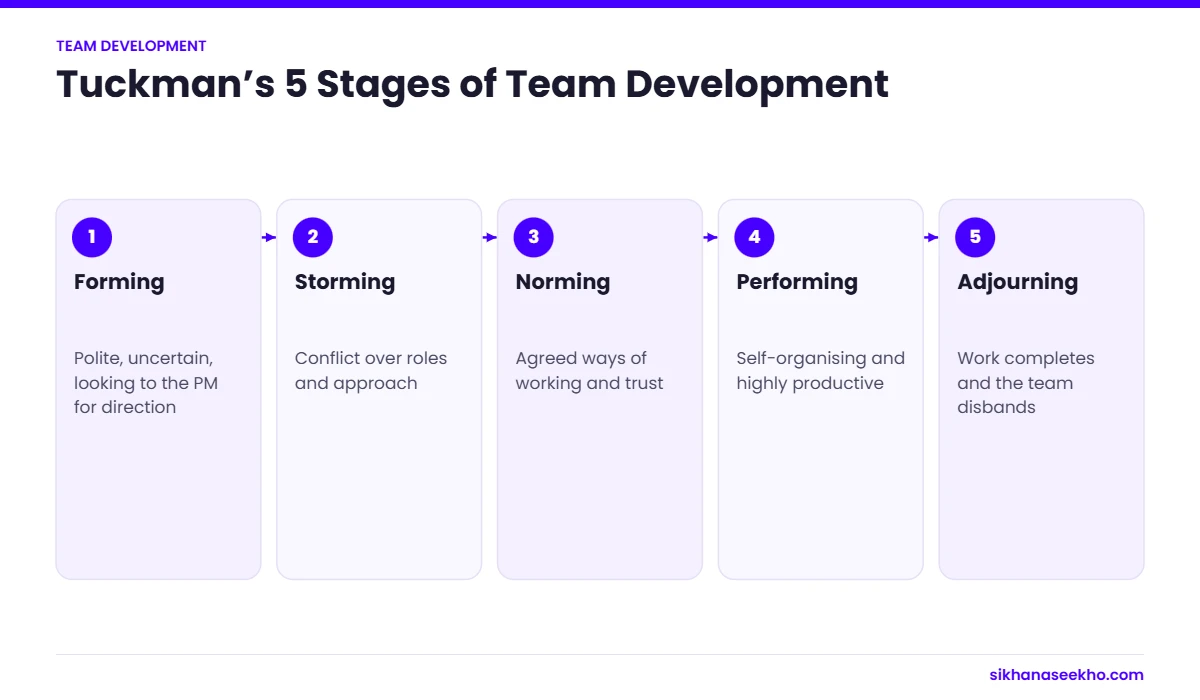
Teams move through these stages, and can slip back when members change.
Physical resources include equipment, materials, supplies, facilities and infrastructure. They are managed primarily through planning and control processes: estimating what is needed, procuring it, ensuring it arrives on schedule and is used efficiently, and managing over- or under-utilisation. Physical resource management overlaps significantly with procurement management when external suppliers provide equipment or materials.
Team resources are the human beings who perform project work: project team members, subject matter experts, contractors and stakeholders who contribute to project delivery. Team resource management is fundamentally different from physical resource management because people have goals, emotions, motivations, relationships and careers that must be understood and respected. The processes of Develop Team and Manage Team are explicitly focused on the human dimensions of project management: leadership, motivation, conflict, development and performance.
✦
The servant leadership context: The PMP exam's current ECO (Exam Content Outline) emphasises servant leadership as the preferred PM leadership model, a model where the PM's primary role is to remove obstacles, develop team capability, and create the conditions in which the team can do their best work. This contrasts with the traditional command-and-control PM model. Many PMP scenario questions have "wrong" answers that reflect directive management and "right" answers that reflect servant leadership and team empowerment.
The Six Processes
Project Resource Management: The 6 PMBOK Processes
9.1
Plan Resource Management
Planning Process Group · Defines how to estimate, acquire, manage and use physical and team resources
+
Plan Resource Management establishes the approach to resource management for the entire project. Its primary outputs are the Resource Management Plan and the Team Charter. The Resource Management Plan defines: how resources will be identified and acquired, the roles and responsibilities of all project participants, the organisational chart (showing reporting relationships), how resource needs will be estimated and planned, how team members will be trained and developed, how performance will be assessed, and how resource management processes will be controlled.
The Team Charter is a document that establishes the team's operating norms, the ground rules by which the team will work together. It covers communication expectations, decision-making processes, conflict resolution approaches, meeting norms, and accountability frameworks. A well-developed Team Charter reduces conflict and ambiguity later in the project by establishing shared expectations upfront.
Key tools in Plan Resource Management:
Expert judgement: Drawing on experience of resource requirements from similar past projects and subject matter experts in relevant technical domains.
Data representation: RACI chart: The Responsibility Assignment Matrix (RAM) maps project activities to team roles, using RACI codes (Responsible, Accountable, Consulted, Informed) to define who does what for every deliverable or activity. The RACI ensures every piece of work has exactly one person Accountable and at least one person Responsible.
Organisational theory: Understanding how different organisational structures (functional, projectised, matrix) affect resource availability, authority and team dynamics, which directly informs resource planning assumptions.
Inputs
Project Charter
Project Management Plan (Quality, Scope, Schedule Mgmt Plans)
Data representation (hierarchical charts, RACI, text-oriented)
Organisational theory
Meetings
Outputs
Resource Management Plan
Team Charter
Project Documents Updates (Assumption log)
9.2
Estimate Activity Resources
Planning Process Group · Estimates team and physical resources required for each activity
+
Estimate Activity Resources determines the type, quantity and characteristics of resources needed to perform each activity in the activity list. This process links directly to Estimate Activity Durations in Schedule Management, the duration of an activity depends on the resources assigned to it, and the resources required depend on the duration target. These two processes iterate together until consistent, feasible estimates are reached.
Resources are estimated at the activity level, not just at the project or phase level. For each activity, the PM must determine: how many person-hours of what skill level are needed, what physical resources (equipment, materials, facilities) are required and when, and what constraints apply to resource availability (shared resources, calendar constraints, geographic locations).
Bottom-up estimating is the most accurate technique here: estimating resources at the individual activity level and aggregating upward through the WBS. It requires a well-defined activity list and produces a Resource Breakdown Structure (RBS): a hierarchical list of resources organised by category and type that provides the structure for resource planning, tracking and reporting.
Inputs
Project Management Plan (Resource, Scope Management Plans)
Project Documents (Activity list & attributes, Assumption log, Risk register)
Executing Process Group · Obtains team members, facilities, equipment and other resources
+
Acquire Resources is the process of obtaining the team members, facilities, equipment, materials and other resources needed to complete project work. It runs throughout execution: resources are acquired progressively as different project phases begin, not all at once at project initiation.
Acquiring team resources presents unique challenges in most organisations because project managers typically have limited authority over resource allocation. In functional and matrix organisations, team members are assigned by their functional managers, the PM must negotiate for the right resources with the right availability. This negotiation is a core PM competency that directly affects team quality and project performance.
Pre-assignment occurs when team members are identified and committed to the project during the initiation phase, often because their specific skills are what justified the project, or because of contractual requirements. Pre-assigned resources are known before the project planning begins; their availability is typically committed but should be verified rather than assumed.
Virtual teams, team members who work in different locations, time zones, or organisations, require specific management approaches. The PM must address: communication infrastructure (collaboration tools, meeting platforms), cultural and time zone differences, trust-building without face-to-face interaction, performance visibility without physical co-location, and the risk of isolation and disengagement that remote working creates.
Inputs
Project Management Plan (Resource, Procurement, Cost Management Plans)
Executing Process Group · Improves team competencies, interaction and the overall team environment to enhance project performance
+
Develop Team is the process of improving team competencies, team member interaction, and the overall team environment. It is the most human-centred process in all of PMBOK. It focuses on building the psychological safety, cohesion, skill and motivation that enable a group of individuals to function as a high-performing team. The primary output is an assessment of Team Performance: how well the team is functioning, whether performance standards are being met, and what further development is needed.
Training and development: Identifying and addressing team members' skill gaps through formal training, coaching, mentoring and on-the-job learning. Training costs are project costs and must be planned and budgeted. Skills gaps that cannot be addressed through development within the project timeline may require resource replacement or procurement of specialist support.
Team-building activities: Structured activities designed to strengthen relationships, build trust, improve communication and develop shared norms. Effective team building is not a one-time event. It requires ongoing investment throughout the project lifecycle, particularly during and after periods of conflict or significant change.
Colocation: Placing team members in the same physical location to improve communication, collaboration and team identity. War rooms (dedicated project spaces where the whole team works together) are a colocation technique. While remote work has become standard, colocation during critical project phases can significantly accelerate team development and reduce communication friction.
Recognition and rewards: Formally acknowledging and rewarding team member contributions. Effective recognition systems must be: genuine (not formulaic), timely (close to the contribution), specific (about what was done and why it mattered), and aligned to team values. Public recognition in front of peers is typically more motivating than private financial rewards for many team members.
Inputs
Project Management Plan (Resource Management Plan)
Project Documents (Lessons learned register, Project schedule, Project team assignments, Resource calendars, Team charter)
Enterprise Environmental Factors
Organisational Process Assets
Tools & Techniques
Colocation
Virtual teams
Communication technology
Interpersonal and team skills (conflict management, influencing, motivation, negotiation, team building)
Recognition and rewards
Training
Individual and team assessments
Meetings
Outputs
Team Performance Assessments
Change Requests
Project Management Plan Updates
Project Documents Updates (Lessons learned, Project schedule, Project team assignments, Resource calendars, Team charter)
Enterprise Environmental Factors Updates
9.5
Manage Team
Executing Process Group · Tracks team member performance, provides feedback, resolves issues and manages team changes
+
Manage Team is the process of tracking team member performance, providing feedback, resolving issues, and managing team changes to optimise project performance. Where Develop Team is proactive (building capability and cohesion), Manage Team is more reactive and ongoing: addressing performance issues, resolving conflicts, navigating interpersonal dynamics and making decisions about resource changes when performance problems cannot be resolved through development alone.
Performance appraisals within projects: Formal and informal assessments of individual team member performance against agreed expectations. Project PMs often contribute to functional performance reviews of team members, even when they do not have direct line management authority. These contributions are a formal communication channel between project performance and individual career progression.
Conflict management: Conflict is inevitable in projects: resource constraints, schedule pressure, different professional perspectives and personality differences all create friction. The key insight from PMBOK is that conflict is not inherently negative: well-managed conflict can improve decision quality, surface important issues and strengthen team relationships. The PM's responsibility is to manage conflict constructively, not to eliminate it. See the full conflict resolution styles section below.
Emotional intelligence (EI): The PM's ability to recognise, understand and manage their own emotions and the emotions of others. High EI enables PMs to navigate the interpersonal complexity of team management: particularly during high-stress periods where anxiety, frustration and interpersonal tension are elevated. EI is explicitly referenced in PMBOK as a tool and technique for Manage Team.
Inputs
Project Management Plan (Resource Management Plan)
Project Documents (Issue log, Lessons learned, Project team assignments, Team charter)
Work Performance Reports
Team Performance Assessments
Enterprise Environmental Factors
Organisational Process Assets
Tools & Techniques
Interpersonal and team skills (conflict management, decision making, emotional intelligence, influencing, leadership)
Project management information system
Outputs
Change Requests
Project Management Plan Updates
Project Documents Updates (Issue log, Lessons learned, Project team assignments)
Enterprise Environmental Factors Updates
9.6
Control Resources
Monitoring & Controlling Process Group · Ensures resources are available as planned; manages variances in physical resources
+
Control Resources is the monitoring and controlling process that ensures physical and team resources are available as planned, that actual resource usage is compared to the resource management plan, and that corrective action is taken when significant variances are identified. It focuses primarily on physical resources, equipment, materials, facilities, though it also covers team resource utilisation monitoring.
Control Resources addresses situations such as: equipment arriving late or failing before work is complete, material quality not meeting specification, resource over-utilisation causing burnout, resource under-utilisation creating idle cost, and changing resource requirements as scope evolves. Each situation requires a different corrective response: from supplier escalation (for late physical resources) to schedule adjustment (for resource conflicts) to team reallocation (for utilisation imbalances).
Resource optimisation: Two techniques from Schedule Management are applied here in a resource management context. Resource levelling resolves over-allocations by adjusting activity timing: potentially extending schedule duration. Resource smoothing uses activity float to reduce demand peaks without extending the schedule. Both aim to produce a resource plan that is feasible within available capacity.
Inputs
Project Management Plan (Resource Management Plan)
Bruce Tuckman's model of team development is one of the most important frameworks in project resource management, and one of the most heavily tested topics on the PMP exam. It describes the predictable stages that teams move through as they form, establish working relationships, resolve conflict and reach high performance. Understanding these stages helps PMs apply the right leadership approach at each phase of team development.
Tuckman's 5 Stages of Team Development
1
Forming
Team members meet and begin to understand their roles, responsibilities and how the team will operate. Behaviour is typically polite and cautious: individuals are testing boundaries and forming impressions. Productivity is low because the team is still learning how to work together. People are uncertain about what is expected of them and often look to the PM for direction.
Provide clear direction, structure and expectations. Define roles and responsibilities explicitly. Build psychological safety. Facilitate introductions and relationship-building.
2
Storming
The most difficult stage: conflict emerges as team members compete for position, challenge authority, disagree about approaches, and express frustration with constraints. Power struggles, personality clashes and resistance to leadership are common. Productivity drops further. Many teams get stuck here and never reach high performance. Teams that work through storming constructively emerge stronger.
Facilitate conflict resolution without avoiding it. Coach individuals through disagreements. Reinforce the team charter and agreed norms. Use collaborative conflict resolution rather than suppression. Be patient: this stage is necessary, not a failure.
3
Norming
The team establishes working norms: shared standards for how work will be done, how decisions will be made, and how the team will operate together. Conflict decreases, cohesion increases, and the team begins to function more efficiently. Trust starts to build. Individuals begin to identify with the team as a unit rather than as separate individuals.
Reinforce positive norms and collaborative behaviours. Gradually shift from directive to facilitative leadership. Encourage team-led decision making. Celebrate early successes to build confidence and cohesion.
4
Performing
The team operates at high effectiveness: members work interdependently, leverage each other's strengths, solve problems collaboratively and produce excellent work with minimal friction. The team is self-managing in day-to-day work; the PM can focus on strategic issues, stakeholder management and removing external obstacles rather than directing the team's work.
Shift to servant leadership: remove obstacles, provide resources, protect the team from external interference. Delegate decision-making authority. Maintain morale and momentum. Focus on stakeholder management and strategic issues.
5
Adjourning
The project ends and the team disbands. This stage involves completing final deliverables, capturing lessons learned, formal closure activities, and managing the emotional dimensions of team dissolution: which can include both relief and genuine loss, particularly for high-performing teams with strong bonds. Not in Tuckman's original four-stage model; added later.
Conduct thorough lessons learned. Provide career development feedback to team members. Recognise and celebrate team achievements. Manage the emotional aspects of closure with empathy. Ensure smooth knowledge transfer.
Conflict Resolution
The 5 Conflict Resolution Methods: Ranked by Effectiveness
Conflict is a natural and often productive part of project team dynamics. PMBOK identifies five conflict resolution techniques, and the PMP exam consistently tests which technique is most appropriate in which scenario. The ranking below reflects PMBOK's preferred approach: collaborative problem-solving first, forcing last.
✦Collaborate / Problem SolveBest approach
Both parties work together to find a solution that fully satisfies all parties' interests. Requires open communication, trust and time. Produces the most durable resolution because all parties are genuinely satisfied. PMBOK's preferred technique. It builds relationships and produces lasting solutions. Also called "confronting" in some PMBOK versions.
✦Compromise / ReconcileAcceptable
Both parties give up something to reach a mutually acceptable solution. Neither party is fully satisfied but both accept the outcome as fair. A reasonable default when collaboration is not feasible due to time constraints or entrenched positions. Sometimes called a "lose-lose" outcome, both parties made concessions, though this framing is too negative for its practical value.
✦Accommodate / SmoothSituational
One party accommodates the other's position, emphasising areas of agreement and downplaying differences. Does not address the underlying issue: may allow conflict to resurface later. Sometimes appropriate as a short-term measure to preserve relationships or buy time for a more comprehensive solution. Overuse leads to unresolved underlying tensions.
✦Avoid / WithdrawShort-term only
One or both parties retreat from the conflict situation, refusing to engage. Does not resolve the conflict, the underlying issue remains. Sometimes appropriate when the timing is wrong (the conflict is premature or emotions are too high for productive resolution). Persistent avoidance of conflict is destructive to team performance and trust. Most useful as a temporary tactical measure.
✦Force / DirectLast resort
The PM or a senior party imposes a solution, typically using positional authority or power. One party wins; the other loses. Creates resentment, undermines trust, and produces only temporary resolution. Appropriate only in genuine emergencies (safety issue, immovable deadline, legal requirement) where time constraints prevent collaborative resolution. Overuse destroys team morale and psychological safety.
Motivation Theories
Motivation Theories in Project Resource Management
The PMP exam references several motivation theories in the context of Develop Team and Manage Team. Each provides a different lens through which to understand what drives team member performance and how PMs can create motivating environments.
Maslow's Hierarchy of Needs
Five needs arranged hierarchically: Physiological → Safety → Social/Belonging → Esteem → Self-Actualisation. Lower-order needs must be sufficiently met before higher-order needs motivate. In project management: a team member worried about job security (Safety) will not be motivated by project achievement recognition (Esteem). PMs must understand which level of need is currently most salient for each team member. Remote workers may have Social needs that need deliberate addressing through team-building.
Herzberg's Two-Factor Theory (Hygiene vs Motivators)
Hygiene factors (salary, working conditions, company policy, supervision): their absence causes dissatisfaction but their presence does not motivate. Motivating factors (achievement, recognition, the work itself, responsibility, growth): their presence actively motivates. Key implication: paying people fairly removes dissatisfaction but does not create motivation. To motivate, PMs must provide meaningful work, recognition, autonomy and development opportunities, not just better pay.
McGregor's Theory X and Theory Y
Theory X: Assumes people are inherently lazy, dislike work, and must be coerced, controlled and directed. Leads to micromanagement, close supervision and directive management styles. Theory Y: Assumes people are self-motivated, enjoy meaningful work, seek responsibility, and exercise self-direction when committed to objectives. Theory Y assumptions underpin servant leadership and Agile team management. The PMP exam consistently favours Theory Y approaches, autonomy, trust, meaningful work, over Theory X approaches.
McClelland's Theory of Needs (Acquired Needs)
Three acquired needs that motivate individuals differently: Achievement (nAch): driven by setting and achieving challenging goals, seeking feedback on performance; Affiliation (nAff): motivated by relationships, belonging and being liked; Power (nPow): motivated by influencing others, either for personal gain (personal power) or organisational effectiveness (institutional power). PMs must recognise which need profile dominates each team member and structure motivation accordingly. Achievement-oriented individuals need stretch targets; affiliation-oriented individuals need team belonging; power-oriented individuals need influence and leadership responsibility.
Power and Influence
Types of Power: How PMs Influence Without Authority
Project managers frequently lack formal authority over the team members they depend on: particularly in functional and matrix organisations. Understanding the different sources of power available to a PM is essential for effective team leadership and stakeholder management.
Five Power Types: From Formal to Informal
Formal / Legitimate Power
The power that comes from the PM's official position and title. Team members comply because the PM has organisational authority over project decisions.
"As project manager, I am authorising this change."
Reward Power
The ability to offer positive consequences, recognition, bonuses, promotions, career opportunities, in exchange for desired behaviour. Effective when rewards are valued and the PM controls access to them.
"Your contribution on this project will be highlighted in your performance review."
Penalty / Coercive Power
The ability to impose negative consequences: poor reviews, assignment to undesirable work, exclusion from opportunities. Produces compliance but destroys trust and motivation. PMBOK explicitly discourages overuse. Should be a last resort.
"If this is not resolved, I will need to escalate to your functional manager."
Expert Power
Influence derived from the PM's technical knowledge, skills or experience. Team members comply because they trust the PM's expertise and judgement. Highly effective and does not require formal authority. Most valued when the PM has genuine domain expertise relevant to the project.
"Based on my experience with similar migrations, the approach that minimises risk is..."
Referent Power
Influence derived from the PM's personal character, relationships and reputation: people follow them because they like, respect or admire them. The most powerful and durable form of influence. Cannot be manufactured; built through consistent integrity, empathy and genuine investment in team members' development and wellbeing.
Team members go above and beyond because they respect and trust the PM as a person.
✦
PMP exam pattern: The exam consistently favours expert power and referent power as the most effective forms of PM influence. Questions describing situations where a PM needs to influence team members without formal authority should be answered with expert or referent power approaches. Coercive/penalty power is almost never the right PMP exam answer outside of a genuine compliance or safety emergency.
Responsibility Assignment
The RACI Matrix: Defining Roles and Responsibilities
The RACI matrix (Responsibility Assignment Matrix) is the primary tool for defining and communicating who is responsible for what on a project. Every deliverable or activity in the WBS should have RACI designations for all relevant roles.
Activity / Deliverable
Project Manager
Business Analyst
Developer
Test Lead
Sponsor
Requirements document
R
A
C
C
I
Solution design
C
C
A
C
I
Build and unit test
I
C
A
C
I
System integration test
C
C
R
A
I
User acceptance test
C
R
C
A
C
Go-live approval
R
C
C
C
A
R = Responsible (does the work) · A = Accountable (owns the outcome: only one per row) · C = Consulted (provides input before completion) · I = Informed (notified after completion)
RACI rules to remember: Every activity must have exactly one Accountable: two people accountable means nobody is truly accountable. Every activity must have at least one Responsible. There can be multiple R, C and I designations per row. An activity with too many C designations becomes a bottleneck: consulting everyone delays decisions. An activity with no I designations may result in stakeholders surprised by outcomes.
Interrelation to Other Knowledge Areas
How Resource Management Connects to Every Other Knowledge Area
✦KA01: Integration Management
The Resource Management Plan is a subsidiary component of the Project Management Plan, integrated under KA01. Team changes that affect project performance must be processed through integrated change control. When a team member departs mid-project or resource availability changes significantly, a change request may be needed to update the schedule and cost baselines. The PM's leadership style directly affects team performance, which affects the project's overall performance: integration management's health is inseparable from team resource management quality.
✦KA02: Scope Management
The WBS is the foundation for activity resource estimation in KA06. Every work package must be assigned to at least one Responsible resource via the RACI matrix. Scope changes that add work packages require resource planning updates: new resources may need to be acquired, or existing resources reallocated. The RACI matrix maps scope (deliverables) to responsibility (team members), making scope and resource management fundamentally linked throughout the project lifecycle.
✦KA03: Schedule Management
Resource availability is a primary constraint on activity duration. Estimate Activity Resources (KA06) and Estimate Activity Durations (KA03) iterate together. You cannot finalise either without the other. Resource calendars (working hours, holidays, part-time allocations, shared resource availability) define when resources can work on project activities. Resource levelling to resolve over-allocations may extend the critical path. Team performance, whether the team is in forming, storming or performing, directly affects actual vs estimated activity durations.
✦KA04: Cost Management
Labour is typically the dominant project cost category: resource rates, hours and utilisation flow directly into cost estimates and the cost baseline. Crashing the schedule (adding resources to compress the critical path) is a joint cost-resource management decision. Team development activities (training, team-building, colocation) are project costs that must be budgeted. Resource over-allocation resolved through overtime adds cost. Poor team performance leading to rework adds unplanned cost that damages CPI.
✦KA05: Quality Management
Resource skill gaps directly cause quality defects. An undertrained developer introduces bugs; an inexperienced BA writes ambiguous requirements. Training (a Develop Team activity) is simultaneously a quality prevention investment. It reduces defect probability by ensuring team members have the skills to do their work correctly. Quality audits may identify process failures that trace back to team competency gaps, triggering resource development interventions through KA06.
✦KA08: Risk Management
Resource risks are among the most common project risks: key person dependency (project fails if a specific individual leaves), resource unavailability (functional managers withhold promised resources), skill gaps (team cannot perform required work), and team conflict (interpersonal dynamics impede delivery). Key person risks require specific risk responses: knowledge transfer, cross-training, succession planning. The Risk Register feeds into resource planning as a constraint: high-risk activities may require more senior or experienced resources than standard allocation would suggest.
✦KA07: Communications Management
Team development depends on effective communication infrastructure. Virtual teams require deliberate communication planning, collaboration tools, meeting cadences, async communication norms, to compensate for the absence of face-to-face interaction. The Communications Management Plan defines how team members communicate, which directly enables or impedes team development. Conflict (a Manage Team activity) often has a communication failure at its root: unclear expectations, misunderstood instructions, or information withheld between team members.
✦KA09: Procurement Management
The make-or-buy decision in Procurement Management is directly linked to resource management:the decision to buy is typically driven by a resource capability or capacity gap. Contracted resources (consultants, contractors, outsourced teams) are managed through their contracts (KA09), not through the same team development processes as internal team members. Key person clauses, substitution approval, and supplier mobilisation plans in contracts are procurement mechanisms that address resource management concerns. Contract terms must align with the project's resource management plan.
✦KA10: Stakeholder Management
Team members are stakeholders. The Stakeholder Register should include project team members, and their engagement level should be actively managed alongside external stakeholders. Functional managers who control resource allocation are critical stakeholders in a matrix organisation: their cooperation or resistance directly affects the PM's ability to acquire and retain the team. The interpersonal and leadership skills developed through resource management (emotional intelligence, conflict management, influence) are equally applicable to stakeholder management.
Agile and Hybrid Approaches
Resource Management in Agile, Waterfall and Hybrid Environments
Resource Management in Waterfall
Traditional waterfall resource management follows the full six-process PMBOK model:
Detailed resource planning upfront: all resource requirements identified from the full WBS
Formal RACI matrix covering all activities and roles
Resource calendars defining availability across the project duration
Resource levelling applied during schedule development
Formal performance appraisal contributions to functional managers
Training plans developed and executed within defined project phases
Physical resource procurement managed through formal procurement processes
PM holds formal authority over project decisions; team members report through dual lines (functional and project)
Strength: Clear roles, responsibilities and reporting lines. Challenge: Resource availability commitments made early may not hold through the project lifecycle in volatile organisations.
Resource Management in Agile
Agile resource management is structured around stable, cross-functional teams with servant leadership:
Stable team composition: Agile thrives on team stability, the same people working together across multiple sprints rapidly progress through Tuckman's stages to performing
Cross-functional teams: All skills needed to deliver a sprint are within the team: no waiting for external specialists or handoffs
Self-organising teams: Teams decide how to do the work within the sprint; the Scrum Master removes obstacles rather than directing activities
Servant leadership: The Scrum Master (equivalent to PM) prioritises team empowerment, coaching and obstacle removal over directive management
Sustainable pace: Agile explicitly protects teams from overcommitment: velocity-based sprint planning prevents the over-allocation that causes burnout
Retrospectives provide continuous team development through structured reflection
T-shaped skills (broad knowledge + deep expertise) are valued for cross-functional flexibility
Strength: High-performing self-organising teams. Challenge: Stable team composition conflicts with the functional manager's need to allocate specialists across multiple projects.
Exam Tips
Resource Management: 7 Exam Tips for PMP and APM PMQ
1
Collaborate/Problem Solve is almost always the preferred conflict resolution approach. The PMP exam strongly favours collaborative conflict resolution that addresses the root cause and satisfies all parties. Forcing (directive authority) is almost never the right answer. Avoidance is occasionally acceptable as a short-term measure. When in doubt, choose the option that involves the conflicting parties working through the issue together.
2
Know Tuckman's stages and the PM's appropriate response at each. Forming requires direction and clarity. Storming requires conflict facilitation, not suppression. Norming requires coaching and gradual delegation. Performing requires servant leadership and obstacle removal. Adjourning requires closure management. Exam scenarios describe a team situation and ask what the PM should do: match the behaviour to the stage.
3
Theory Y and servant leadership are the exam's preferred management orientation. The PMP exam consistently rewards answers that trust the team, delegate authority, empower self-organisation, and support development. Theory X approaches (close supervision, directive control, coercive authority) are almost always wrong answers. When two options look similar, choose the one that gives the team more autonomy and the PM more of a facilitating role.
4
Herzberg: hygiene factors prevent dissatisfaction; motivators create motivation. A question asking what motivates a team member should be answered with factors from the motivating factors category (achievement, recognition, growth, the work itself), not hygiene factors like pay or working conditions. Removing a hygiene factor causes dissatisfaction; improving it does not create motivation.
5
Expert and referent power are the most effective for PMs without formal authority. In matrix organisations where PMs do not have line authority over team members, expert power (knowledge and competence) and referent power (personal relationships and respect) are the most effective influence mechanisms. Coercive/penalty power creates compliance but destroys trust. Formal/legitimate power is only available to PMs with explicit authority.
6
One and only one Accountable per RACI row. A key RACI rule tested on both PMP and APM PMQ: each activity must have exactly one person Accountable, the person who owns the outcome and is ultimately responsible to the organisation. Two Accountable parties means neither is truly accountable. Multiple Responsible parties are acceptable (the work can be shared); multiple Accountable parties create confusion and diluted ownership.
7
Resource Management Plan includes both physical and team resources. Exam questions sometimes focus only on people, but PMBOK Resource Management explicitly covers physical resources (equipment, materials, facilities) as well. The Control Resources process (9.6) is primarily about physical resources: ensuring equipment arrives on schedule, managing material utilisation, and correcting resource variances. Do not confuse it with Manage Team (9.5), which focuses on people performance.
Apply This Knowledge Area in Your PMP or APM PMQ Exam
Resource management, particularly Tuckman's model, conflict resolution, motivation theories and power types, is among the most heavily examined areas of the PMP exam. The APM PMQ tests resource and team management across its leadership and people management learning outcomes.
The six PMBOK processes in Project Resource Management (Knowledge Area 9) are: (1) Plan Resource Management: defining the approach to estimating, acquiring, managing and developing resources, producing the Resource Management Plan and Team Charter; (2) Estimate Activity Resources: determining the type, quantity and characteristics of resources needed for each activity, producing Resource Requirements and the Resource Breakdown Structure (RBS); (3) Acquire Resources: obtaining team members and physical resources, producing Project Team Assignments and Resource Calendars; (4) Develop Team: improving team competencies, interaction and environment to enhance performance, producing Team Performance Assessments; (5) Manage Team: tracking performance, providing feedback, resolving conflict and managing team changes, producing Change Requests and project document updates; (6) Control Resources: ensuring resources are available as planned, managing physical resource variances and correcting deviations, producing Work Performance Information and Change Requests.
Tuckman's model describes five stages that teams progress through: Forming: team members meet, roles are unclear, behaviour is cautious, productivity is low, and team members look to the PM for direction; Storming: conflict emerges as members compete for position and express frustration, productivity drops further, and many teams get stuck here; Norming, the team establishes working norms, conflict decreases, cohesion builds, and productivity begins to rise; Performing, the team operates at high effectiveness, is largely self-managing, and the PM can focus on stakeholder management and strategic issues rather than directing daily work; and Adjourning, the project ends, the team disbands, and the PM manages the closure activities and emotional dimensions of team dissolution. The PM's appropriate leadership approach changes at each stage: directive at Forming, facilitative at Storming, coaching at Norming, and servant leadership at Performing.
The best conflict resolution method, according to PMBOK, is Collaborate/Problem Solve, also called "confronting", where all parties work together to find a solution that genuinely satisfies everyone's interests. It requires time, trust and open communication, but produces the most durable resolution because the underlying issue is addressed rather than suppressed or deferred. The five methods ranked from most to least preferred are: Collaborate/Problem Solve (best, addresses root cause, satisfies all parties), Compromise/Reconcile (acceptable, both parties give something up, acceptable outcome), Accommodate/Smooth (situational, one party yields, temporary measure only), Avoid/Withdraw (short-term only, issue remains unresolved, appropriate only when timing is wrong), Force/Direct (last resort: imposes a solution using authority, creates resentment and destroys trust). The PMP exam consistently rewards collaborative approaches and penalises forcing except in genuine emergencies.
The RACI matrix (Responsibility Assignment Matrix) is a grid that maps project activities or deliverables (rows) against project roles (columns), with each cell containing one of four codes: Responsible (R), the role that does the actual work to complete the activity; Accountable (A), the role that owns the outcome and is answerable for it (only one per row, if two people are accountable, neither is truly accountable); Consulted (C): roles that provide input and expertise before the activity is completed (two-way communication); Informed (I): roles that are notified after the activity is completed (one-way communication). The RACI ensures every activity has an owner, prevents duplication and gaps in responsibility, and clarifies the difference between doing work (Responsible), owning outcomes (Accountable), providing expertise (Consulted) and staying aware (Informed).
Develop Team (9.4) and Manage Team (9.5) are both executing processes but with different orientations. Develop Team is proactive and developmental. It focuses on improving team competencies, building team cohesion, creating an environment of psychological safety, and investing in the team's long-term capability and performance. Activities include training, team-building, recognition and colocation. Its output is Team Performance Assessments: how well is the team developing? Manage Team is more reactive and performance-focused. It tracks individual and team performance, provides feedback, resolves conflicts, addresses performance problems, and manages changes to the team composition when performance issues cannot be resolved through development. Its primary tools are emotional intelligence, interpersonal skills and conflict management. Develop Team asks "how do we build the best possible team?"; Manage Team asks "how do we address issues and maintain performance right now?"
Agile resource management differs fundamentally from the traditional six-process PMBOK model in several important ways. Agile teams are stable and cross-functional, the same team members work together across multiple sprints, rapidly progressing through Tuckman's stages to high performance. This stability is a deliberate design choice: high-performing Agile teams are significantly more productive than newly-formed ones, and constant team rotation prevents the deep norming and performing stages from being reached. Teams are self-organising within the sprint: members decide how to accomplish the work rather than being directed by the PM. The Scrum Master (equivalent to the PM) practices servant leadership: removing obstacles, facilitating the team process, coaching individuals, and protecting the team from external interference rather than directing tasks. Sprint planning uses team velocity to prevent over-allocation (a common cause of burnout in traditional projects). Retrospectives provide continuous structured team development built into every sprint cycle.

Pingback: CAPM Certification: An Entry-Level Project Management Credential
Pingback: Pass the Google PM Certificate in 3 Months