Free WBS Template: Work Breakdown Structure Word Download
You cannot schedule, budget or assign work until you know what the work is. A WBS breaks the project into every piece of work, in levels, with a WBS code for each item. Go down until each work package can be given to one owner, estimated and tracked. This Word template gives you the structure. Your scope fills it in.
No email required. Instant Word download.
Quick answer
A work breakdown structure (WBS) is a hierarchical breakdown of all the work needed to deliver a project, with each item given a WBS code. This free Word template uses a four-level hierarchy and includes a WBS dictionary, aligned with PMBOK.
If you want to learn how to build a WBS from scratch, with the theory and PMP exam angle, read my work breakdown structure guide. This page is for doing it: download the template, see a filled-in example and avoid the mistakes I see most.
What's in the WBS template?
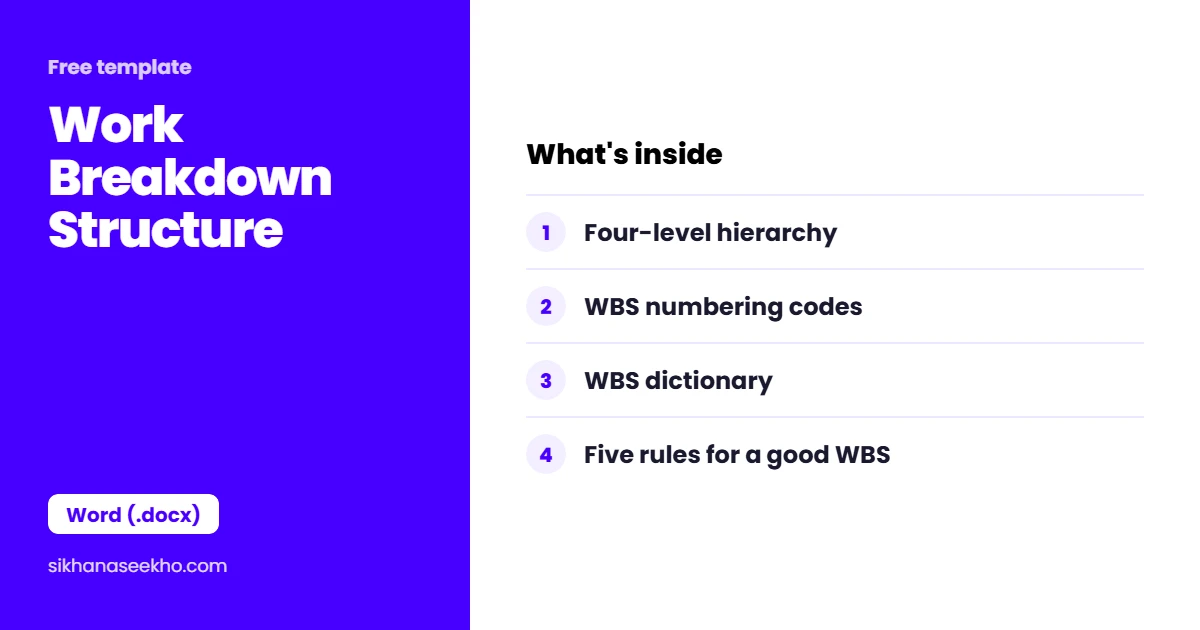
The template is a four-level outline with WBS codes already formatted. Level 1 is the whole project. Levels 2 to 4 break the scope down step by step until each item is a work package: something you can assign, estimate and track.
| Level | Name | Content | Example |
|---|---|---|---|
| 1 | Project | The entire project: all scope in one node. WBS code: 0 | "CRM Implementation Project" |
| 2 | Phase / Major Deliverable | Major phases or deliverable groups. WBS codes: 1.0, 2.0, 3.0… | "1.0 Initiation", "2.0 Planning", "3.0 Development" |
| 3 | Deliverable | Specific deliverables within each phase. WBS codes: 1.1, 1.2, 2.1… | "2.1 Project Charter", "3.1 Database Design" |
| 4 | Work Package | The lowest level: assignable, estimable, trackable. WBS codes: 1.1.1, 1.1.2… | "1.1.1 Draft charter", "1.1.2 Stakeholder review" |
What makes a good WBS?
A WBS that breaks these rules causes problems later in the schedule, the estimates and scope control. Use these five rules as a check before you baseline it.
Example: filling in the WBS for an office fit-out
The sample in the template uses generic project phases. Here is how one branch looks on a real kind of job, an office fit-out in the UAE. This is an example only. Notice that every line is a deliverable (a noun), and the work packages have one owner each.
| WBS code | Element | Level | Owner and notes |
|---|---|---|---|
| 3.0 | MEP Works | 2: Phase / group | MEP manager |
| 3.2 | Fire Alarm System | 3: Deliverable | MEP coordinator |
| 3.2.1 | Fire alarm devices and cabling, Level 3 | 4: Work package | Fire alarm subcontractor. Includes supply, install and testing. Excludes ceiling access panels (sits in 4.1). |
| 3.2.2 | Civil Defence approval certificate | 4: Work package | MEP coordinator. Done when the approval is received, not when the inspection is booked. |
Mistakes I see when people fill this in
- Verbs instead of deliverables. "Install fire alarm" is an activity for the schedule. "Fire alarm system" belongs in the WBS.
- Authority approvals left out. Permits and inspections take real time and effort. If they are not in the WBS, they will not be in the schedule either.
- Work in two places. Ceiling access panels in both the MEP and the ceiling packages means you pay or plan for them twice.
- Codes changed halfway. Renumbering after the baseline breaks the link to your schedule and cost reports.
What is a WBS dictionary?
The WBS outline tells you what the work packages are. The WBS dictionary tells you what each one means, clearly enough that two people reading it would do the same work. The template has a dictionary table for the first 10 work packages. Add rows as you need them.
| WBS Code | Work Package Name | Includes | Excludes | Acceptance Criteria | Owner |
|---|---|---|---|---|---|
| 1.1.1 | Draft Charter | First draft of project charter incorporating scope, objectives, PM authority and initial stakeholder list | Stakeholder sign-off (1.1.3), budget approval | Draft reviewed by sponsor and two business owners before advancing | PM |
| 1.1.2 | Stakeholder Review | Circulation of draft charter to all Level 2 stakeholders, collation of feedback, incorporation of changes | Final sign-off: that is 1.1.3 | Feedback received from all named reviewers; all material comments resolved or deferred with documented rationale | PM |
| 1.1.3 | Sponsor Sign-Off | Formal signature of final project charter by project sponsor | Distribution to full stakeholder list (separate comms activity) | Signed charter on file; version 1.0 baselined in document management system | Sponsor |
The Includes and Excludes columns matter most. They stop the classic argument: "I thought that was part of package X." Writing what is excluded is as important as writing what is included. Exclusions are what make your scope boundary hold up when someone pushes.
WBS: 4 Common Questions
Keep learning
- Free Gantt Chart Template: Excel Download
- Free Project Budget Template: Excel Download
- Free Communication Plan Template: Excel Download
- Free Change Management Plan Template: Word Download
- Free Procurement Plan Template: Word Download
- Free Quality Management Plan Template: Word Download