Certifications PMP CertificationWorld’s top PM cert CSM: Certified ScrumMasterTop agile cert CAPMEntry-level PM cert PRINCE2UK & Europe standard View All Certifications ?
PM Guides Agile GuideComplete breakdown Scrum GuideRoles, ceremonies, artifacts EVM GuideAll formulas explained View All Guides ?
Career & Salary PM Salary 2026By country & level How to Become a PMStep-by-step roadmap 50 Interview QuestionsWith strong answers
PM Software Monday.com ReviewTop pick 2026 ClickUp ReviewBest value Best Free PM ToolsNo trials, truly free View All Software ?
Free Tools & Templates EVM CalculatorFree, no signup Gantt Chart MakerBuild & export free PMP Eligibility Checker30-second result Free PM Templates30 templates in Excel, Word and PDF
Get the Free PMP Guide ?
Free Template · Updated March 2026

Free RACI Matrix Template
Excel & Google Sheets

A ready-made RACI matrix with 30 pre-filled tasks across 5 project phases, 18 team roles, R/A/C/I cells that colour themselves, a responsibility summary sheet and a blank sheet you can fill from scratch. Download it in Excel and open it in Google Sheets.

✓By Syed Mujeeb Ur Rehman, PMP
✓Updated March 2026
✓4 sheets · 30 tasks · 18 roles
✓Free: no signup
What's Inside

Four sheets: RACI Matrix (30 pre-filled tasks, auto-colour, dropdowns), Responsibility Summary (plain-English summary per role), Blank Template (10 custom team members, 25 blank rows) and Instructions (11-step guide with common mistakes).

RResponsible
AAccountable
CConsulted
IInformed

Role codes auto-colour when typed: no manual formatting needed

Download Free Template

Excel (.xlsx) · Works in Google Sheets too

RACI MATRIX PREVIEW
Task / Activity PM BA Dev Spon
Approve business case
R
A
Requirements gathering
I
R
C
I
Solution design
I
C
R
I
Status reporting
R
C
I
I
Project sign-off
R
I
I
A
.XLSX Google Sheets FREE
  • 30 tasks across 5 project phases
  • 18 pre-labelled team role columns
  • Auto-colour on R, A, C, I entry
  • Dropdown validation on all cells
  • Responsibility Summary sheet
  • Blank Template with 10 custom roles
  • 11-step instructions + common mistakes
  • Print-ready landscape format
↓ Download Free (.xlsx) Open in Google Sheets →
30
Pre-filled tasks across 5 phases
18
Team roles pre-labelled
4
Sheets: Matrix, Summary, Blank, Guide
Free
No account or payment required

Quick answer

A RACI matrix is a chart that shows who is Responsible, Accountable, Consulted and Informed for each project task. This free Excel template has 30 pre-filled tasks across 5 phases, 18 team roles, colour-coded R, A, C and I cells, a summary sheet and a blank sheet.

This page gives you the RACI file and shows you how to fill it in. If you want the bigger picture of planning people, equipment and materials across a project, read my guide to project resource management.
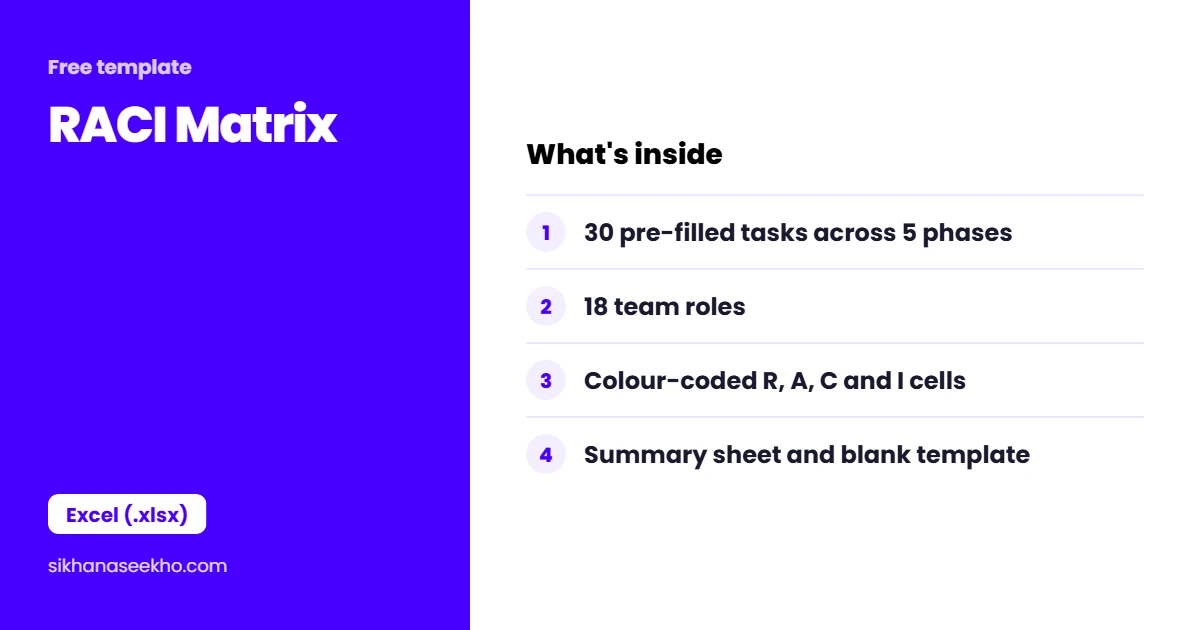
RACI Matrix template preview: 30 pre-filled tasks across 5 phases, 18 team roles, Colour-coded R, A, C and I cells, Summary sheet and blank template
What is inside the free raci matrix template.
01 · The Four Roles

What do R, A, C and I mean?

A RACI only works if each letter means exactly what it should. Most confusion comes from mixing up R and A, or C and I. Get those right and the chart becomes useful.

✦
From my experience: On my UAE construction projects, most of the arguments I had to settle came down to one question: who actually decides? The consultant, the client representative or me? A RACI with exactly one Accountable person per activity answered that before it became a dispute. I teach my PMP students the same rule.
R
Responsible: Does the work
The person or people who actually perform the task or produce the deliverable. Multiple people can share Responsibility for one task. Without at least one R, nobody knows who is supposed to do the work.
At least one R required per task
A
Accountable: Owns the outcome
The single person who is answerable for the task being completed correctly. They approve the work before it is signed off. If it goes wrong, they answer for it. Cannot be shared: two A's means no A.
Exactly ONE A per task: never more
C
Consulted: Provides input
People whose expertise or approval is needed before the work is completed. Two-way communication. They give input, the team acts on it. Be selective: only mark C if their input genuinely shapes the output.
Input sought before work is done
I
Informed: Kept in the loop
People who need to know the outcome or progress but whose input is not required. One-way communication. Mark I only for people who need the information to do their own job, not as a blanket "keep everyone happy" assignment.
Updated after decisions are made
02 · Template Contents

Which tasks are pre-filled in the RACI template?

The RACI Matrix sheet comes with 30 realistic tasks in 5 phases, each already assigned across 18 common roles. Edit, delete or rename any task to fit your project.

#Task / ActivityPhase
Initiation: 5 Tasks
1Approve project business caseInitiation
2Develop and sign project charterInitiation
3Identify and map stakeholdersInitiation
4Appoint project teamInitiation
5Conduct project kick-off workshopInitiation
Planning: 9 Tasks
6–9PM plan, scope/WBS, schedule, budgetPlanning
10–14Risk register, communications, procurement, resources, baseline sign-offPlanning
Execution: 7 Tasks
15–21Team management, stakeholder engagement, requirements, design, build, testing, trainingExecution
Monitoring & Control: 5 Tasks
22–26Status reporting, risks/issues, change control, budget tracking, quality assuranceMonitoring
Closure: 4 Tasks
27–30UAT sign-off, lessons learned, closure report, benefits handoverClosure
✦
The Blank Template sheet (Sheet 3) has 10 unlabelled team member columns and 25 blank rows: perfect for building your own RACI from scratch using your actual team names and tasks. The auto-colour formatting works there too.
03 · The Rules

How do you make a RACI matrix that works?

A RACI that breaks these rules causes more confusion than it fixes. Before you share yours, check every row against each rule.

1
Every task must have exactly one A No A means nobody owns the outcome. Two A's means neither person truly owns it. If there's disagreement, the sponsor decides. This is the non-negotiable rule of the RACI model.
2
Every task must have at least one R If nobody is Responsible for doing the work, the task will not get done. On tasks where multiple people share R, make sure each person knows which specific part they own.
3
A and R can be the same person For smaller tasks or senior individual contributors, one person may be both Responsible (doing the work) and Accountable (owning the outcome). This is valid, just ensure it's intentional, not lazy assignment.
4
Avoid marking C and I for everyone A RACI where everyone is Consulted on everything creates bottlenecks and consultation fatigue. Be selective: mark C only when that person's input genuinely changes the output. Mark I only when they need the information to do their own work.
5
Don't make the PM Responsible for everything The PM coordinates and is accountable for delivery, but the team does the work. If the PM is R on 90% of tasks, the RACI is telling you that the team doesn't have clear ownership. Fix the accountability, not just the spreadsheet.
6
Review the RACI at kick-off: don't just send it Walk through the matrix with the whole team at the kick-off workshop. People who have discussed and agreed their assignments are more likely to own them than those who received a spreadsheet by email.
7
Update the RACI when the project changes If scope changes, team members change or new workstreams are added, update the RACI. An outdated RACI is worse than no RACI. It gives the team false clarity about who is responsible for what.

How to fill it in: a construction example

This is an example only, for four tasks on a typical building project in the UAE. Read each row and check: one A, at least one R, and C used only where input really changes the result.

TaskPMSite EngineerMEP SubcontractorConsultantClient Rep
Prepare and submit MEP shop drawingsACRI-
Book the authority inspectionARCII
Approve finishes samplesCI-RA
Close the snag list before handoverARRCI

Mistakes I see when people fill in a RACI

  • Two A's on one row, usually the PM and the client representative. Agree who decides before work starts.
  • Putting a whole department in a column. Use a role or a named person.
  • Marking C for everyone. Every C is someone you must wait for, so approvals slow down.
  • Building the RACI alone and emailing it. Walk through it with the team and the subcontractors.
  • Not updating it when a subcontractor or key person changes.
04 · FAQ

RACI Matrix: 5 Common Questions

A RACI matrix is a chart that lists project tasks against people and gives each person one of four roles: Responsible (does the work), Accountable (owns the result), Consulted (gives input before the work is done) or Informed (kept updated). It is the simplest way to stop the "I thought you were doing that" problem on projects with many teams.
RACI stands for Responsible (the person who does the work), Accountable (the person who owns the outcome, only one per task), Consulted (people whose input is sought before work is completed, two-way communication) and Informed (people kept updated on progress and decisions: one-way communication). Some organisations extend it to RASCI (adding Supportive) or CAIRO (adding Out of the loop).
Responsible means the person or people who do the task. Several people can be Responsible. Accountable means the one person who owns the result and answers for it. There is only ever one A per task. Example: the MEP subcontractor is Responsible for preparing shop drawings, and the PM is Accountable for getting them submitted on time and complete.
Exactly one. If two people are Accountable, each assumes the other one owns it, and nobody acts when things go wrong. If there is a disagreement about who should be Accountable, the sponsor or steering committee decides before work starts. Two A's is not a compromise. It is an argument you have postponed.
Use a RACI at the start of any project with several departments, outside contractors or unclear handovers. Fill it in during planning and walk through it at the kick-off meeting. Update it when scope, people or major tasks change. See our stakeholder management guide for how the RACI fits into wider stakeholder engagement.