
The agile principles are 12 short statements in the Manifesto for Agile Software Development (2001). They tell you how an agile team should think: deliver small pieces often, talk to the customer, accept change, keep the team motivated and keep improving. Scrum, Kanban and XP are all built on them.
This page explains the 12 agile principles one by one, each with a real example. If you want the bigger picture of agile, its frameworks and how it is tested on the PMP exam, read my agile guide. This page is for understanding the principles themselves.
What is agile?
Agile is a way of running a project in small steps. You build a bit, show it to the customer, learn and adjust. You do not try to fix every detail on day one. The Agile Manifesto gives four values and twelve principles that explain this way of working. On this page I take the twelve principles one by one, in plain words, with a real example for each.
Where did agile come from?
Through the 1990s, many software teams were tired of long plans that broke as soon as the customer saw the product. Lighter methods such as Scrum and XP appeared. In 2001, 17 practitioners met and wrote the Agile Manifesto to capture what these methods had in common. Since then agile has spread well beyond software.
Why is agile important in project management?
Agile matters because most projects face change. Customers learn what they want only when they see something real. If you deliver in small pieces, you get feedback early, you waste less work, and problems show up while they are still cheap to fix. It also keeps the team and the stakeholders talking every week, not only at the start and the end.
II. Agile Principles
A. The 12 Agile Principles
Here are the 12 principles as a short list. Below the list, I explain each one in plain words with an example.
- Customer satisfaction through early and continuous delivery of valuable software.
- Welcome changing requirements, even in late development.
- Deliver working software frequently, with a preference for shorter timescales.
- Business people and developers must work together daily throughout the project.
- Build projects around motivated individuals, give them the environment and support they need, and trust them to do the job.
- A face-to-face conversation is the most efficient and effective method of conveying information to and within a development team.
- Working software is the primary measure of progress.
- Agile processes promote sustainable development. The sponsors, developers, and users should be able to maintain a constant pace indefinitely.
- Continuous attention to technical excellence and good design enhances agility.
- Simplicity, the art of maximizing the work not done: is essential.
- The best architectures, requirements, and designs emerge from self-organizing teams.
- The team regularly reflects on how to become more effective, then tunes and adjusts its behavior accordingly.
B. Explanation of each principle
- Customer satisfaction through early and continuous delivery of valuable software: Give the customer something useful early, then keep adding to it. Example: a team building a booking app releases simple booking first, then adds payments and reminders in later releases. The customer starts getting value in weeks, not after a year.
- Welcome changing requirements, even in late development: Change is normal, so plan for it instead of fighting it. Example: halfway through, a retailer asks for a click-and-collect option because a competitor launched one. An agile team adds it to the backlog and the product owner ranks it. No long change board needed.
- Deliver working software frequently, with a preference for the shorter timescale: Short cycles mean fast feedback and less risk. Example: a team works in two-week sprints and shows a working increment at every sprint review. If something is wrong, they lose two weeks at most, not six months.
- Business people and developers must work together daily throughout the project: The people who know the business and the people who build must talk often. Example: the product owner sits with the team, answers questions the same day and clears up a confusing rule before the developers build the wrong thing.
- Build projects around motivated individuals, giving them the environment and support they need and trusting them to get the job done: Hire good people, remove blockers and stop micromanaging. Example: instead of assigning every task, the manager lets the team pick their own work and spends their time getting them access to test servers and the right tools.
- The most efficient and effective method of conveying information to and within a development team is the face-to-face conversation: Talking clears things up faster than long email chains. Example: a ten-minute call with the designer settles a question that would take two days of emails. For remote teams, a video call is the closest thing.
- Working software is the primary measure of progress: Progress is what works, not how many documents you produced or what percentage a task “feels” complete. Example: a team reports “the login and search features are done and tested” rather than “we are 70% complete”.
- Agile processes promote sustainable development. The sponsors, developers, and users should be able to maintain a constant pace indefinitely: No heroics every week. Example: a team that worked late nights for three sprints sees more bugs and sick days. They cut their sprint commitment to a pace they can keep, and quality goes back up.
- Continuous attention to technical excellence and good design enhances agility: Clean work is easier to change later. Example: the team writes automated tests and tidies messy code every sprint. When the customer asks for a change, they can make it quickly without breaking other features.
- Simplicity, the art of maximizing the amount of work not done: is essential: Do not build what nobody needs. Example: the stakeholder list had 40 report types. The team asked users which ones they actually open and built the five that matter first. The rest were never requested again.
- The best architectures, requirements, and designs emerge from self-organizing teams: The people doing the work usually find the best solution. Example: rather than a manager deciding the technical approach, the developers discuss options together and choose one they can all support and maintain.
- The team regularly reflects on how to become more effective, then tunes and adjusts its behavior accordingly: Stop, look back, improve. Example: in a retrospective the team notices that unclear acceptance criteria cause rework. They agree to review criteria with the product owner before each sprint starts, and check next time if it helped.
- If the customer asks for a change, the agile answer is usually “add it to the backlog and let the product owner prioritise it”, not “reject it” or “raise a formal change request”.
- If the team is working overtime every sprint, think sustainable pace: reduce the commitment, do not push harder.
- If the question asks how to show progress, pick working product shown at a review over a status report or percent complete.
Exam tip: how the principles appear in PMP questions
About 60% of the PMP exam is agile or hybrid, and you will rarely be asked to recite a principle. Instead you get a situation. When I teach this to my PMP students, I give them three quick checks:
The mistake I see most is students choosing the “control” answer from their predictive habits. Ask yourself which option best matches the principle in the situation.
Agile methods at a glance
| Method | Core idea | Key practices | Best for |
|---|---|---|---|
| Scrum | Short fixed-length sprints | Sprint planning, daily scrum, review, retrospective | Product teams with changing requirements |
| Kanban | Visualise and limit work in progress | Kanban board, WIP limits, flow metrics | Continuous work such as support or operations |
| Lean | Remove waste and deliver value fast | Value stream mapping, continuous improvement | Process improvement across the organisation |
| XP (Extreme Programming) | Engineering quality | Pair programming, test-driven development, continuous integration | Software teams |
| SAFe | Agile at scale | Planning intervals, agile release trains | Large organisations with many teams |
Sources: Agile Manifesto (2001), Scrum Guide (2020).
III. Agile Methodologies
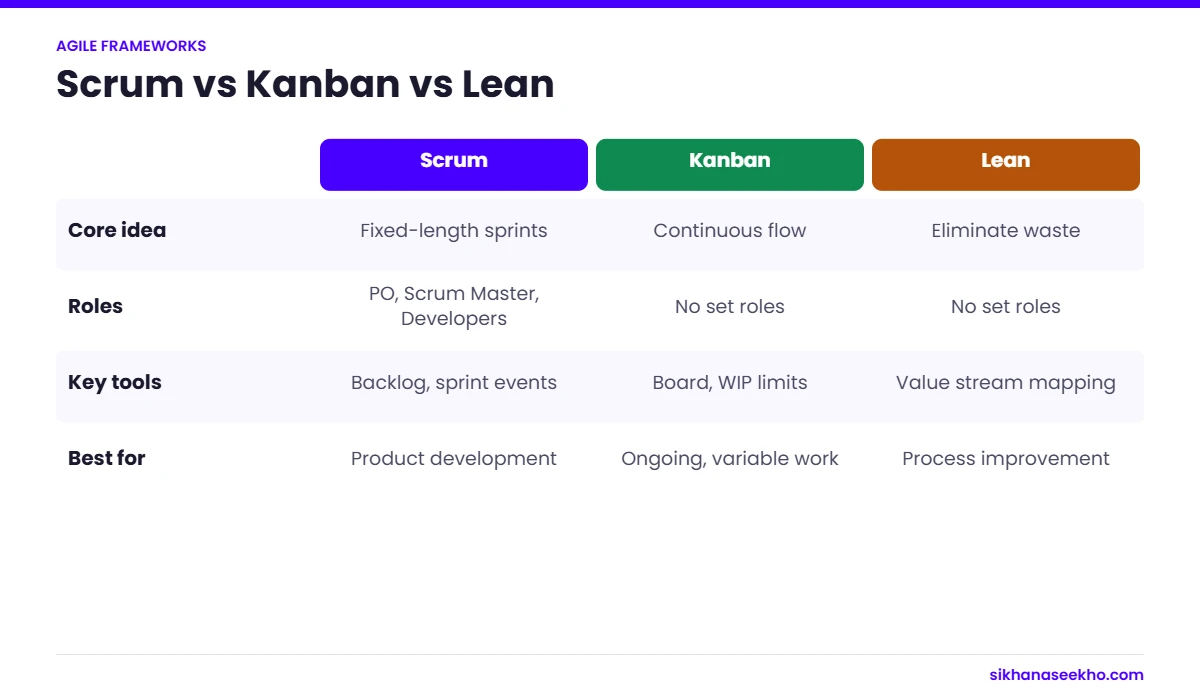
An agile method is a practical way of putting the values and principles to work. Each one gives you roles, meetings or tools. Below is a short overview of the most common ones: Scrum, Kanban and Lean.
A. Overview of Agile Methodologies
They all share the same pattern: work in small steps, get feedback often and improve as you go. They differ in how they organise the work. Scrum uses fixed sprints, Kanban uses continuous flow, and Lean focuses on removing waste.
B. Scrum
Scrum is the most used agile framework. It is built on three pillars: transparency, inspection and adaptation. Work is done in short sprints of one month or less, and the team inspects the product and its way of working at the end of every sprint.
1. Scrum Roles
The 2020 Scrum Guide defines three accountabilities: the Product Owner, the Scrum Master and the Developers.
The Product Owner decides what gets built and in what order. They own the product backlog and keep it ranked by value, so the team always works on the most useful items first.
The Scrum Master helps the team use Scrum well. They coach, run or facilitate the events when needed, and remove blockers the team cannot remove on its own. They serve the team. They are not its boss.
The Developers are the people who build the product. The team is self-managing and cross-functional, which means it has all the skills it needs and decides itself how to do the work.
2. Scrum Events
Scrum has a small set of events that give the team a regular rhythm:
- Sprint Planning: at the beginning of each sprint, the team plans the work they will complete.
- Daily Scrum: a short meeting to review progress, identify obstacles or impediments, and plan the day’s work.
- Sprint Review: at the end of each sprint, the team demonstrates the work they have completed and solicits stakeholder feedback.
- Sprint Retrospective: a meeting held at the end of each sprint to review the team’s processes and identify opportunities for improvement.
3. Scrum Artifacts
Scrum has three artifacts that keep the work visible:
- Product Backlog: a prioritized list of work that needs to be done to deliver the product.
- Sprint Backlog: a list of work the team will complete during the current sprint.
- Increment: the sum of all the completed product backlog items at the end of a sprint.
C. Kanban
Kanban grew out of the Toyota Production System, where cards signalled when more parts were needed. Knowledge workers adopted it to make their work visible and keep it flowing.
- Kanban Principles The Kanban methodology is based on the following principles:
i. Visualise the work: Put all work on a board with columns such as “To Do”, “In Progress” and “Done”. You cannot manage what you cannot see.
ii. Limit work in progress (WIP): Set a maximum number of items per column. Fewer items started means more items finished.
iii. Manage flow: Watch where work gets stuck and fix the bottleneck, so items move smoothly from start to finish.
iv. Make process policies explicit: Write down the rules, such as what “done” means for each column, so everyone works the same way.
v. Implement feedback loops: Hold short, regular reviews to check the flow and agree on small improvements.
- Kanban Board: a board with one column per stage of your process. Each piece of work is a card that moves left to right as it progresses.
The board shows the whole team, in one look, what is waiting, what is in progress and what is finished.
- Workflow Management: the focus is on smooth flow, not on fixed time boxes.
In practice you track how long items take, spot the column where cards pile up, and fix that step first. Small, steady fixes beat big redesigns.
D. Lean
- Lean Principles
Lean comes from the Toyota Production System. Its core idea is simple: give the customer what they value and cut everything else. The five Lean principles are:
i. Value: Define value from the customer’s point of view.
ii. Value Stream: Map every step from request to delivery and spot the steps that add no value.
iii. Flow: Make the remaining steps run without waiting or hand-off delays.
iv. Pull: Produce only what is needed, when it is needed.
v. Continuous Improvement: Keep looking for waste and removing it.
2. Value Stream Mapping
Value stream mapping is a picture of how work flows from request to delivery. You draw every step with the people from each area involved, then mark where work waits.
For each step you note the working time and the waiting time. In most maps the waiting time is far bigger than the working time. That gap is where you start improving.
3. Continuous Improvement
Continuous improvement (kaizen) means small improvements, all the time. Many teams use the Plan, Do, Check, Act cycle.
Plan: pick a problem and a target. Do: try a change on a small scale. Check: look at the result. Act: keep the change if it worked, or try something else.
The aim is a habit, not a one-off project. Everyone on the team should feel free to point out waste.
IV. Agile Frameworks
A. Overview of Agile Frameworks: A framework gives you a ready structure of roles, events and practices. Some are for a single team, such as Scrum. Others help many teams work together, such as SAFe and Disciplined Agile.
B. Agile Manifesto: The Agile Manifesto was written in 2001 by 17 software practitioners. It has four values:
- Individuals and interactions over processes and tools
- Working software over comprehensive documentation
- Customer collaboration over contract negotiation
- Responding to change over following a plan
The manifesto says that while there is value in the items on the right, agile teams value the items on the left more. It does not say “no documents” or “no plans”.
C. Scaled Agile Framework (SAFe): SAFe is a framework for using agile across many teams in a large organisation. It adds roles, events and planning to keep teams aligned and handle dependencies between them.
- Overview of SAFe: Teams are grouped into Agile Release Trains that plan together in regular Planning Interval (PI) planning events, so they work towards the same goals.
- SAFe Framework: SAFe comes in configurations of different sizes: Essential, Large Solution, Portfolio and Full. An organisation picks the one that fits its size.
D. Disciplined Agile (DA): Disciplined Agile, now owned by PMI, is a toolkit rather than one fixed method. It helps teams choose their way of working based on their own situation.
- Overview of DA: DA mixes practices from Scrum, Kanban, Lean and other sources and gives you options at each decision point.
- DA Framework: DA offers several life cycles, such as agile, lean, continuous delivery and exploratory, and its main idea is “choose your way of working” instead of following one method blindly.
Agile principles: common questions
How many agile principles are there?
There are 12 principles, supported by 4 values, in the Manifesto for Agile Software Development written in 2001 by 17 software practitioners.
What are the 4 agile values?
Individuals and interactions over processes and tools; working software over comprehensive documentation; customer collaboration over contract negotiation; responding to change over following a plan.
Is agile only for software?
No. Agile started in software, but its principles are now used in marketing, HR, construction design, product development and many other areas.
Is Scrum the same as agile?
No. Agile is a set of values and principles; Scrum is one framework that applies them.
V. Implementing Agile in Project Management
Moving to agile is not just a new set of meetings. Focus on these areas:
A. Agile Planning Agile planning involves the following steps:
- Agile Project Management Lifecycle: Jim Highsmith describes five phases: Envision, Speculate, Explore, Adapt and Close. The team loops through Speculate, Explore and Adapt many times.
- Agile Project Charter: A short charter that states the vision, the problem you solve, who the customer is and what success looks like. Keep it to a page or two.
- Agile Project Plan: Plan in layers: a rough roadmap for the year, a release plan for the next few months and a detailed plan only for the next sprint.
B. Agile Project Execution Agile project execution involves the following steps:
- Agile Team Collaboration: The team talks every day, for example in a 15-minute daily scrum, and works closely with the product owner.
- Agile Metrics: Use a few simple measures such as velocity, burndown or cycle time. Use them to help the team improve, not to compare teams.
- Agile Project Reviews: Show working results to stakeholders in reviews, and hold retrospectives to improve the team’s way of working.
C. Agile Project Monitoring and Control Agile project monitoring and control involve the following steps:
- Agile Risk Management: Short cycles reduce risk on their own. Add risk items to the backlog and talk about risks in planning and daily meetings.
- Agile Change Management: New requests go into the backlog. The product owner ranks them against other work. Change is expected, not a crisis.
- Agile Communication: Use visible boards, short meetings and open channels so anyone can see progress without asking for a report.
Start small, with one team, and improve from there.
VI. Benefits of Agile
A. Benefits of Agile in Project Management
Teams that apply the principles well usually see these benefits:
- Flexibility: Agile methodology offers flexibility to change project requirements, deliverables, and timelines.
- Faster Delivery: Agile methodology focuses on delivering working software in short timeframes, resulting in faster customer value delivery.
- Improved Quality: Agile methodology emphasizes continuous testing and integration, producing a higher-quality product.
- Increased Collaboration: Agile gets team members and stakeholders working together between team members and stakeholders, leading to better Communication and shared ownership of project outcomes.
- Continuous Improvement: Agile methodology focuses on continuous improvement and learning, allowing teams to adapt and refine their processes to optimize performance.
B. Improved Time-to-Market
Small releases reach users sooner. If the market changes, you can change direction at the next sprint instead of the next year.
C. Increased Customer Satisfaction
The customer sees the product often and shapes it as it grows, so the final result is closer to what they really need.
D. Improved Quality
Testing happens every sprint, not at the end. Defects are found while they are small and cheap to fix.
E. Improved Team Morale
When people choose how to do their work and see their results used, they care more. Morale usually goes up.
VII. Challenges of Agile
A. Challenges of Agile in Project Management:
Agile is not easy to adopt. These are the challenges I see most often:
Meeting customer expectations: The customer must stay involved. Some customers expect to hand over requirements and come back at the end, and that does not work in agile.
Keeping up with the pace: Daily contact and frequent delivery can feel intense for people used to long phases.
Adapting to change: Agile values responding to change over following a plan. People used to strict plans can find this uncomfortable at first.
Managing project scope: Scope is flexible and time and cost are often fixed. Project managers used to fixed scope need a new mindset.
B. Resistance to Change:
People resist what they do not understand. Team members or managers may doubt agile, skip meetings or keep working the old way. Training, early quick wins and visible support from leaders help most.
C. Lack of Defined Processes:
Some teams think agile means “no process”. They drop planning and documentation and end up confused. Agile still needs clear rules, such as a definition of done and a ranked backlog.
D. Misunderstanding of Agile:
A common myth is that agile means no planning. In fact agile teams plan all the time, just in smaller pieces. Another is that the customer can change anything at any moment. Changes go into the backlog and are ranked, they do not interrupt a sprint at random.
VIII. Conclusion
A. Summary of Agile: Agile means working in small steps, getting feedback often and adapting. The 12 principles explain how: deliver early, welcome change, work with the customer, trust the team and keep improving.
B. Importance of Agile in Project Management: Most projects face change. Agile helps you respond with less waste and less risk, and it keeps stakeholders involved all the way.
C. Final thoughts on Agile: Agile is not magic and it has challenges. Learn the principles, apply them with judgement, and mix in predictive practices where your project needs them. That hybrid view is also what the PMP exam expects.
Here are few agile project management checklist you should know as a manager.
Keep learning
- How Do You Inspire Your Agile Team? 5 Strategies to Follow
- AI in Agile Projects: Improving Collaboration in American Teams
- What Techniques Could the Scrum Master Use?
- Agile Project Management Checklist
- Agile Project Management: Complete Guide for 2025
- Scrum Guide 2026: Roles, Ceremonies & Artifacts