
A project coordinator is the person who supports a project with scheduling, documentation and communication, while a project manager is the person accountable for delivering the project’s objectives. Coordinators organise the work; project managers make the decisions, own the budget and answer to the sponsor.
Understand how these two roles differ in responsibilities and career growth. Explore the project coordinator vs project manager comparison to choose your best entry-level path.
Project management is a dynamic field with multiple career entry points. Two of the most common roles for newcomers are project coordinator and project manager. While both positions are essential to project success, they differ significantly in scope, authority, required skills, and career trajectory. This comprehensive guide will clarify the project coordinator vs project manager debate, helping you decide which role aligns best with your goals.
Project Coordinator vs Project Manager: Overview
At first glance, the project coordinator vs project manager roles may seem similar. Both work to keep projects on track and support teams. However, the differences become clear when you examine their daily responsibilities, decision-making power, and leadership expectations.
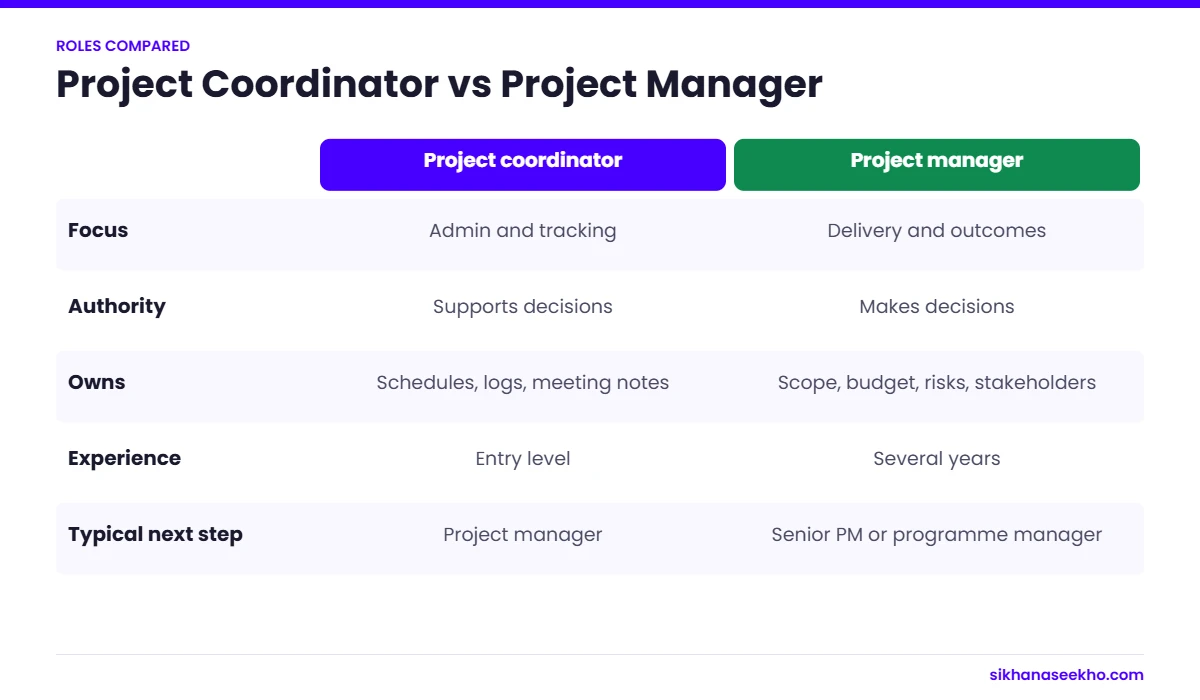
Responsibilities: Project Coordinator vs Project Manager
Project Coordinators
- Focus on day-to-day operations and administrative support.
- Schedule meetings, track project progress, maintain documentation, and facilitate communication between team members and stakeholders.
- Assist with logistics, update status reports, and ensure tasks are completed on time.
- Support the project manager by coordinating specific aspects of the project.
Project Managers
- Oversee the entire project lifecycle, from planning to execution and closure.
- Define project scope, set goals, manage budgets, and allocate resources.
- Lead the team, make high-level decisions, and communicate with stakeholders and upper management.
- Bear ultimate accountability for the project’s success or failure.
Decision-Making and Authority
A major distinction in the project coordinator vs project manager comparison is decision-making authority.
- Project coordinators operate in a supportive role, making decisions within the framework established by the project manager. They rarely make critical or strategic choices independently.
- Project managers have the authority to approve plans, adjust timelines, resolve conflicts, and make strategic decisions that directly impact project outcomes.
Leadership and Team Management
When it comes to leadership, the project coordinator vs project manager roles diverge:
- Project coordinators facilitate communication and coordinate activities but do not typically lead the team. Their influence is mostly operational, ensuring smooth project flow.
- Project managers serve as the primary leaders, assigning roles, motivating the team, and providing feedback. They are responsible for aligning the project with organizational goals and managing personnel performance.
Required Skills and Experience
Project Coordinators
- Strong organizational skills, attention to detail, and effective communication are key.
- Experience in administrative or support roles is common.
- Certifications like CAPM® (Certified Associate in Project Management) can be beneficial for career advancement.
Project Managers
- Require advanced leadership, strategic planning, risk management, and budgeting skills23.
- Typically have several years of experience in project coordination or related roles.
- Advanced certifications such as PMP (Project Management Professional) or PRINCE2 are often expected.
Scope and Impact
- Project coordinators focus on managing daily operations, tracking milestones, and maintaining documentation. Their work ensures the project runs smoothly but has a limited strategic impact.
- Project managers are responsible for the big picture: defining objectives, managing resources, mitigating risks, and ensuring the project delivers value on time and within budget. Their decisions shape the overall project outcome.
Career Growth: Project Coordinator vs Project Manager
The project coordinator vs project manager debate is also about career progression.
- Project coordinators often start in entry-level or intermediate roles. With experience, certifications, and skill development, many move up to project manager positions25.
- Project managers typically have more experience and education. They can advance to senior project manager, program manager, or even executive roles as they continue to build expertise.
Salary and Earning Potential
- Project managers generally command higher salaries due to their broader responsibilities and leadership roles. The average salary for a project manager is higher than that of a project coordinator.
- Project coordinators earn less but can increase their earning potential by gaining experience and advancing into management roles.
Collaboration and Synergy
Despite their differences, project coordinators and project managers work closely together. Their collaboration ensures projects are completed on time, within budget, and to the required quality standards. The synergy between these roles is vital for project success.
Summary Table:
| Aspect | Project Coordinator | Project Manager |
|---|---|---|
| Main Focus | Day-to-day operations, admin support | Full project lifecycle, strategy |
| Decision Authority | Limited, supportive | High, strategic |
| Leadership | Facilitates, coordinates | Leads, motivates, manages |
| Required Experience | Entry-level, admin or support roles | Several years, prior coordination |
| Certifications | CAPM® (entry-level) | PMP®, PRINCE2® (advanced) |
| Salary Potential | Lower, entry-level | Higher, leadership |
| Career Growth | Pathway to project manager | Senior PM, program manager, executive |
How do the certifications compare?
Certifications follow the same split. PMI’s CAPM is designed for coordinators and early-career staff: it needs 23 hours of project management education and no experience, and the exam fee is $225 for PMI members and $300 for non-members.
The PMP is aimed at project managers. It needs 36 months of experience leading projects with a 4-year degree, or 60 months without one, plus 35 contact hours of training. The exam fee is $405 for members and $655 for non-members.
Many people take CAPM while working as a coordinator, then move on to the PMP once they have enough experience leading projects. Both certifications renew every 3 years: CAPM with 15 PDUs and PMP with 60 PDUs.
How long does it take to move from coordinator to manager?
There is no fixed timeline, but many coordinators step up within 2 to 4 years. The move happens faster when you take ownership of a small project or workstream early and can show results.
Keep a log from your first month: project names, budgets, team sizes and what you personally delivered. When you apply for project manager roles, or for the PMP, that log is your evidence. PMI asks for the number of months you spent leading projects within the last 8 years, so dated records matter.
PMI’s Talent Gap research estimated that around 25 million new project professionals will be needed by 2030, so demand for people who can make this step remains strong in 2026.
What does a typical week look like in each role?
A project coordinator’s week is built around keeping information moving. Typical tasks include updating the schedule, booking and minuting meetings, chasing actions, maintaining the risk and issue logs, preparing data for reports and answering questions from the team. Success is measured by accuracy and responsiveness.
A project manager’s week is built around decisions. Typical tasks include reviewing progress against the baseline, deciding how to recover slippage, negotiating with stakeholders, approving or escalating changes, managing the budget and reporting to the sponsor. Success is measured by outcomes: whether the project delivers its objectives.
If you are a coordinator who wants to step up, start taking on the second list in small ways. Offer to draft the recovery plan, run the next progress meeting or own a small workstream. Those examples become the evidence you need for a project manager role.
In 2026, many employers also advertise hybrid project coordinator and junior project manager roles, which are a useful bridge between the 2 positions.
Which role should you apply for?
If you have under 2 years of experience, apply for coordinator roles and ask in interviews how coordinators grow into project managers there. If you have already led small projects, apply for junior project manager roles and lead your CV with those results.
FAQs:
Can a project coordinator become a project manager?
Yes, many project coordinators advance to project manager roles by gaining experience, developing leadership skills, and earning certifications.
What certifications help in transitioning from coordinator to manager?
Start with CAPM for coordinators, then pursue PMP or PRINCE2 for project manager positions.
Who earns more: project coordinator vs project manager?
Project managers typically earn higher salaries due to their broader responsibilities and decision-making authority.
Do both roles require the same level of education?
No. Project managers usually need more advanced education and experience, while coordinators can start with less formal education.
Which role is better for entry-level professionals?
Project coordinator is ideal for those starting out, offering a strong foundation for advancing into project management.
Understanding the project coordinator vs project manager distinction helps you choose the right starting point for your project management career. Both roles are essential, but your choice depends on your skills, interests, and long-term goals.
Keep learning
- Remote Project Manager Jobs: How to Find Them
- How to Build a Project Management Portfolio: A Step-by-Step Guide for Job Seekers
- Top YouTube Channels to Learn Project Management for Free
- Best Project Management Podcasts to Follow
- How to Get Your First Project Management Internship in the UK and US
- How to Write a Project Management Resume