
Project Risk Management (PMBOK Knowledge Area 11) is the collection of seven processes that identify, analyse, plan responses to, implement responses to, and monitor project risks: both threats (negative risks) and opportunities (positive risks). The seven processes are: Plan Risk Management (defining the approach), Identify Risks (cataloguing all potential risks), Perform Qualitative Risk Analysis (prioritising risks by probability and impact), Perform Quantitative Risk Analysis (numerically analysing the combined effect of risks on project objectives), Plan Risk Responses (developing strategies and actions for each priority risk), Implement Risk Responses (executing the planned response actions), and Monitor Risks (tracking identified risks, identifying new risks, and evaluating risk process effectiveness). The central insight is that risk management applies equally to threats and opportunities: it is not just about avoiding bad outcomes but about actively pursuing good ones.
Project risk management is one of the most intellectually rich knowledge areas in PMBOK, and the one most commonly reduced to a compliance exercise in practice. The risk register gets populated in the planning phase, reviewed at steering group meetings, and then largely forgotten until something goes wrong. When it does, the response is reactive rather than proactive, and the question "was this in the risk register?" is asked after the damage is done rather than before it could be prevented.
Genuine risk management is fundamentally different. It is a continuous, iterative discipline that runs from initiation through project close. It asks not just "what could go wrong?" but "what is the probability-weighted impact on our objectives, and what is the most cost-effective way to modify that probability or impact?" It treats the risk register as a living decision-support tool, not a governance artefact.
It also recognises that risks are two-directional. Every project faces threats: uncertainties that could worsen its performance. Every project also faces opportunities: uncertainties that could improve it. Risk management that only addresses threats leaves systematic value creation on the table.
This guide covers all seven PMBOK processes with full ITO breakdowns, the complete risk response strategies for both threats and opportunities, the probability and impact matrix, the Expected Monetary Value (EMV) framework with a worked example, qualitative and quantitative analysis techniques, and how risk management operates across Agile, waterfall and hybrid environments.
Key Risk Management Concepts
What Is a Risk?
A risk is an uncertain event or condition that, if it occurs, has a positive or negative effect on one or more project objectives (scope, schedule, cost or quality). Three elements define a risk: a cause (the situation that gives rise to the uncertainty), an event (what might happen), and an effect (the impact on project objectives if the event occurs). A well-formed risk statement captures all three: "Because of [cause], [event] might occur, resulting in [effect on objectives]."
The critical distinction between a risk and an issue: a risk is a future uncertainty that has not yet occurred. An issue is a risk that has materialised. It has happened and must now be managed as a current problem rather than a future uncertainty. Risk management addresses future states; issue management addresses current states.
Known Unknowns vs Unknown Unknowns
Known unknowns are risks that have been identified. You know they might happen, but you do not know whether they will. The risk register captures known unknowns, and contingency reserves are allocated to cover their potential impact. Unknown unknowns are risks that have not been identified. You do not know they exist. By definition, they cannot be managed proactively. Management reserves (held above the cost baseline) are allocated for unknown unknowns. They require sponsor authorisation to access because they represent genuinely unforeseeable events.
Project Risk Management: The 7 PMBOK Processes
Plan Risk Management is the process of defining how risk management activities will be conducted throughout the project. Its sole output is the Risk Management Plan: a component of the Project Management Plan that describes the methodology, roles, budget, timing, risk categories, definitions of probability and impact, probability and impact matrix, stakeholder risk tolerances, and reporting formats for risk management.
The Risk Management Plan does not list or analyse individual risks. It establishes the framework within which all subsequent risk processes operate. Without this framework, risk identification and analysis will be inconsistent, priorities will be incomparable across different risk categories, and risk thresholds will be undefined.
Key elements defined in the Risk Management Plan:
- Risk categories: A hierarchical structure (Risk Breakdown Structure, RBS) that organises sources of risk: Technical, External, Organisational, Project Management, etc. Provides a systematic prompt for risk identification.
- Definitions of probability and impact: Standardised scales that ensure all team members assess probability and impact consistently. Without agreed definitions, one person's "High probability" is another's "Medium."
- Probability and impact matrix: The grid that maps probability × impact to a risk priority score. Defines which combinations are Low, Medium, High and Very High priority.
- Risk budget: The contingency reserve budget for identified risks and the management reserve for unknown risks.
- Risk thresholds: The specific probability/impact levels at which risks must be escalated, formally reported or immediately actioned.
- Project Charter
- Project Management Plan (All management plans)
- Project Documents (Stakeholder register)
- Enterprise Environmental Factors
- Organisational Process Assets
- Expert judgement
- Data analysis (stakeholder risk appetite analysis)
- Meetings
- Risk Management Plan
Identify Risks is the process of identifying individual project risks and sources of overall project risk, and documenting their characteristics in the Risk Register. It is an iterative process: new risks emerge throughout the project lifecycle as scope evolves, circumstances change, and team members gain experience. Risk identification is not a one-time planning activity; it must be revisited at regular intervals and whenever significant project changes occur.
Key risk identification techniques:
- Brainstorming: Open-group generation of risks without evaluation. Effective for capturing diverse perspectives but may miss systematic risks if not structured. Often combined with the Risk Breakdown Structure as a prompt.
- Interviews: Structured conversations with subject matter experts, team members and stakeholders to elicit their risk perspectives. More likely to surface domain-specific risks that general brainstorming misses.
- SWOT analysis: Analysing project Strengths, Weaknesses, Opportunities and Threats. Connects internal capability assessment to external risk exposure.
- Assumptions and constraints analysis: Examining each project assumption for what happens if it proves false, and each constraint for what happens if it cannot be maintained. Assumptions are fertile ground for risk identification. Every assumption is a potential risk.
- Checklist analysis: Using standardised risk checklists from previous similar projects or industry databases. Efficient but may lead to missing project-specific risks if checklists are followed mechanically.
- Root cause analysis: Working backwards from potential unwanted outcomes to identify their root causes, which can then be addressed proactively.
- Document analysis: Reviewing the project charter, scope statement, WBS, schedule, cost estimate and other project documents to identify risks embedded in assumptions, constraints and dependencies.
- Risk Management Plan
- Project Management Plan (All plans)
- Project Documents (Assumptions log, Cost estimates, Duration estimates, Issue log, Lessons learned, Requirements docs, Resource requirements, Scope baseline, Schedule, Stakeholder register)
- Agreements
- Procurement documentation
- Enterprise Environmental Factors
- Organisational Process Assets
- Expert judgement
- Data gathering (brainstorming, checklists, interviews)
- Data analysis (assumptions and constraints analysis, SWOT, document analysis, root cause analysis)
- Interpersonal and team skills (facilitation)
- Prompt lists
- Meetings
- Risk Register (initial)
- Risk Report (initial)
- Project Documents Updates (Assumptions log, Issue log, Lessons learned)
Perform Qualitative Risk Analysis is the process of prioritising identified risks by assessing their probability of occurrence and their impact on project objectives. It uses a subjective, expert-judgement-based assessment rather than statistical analysis. Its primary purpose is to focus risk response planning on the risks that matter most, and to avoid wasting resources on low-priority risks.
The process uses the Probability and Impact Matrix (defined in the Risk Management Plan) to classify each risk into priority categories: High, Medium and Low. Each risk receives a probability score (e.g., Very Low = 0.05, Low = 0.10, Medium = 0.30, High = 0.70, Very High = 0.90) and an impact score (e.g., Very Low = 0.05, Low = 0.10, Medium = 0.20, High = 0.40, Very High = 0.80). The product of these two scores gives the risk score (probability × impact), which maps to the priority matrix.
Additional qualitative considerations:
- Risk urgency: How soon the risk must be acted upon, a high-probability risk that could materialise in the next two weeks is more urgent than an equally high-probability risk that won't occur for six months.
- Risk proximity: How close the risk is to the current project phase: near-term risks warrant more attention than distant ones.
- Risk manageability: Whether the project team can actually influence the risk probability or impact, or whether the risk is entirely outside the project's control.
- Data quality: How reliable the probability and impact assessments are, a risk with low assessment confidence should be noted as such.
- Risk Management Plan
- Project Management Plan (Scope, Schedule, Cost)
- Project Documents (Assumptions log, Risk register, Stakeholder register)
- Enterprise Environmental Factors
- Organisational Process Assets
- Expert judgement
- Data gathering (interviews)
- Data analysis (risk data quality assessment, risk probability and impact assessment, assessment of other risk parameters)
- Interpersonal and team skills (facilitation)
- Risk categorisation
- Data representation (probability and impact matrix, hierarchical charts)
- Meetings
- Project Documents Updates (Assumptions log, Issue log, Risk register, Risk report)
Perform Quantitative Risk Analysis is the process of numerically analysing the combined effect of identified project risks on overall project objectives. It is not performed on all projects. It requires substantial historical data, sophisticated tools (simulation software) and a sufficient budget to justify the analysis investment. It is most commonly applied on large, complex, high-value projects where quantified confidence intervals for project cost and schedule completion are required by governance.
Where qualitative analysis asks "which risks are most important?", quantitative analysis asks "what is the probability that the project will complete within budget and on schedule, given the full risk profile?" The outputs are probability distributions of project outcomes, typically a cost distribution (probability that actual cost will be within X% of the estimate) and a schedule distribution (probability of completing by the target date).
Primary quantitative techniques:
- Monte Carlo simulation: Runs thousands of project scenarios, sampling from the probability distributions of each uncertain parameter (activity duration, cost, occurrence of identified risks) and producing a probability distribution of project outcomes. The most powerful and widely used quantitative risk technique.
- Expected Monetary Value (EMV) analysis: Calculates the expected financial impact of risks and opportunities by multiplying each outcome's probability by its monetary value. Used in decision tree analysis to compare alternative risk responses.
- Decision tree analysis: Models decisions under uncertainty by mapping out possible outcomes of different choices, assigning probabilities and values to each branch, and calculating the EMV of each decision path to identify the optimal choice.
- Sensitivity analysis / Tornado diagram: Identifies which individual risks have the greatest impact on project outcomes: producing a tornado diagram where the longest bar represents the highest-impact individual risk. Used to focus risk response planning on the most influential risks.
- Risk Management Plan
- Project Management Plan (Cost, Schedule Baselines)
- Project Documents (Assumptions log, Basis of estimates, Cost/duration estimates, Milestone list, Risk register, Resource requirements)
- Enterprise Environmental Factors
- Organisational Process Assets
- Expert judgement
- Data gathering (interviews)
- Interpersonal and team skills (facilitation)
- Representations of uncertainty (probability distributions)
- Data analysis (simulations, sensitivity analysis, decision tree analysis, influence diagrams)
- Project Documents Updates (Risk register, Risk report)
Plan Risk Responses is the process of developing options, selecting strategies and agreeing on actions to address individual project risks and overall project risk exposure. It is the process that turns risk analysis into actionable plans: determining what specific actions will be taken, by whom, when, and with what resources, to modify the probability or impact of each priority risk.
Every priority risk should have at least one planned response. The response strategy chosen depends on the risk type (threat vs opportunity), its probability and impact, and the cost-effectiveness of available responses. A risk response that costs more than the expected risk impact is rarely worth implementing, the response must be proportionate to the threat or opportunity it addresses.
Risk responses also generate secondary risks: new risks introduced by the risk response itself. A response that involves bringing in a third-party supplier to mitigate a technical risk creates new procurement and supplier delivery risks. Secondary risks must themselves be identified, analysed and responded to.
Residual risks are risks that remain after risk responses have been implemented, the remaining risk exposure that is accepted by the project. Contingency reserves are allocated for residual risks of identified threats.
- Risk Management Plan
- Project Management Plan (Resource Management, Cost Baseline)
- Project Documents (Lessons learned, Project schedule, Risk register, Risk report, Stakeholder register)
- Enterprise Environmental Factors
- Organisational Process Assets
- Expert judgement
- Data gathering (interviews)
- Interpersonal and team skills (facilitation)
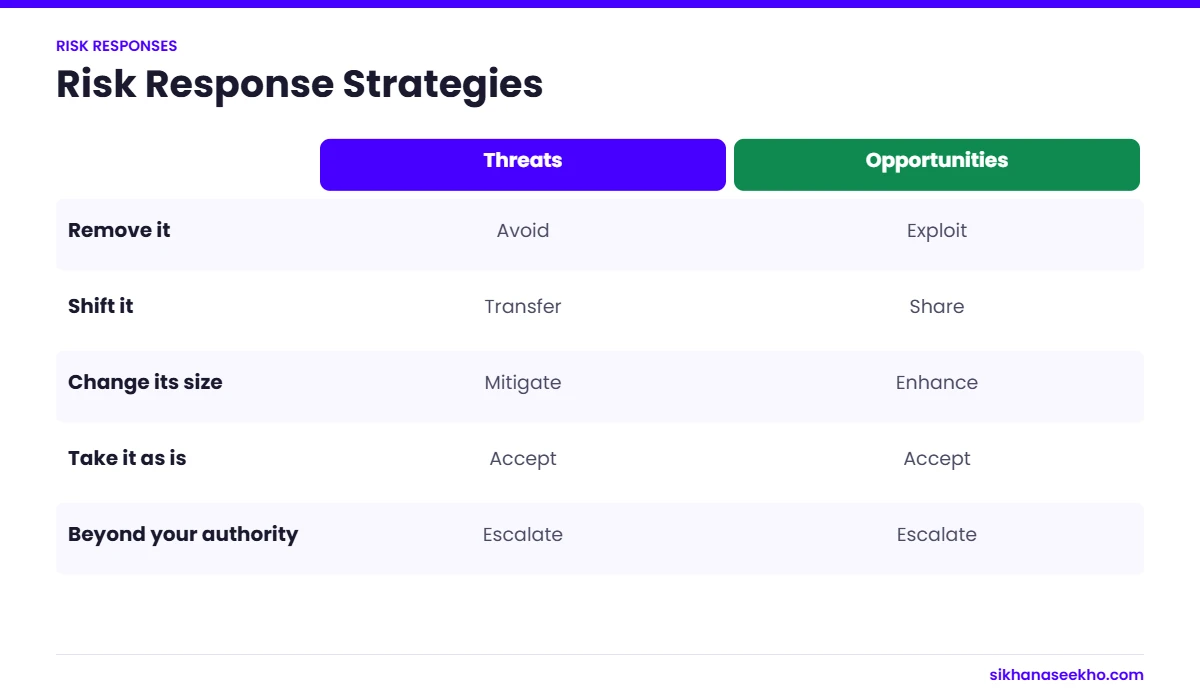
- Strategies for threats (Escalate, Avoid, Transfer, Mitigate, Accept)
- Strategies for opportunities (Escalate, Exploit, Share, Enhance, Accept)
- Contingent response strategies
- Data analysis (alternatives analysis, cost-benefit analysis)
- Decision making (multi-criteria decision analysis)
- Change Requests
- Project Management Plan Updates (Schedule, Cost, Quality, Resource Management Plans; Schedule, Cost Baselines)
- Project Documents Updates (Assumptions log, Cost estimates, Lessons learned, Risk register, Risk report)
Implement Risk Responses is the executing process that ensures the risk response actions agreed in Plan Risk Responses are actually carried out. It was added as a distinct process in PMBOK 6 to address a chronic gap in risk management practice: risk responses are planned but never assigned, tracked or executed. A risk register full of planned responses that nobody acts on provides no risk management benefit.
The primary challenge in Implement Risk Responses is accountability: ensuring that risk owners take ownership of their assigned responses and that the PM actively tracks execution status. Risk responses need to be treated as project work items: assigned to named individuals, given target completion dates, tracked through regular reporting, and escalated when they slip.
This process also covers the implementation of contingent response strategies: responses that are only triggered when a pre-defined condition (trigger) is met. When the trigger event occurs, the contingent response is automatically activated without needing a new decision. Examples: if the lead time for a critical component exceeds 6 weeks (trigger), activate the pre-qualified alternative supplier (contingent response).
- Project Management Plan (Risk Management Plan)
- Project Documents (Lessons learned, Risk register, Risk report)
- Organisational Process Assets
- Expert judgement
- Interpersonal and team skills (influencing)
- Project management information system
- Change Requests
- Project Documents Updates (Issue log, Lessons learned, Project team assignments, Risk register, Risk report)
Monitor Risks is the monitoring and controlling process that tracks identified risks, monitors residual risks, identifies new risks, evaluates risk response effectiveness, and assesses whether overall project risk exposure is acceptable. It runs continuously throughout the project lifecycle: risk monitoring is not a periodic activity but an ongoing discipline.
Risk audits examine and document the effectiveness of risk responses in dealing with identified risks. They assess whether the risk management process is being followed correctly and whether the results are appropriate for the level of project risk. Risk audits may be performed by the PM, a quality function, or an independent third party on high-risk or high-value projects.
Risk reviews (formally scheduled in the Risk Management Plan) re-evaluate previously identified risks for changes in probability, impact or priority; identify whether any risks have closed (never materialised and can no longer occur); identify new risks that have emerged; and review the adequacy of risk responses in light of current project status. Every significant project event, stage boundary, major change, new stakeholder, should trigger a risk review.
Reserve analysis: Monitoring the adequacy of contingency and management reserves relative to remaining risk exposure. As risks close out (either by materialising or by expiring), contingency reserve may be released back to the project budget or retained for remaining risks. If the remaining risk exposure exceeds the available contingency reserve, additional contingency must be requested through change control.
- Project Management Plan (Risk Management Plan)
- Project Documents (Issue log, Lessons learned, Risk register, Risk report)
- Work Performance Data
- Work Performance Reports
- Data analysis (technical performance analysis, reserve analysis)
- Audits
- Meetings
- Work Performance Information
- Change Requests
- Project Management Plan Updates
- Project Documents Updates (Assumptions log, Issue log, Lessons learned, Risk register, Risk report)
- Organisational Process Assets Updates
Risk Response Strategies: Threats and Opportunities
PMBOK defines distinct response strategies for threats (negative risks) and opportunities (positive risks). This symmetry is one of the most important and most frequently overlooked aspects of risk management. Every threat strategy has an opposite opportunity strategy that exploits positive uncertainties rather than managing negative ones.
The Probability and Impact Matrix
The Probability and Impact Matrix is the primary tool for prioritising risks in Qualitative Risk Analysis. It maps the probability of a risk occurring (vertical axis) against its potential impact on project objectives (horizontal axis) to produce a risk priority score (probability × impact) that determines the response urgency.
The matrix thresholds are defined in the Risk Management Plan, not universally standard. A risk-averse organisation will draw the "High" threshold at a lower probability × impact value than a risk-tolerant organisation. The matrix is specific to the project and organisation and must be agreed by the project board before qualitative analysis begins.
Expected Monetary Value Analysis
Expected Monetary Value (EMV) analysis quantifies the financial impact of risks and opportunities by multiplying each outcome's probability by its monetary value. The sum of all individual risk EMVs gives the overall expected monetary impact of the project's risk profile, which informs the size of the contingency reserve required.
| Risk Description | Type | Probability | Impact (£) | EMV (£) |
|---|---|---|---|---|
| Key vendor delivers late, causing 3-week delay | Threat | 40% | −£75,000 | −£30,000 |
| Requirements ambiguity causes rework in Phase 2 | Threat | 60% | −£40,000 | −£24,000 |
| Key resource unavailable during critical path week | Threat | 25% | −£30,000 | −£7,500 |
| Regulatory approval faster than expected, enabling early go-live | Opportunity | 30% | +£50,000 | +£15,000 |
| Technology reuse from prior project reduces development cost | Opportunity | 50% | +£20,000 | +£10,000 |
| Overall Project EMV (Net Risk Exposure) | −£36,500 | |||
Interpreting the result: The project's net risk exposure is −£36,500: meaning the expected cost of threats exceeds the expected value of opportunities by £36,500. This figure informs the minimum contingency reserve required. In practice, the contingency reserve is set higher (typically at the 80th percentile of the Monte Carlo simulation output) to provide confidence that funds will be available even if multiple risks materialise simultaneously.
The Risk Register
The Risk Register is the central risk management document: progressively elaborated through the risk management processes. It begins as a simple list of identified risks (Identify Risks) and evolves to include probability and impact assessments (Qualitative Analysis), quantitative values (Quantitative Analysis), planned responses with owners and trigger conditions (Plan Risk Responses), and current status of active risks (Monitor Risks).
| ID | Risk Description | Prob | Impact | Priority | Owner | Response | Status |
|---|---|---|---|---|---|---|---|
| R01 | Vendor delivers late causing critical path delay | 40% | High | HIGH | PM | Mitigate: dual source; Transfer: liquidated damages clause | Active |
| R02 | Regulatory approval delayed beyond planned 6 weeks | 30% | High | HIGH | BA Lead | Avoid: submit early; Contingency: 4-week schedule buffer | Active |
| R03 | Requirements ambiguity leads to rework in Phase 2 | 60% | Medium | MED | BA Lead | Mitigate: additional requirements workshops in Phase 1 | Active |
| R04 | Technology reuse from prior project reduces dev cost | 50% | Medium | OPP | Tech Lead | Exploit: assign same tech lead as prior project | Active |
| R05 | Key resource illness during UAT phase | 15% | Low | LOW | PM | Accept (passive): monitor; contingency: cross-train backup | Watch |
Quantitative Risk Analysis Tools
How Risk Management Connects to Every Other Knowledge Area
Risk Management in Agile, Waterfall and Hybrid Environments
Traditional waterfall risk management follows the full seven-process PMBOK model:
- Formal Risk Management Plan developed during initiation/planning
- Comprehensive risk identification workshops at project start
- Qualitative analysis applied to all identified risks
- Quantitative analysis on high-value, complex projects
- Formal risk register maintained throughout project lifecycle
- Risk response plans included in project baseline with assigned owners
- Regular risk review meetings (typically monthly)
- Stage gate reviews include risk status assessment
- Contingency and management reserves in cost baseline and budget
- Risk audits conducted periodically or at stage boundaries
Strength: Systematic, documented and auditable risk management. Challenge: Risk register can become a bureaucratic artefact rather than an active management tool if not regularly maintained and acted upon.
Agile manages risk through shorter delivery cycles and continuous adaptation rather than upfront comprehensive planning:
- Sprint-level risk identification: Risks identified and discussed in sprint planning and daily standups rather than formal risk workshops
- Risk-adjusted backlog prioritisation: High-risk backlog items brought forward to early sprints: fail fast, learn quickly, adapt
- Spikes: Short time-boxed investigation activities to resolve technical uncertainties before they become mid-sprint blockers
- Sprint retrospectives: Regular structured reflection that surfaces risk-related process issues and patterns
- Continuous delivery: Working software delivered every sprint provides early evidence of risks materialising, enabling faster response
- Risk acceptance is implicit in the sprint boundary: if a risk materialises, it becomes a sprint impediment managed through the backlog
- Risk reserves managed at the release/programme level rather than individual sprint level
Strength: Inherently risk-adaptive: short feedback loops enable rapid response to materialising risks. Challenge: Less systematic identification of risks beyond the immediate sprint; long-horizon risks may be underweighted.
Risk Management: 7 Exam Tips for PMP and APM PMQ
Apply This Knowledge Area in Your PMP or APM PMQ
Risk management, including the seven processes, all response strategies, EMV analysis and the probability-impact matrix: is one of the most heavily tested areas in both the PMP and APM PMQ examinations.
Pingback: Project Management Artifacts - Streamline Your Workflow
Pingback: CAPM Certification: Job Opportunities for Beginners
Pingback: Project Procurement Management and Contract Types