You can cover most of what you need to pass the APM PMQ with free official resources: the PMQ Qualification Handbook, the full syllabus with all 73 learning outcomes, the official sample exam papers and the APM BoK8 digital preview are all available free from apm.org.uk. The most impactful paid investment is a structured training course from an APM-accredited provider, which gives you guided study, timed exam practice and expert feedback on your long-response technique. The APM PMQ Study Workbook (official, ~£30–£50) is the second most useful paid resource. Beyond those two, additional paid resources are optional. They add breadth but the free materials alone are sufficient for a well-prepared self-study candidate.
✦
From my experience: Many of the students I train sit more than one certification. For the APM PMQ, I tell them to pick one main resource and spend most of their time practising written, exam-style answers.
Free Resources: Start Here
PMQ Qualification Handbook (apm.org.uk)
Full syllabus: 24 objectives, 73 outcomes
Official sample exam papers
APM BoK8 digital preview
APM website topic summaries and articles
YouTube: Parallel Project Training, Wellingtone
APM Learning Platform (free with APM membership)
Paid Resources: Worth Buying
APM PMQ Study Workbook (official) ~£30–£50
APM BoK8 full print edition ~£35–£45
Accredited training course (online self-study or virtual classroom)
Third-party practice question banks
APM membership (~£150–£175/yr): saves £120 on exam fee
The first thing to do when preparing for the APM PMQ is get the free official materials from apm.org.uk: before spending a penny on anything else. The free resources from APM itself are the most targeted study materials available because they are written against the exact exam blueprint. Everything else, courses, textbooks, YouTube channels, practice question banks, supplements these, it does not replace them.
This guide organises everything worth knowing about by category: free official APM resources, the paid resources worth buying, training providers, practice materials and what to skip.
✦
2026 format check: The APM PMQ exam format changed significantly in August 2024, the old three-hour, ten-essay format was replaced by a 40-question, 90-mark mixed format. Some study materials, practice question banks and YouTube videos still reference the old format. Before using any resource, verify it reflects the current exam: 2.5 hours, 40 questions, four question types, long-response written questions. Old essay-format practice does not prepare you for the current exam.
Free Official Resources
Free Official APM Resources: The Essential Starting Point
✦APM PMQ Qualification HandbookFREE
The single most important document for PMQ preparation: more important than any textbook. The Qualification Handbook contains the full syllabus with all 24 learning objectives and 73 learning outcomes, the exam format specifications, question type examples, marking guidance and administrative information about booking and sitting the exam.
Download this before anything else. The 73 learning outcomes are the exact blueprint for what the exam can test. Every topic in the handbook is fair game; every topic not in it will not be tested.
Where to get it: apm.org.uk, search "PMQ Qualification Handbook", free PDF download, no account required.
✦APM PMQ Sample Exam PapersFREE
APM publishes official sample papers for the current exam format, the closest available representation of the real exam's question style, difficulty and format. These are not "typical questions" or unofficial approximations. They are produced by APM using the same question-writing process as the real exam.
Do not just read the sample papers. Complete them under timed conditions with no notes. Reading them without practising under pressure gives false confidence and does not build the time management and writing skills the real exam demands.
Where to get it: apm.org.uk, search "PMQ sample paper", free download.
✦APM Body of Knowledge 8th Edition (BoK8): Digital PreviewFREE preview / Paid full
The APM BoK8 is the definitive reference for APM terminology and concepts. The current syllabus is aligned to BoK8. A digital preview (significant portion of the content) is available free on the APM website. Full access to the digital edition is free for APM members; the print edition costs ~£35–£45.
The BoK8 is a reference book, not a study guide. Use it to look up specific terms and check APM's definitions, not to read cover to cover. Your primary study framework should be the 73 learning outcomes, not the BoK8 chapter structure.
APM members get full digital access free. Non-members can access the preview and use the print edition for the sections most relevant to their weaker learning outcomes.
✦APM Website Topic Articles and SummariesFREE
The APM website (apm.org.uk) publishes articles, definitions and topic summaries on many of the learning outcomes: risk management, benefits management, stakeholder engagement, governance and more. These are written in APM's own terminology and provide useful supplementary reading for specific topics you need to strengthen.
Use these for specific topics you find difficult after initial study, not as a starting point. Search for "APM [topic name]" and check that the article reflects BoK8 content.
✦APM Learning Platform (free with APM membership)FREE with membership
APM members get access to the APM Learning platform, which includes structured learning modules, CPD resources and professional development content. The content is not exam-specific study material, it is broader professional development, but it is a useful supplementary resource for building depth on topics in the syllabus.
APM membership costs ~£150–£175 per year and also saves £120 on the exam fee (£471.60 member vs £591.60 non-member). If you plan to sit the exam, membership pays for itself on the exam fee saving alone.
Free Third-Party Resources
Free Third-Party Resources Worth Using
✦YouTube: Parallel Project Training and WellingtoneFREE
Two UK training providers publish genuinely useful free PMQ content on YouTube. Parallel Project Training has an extensive library of topic videos covering individual PMQ learning outcomes: useful for auditory learners and for reinforcing topics after reading. Wellingtone publishes PMQ webinar content and exam technique guidance, including insights into how APM markers award marks on long-response questions.
Before watching, check the video date. Videos from before August 2024 may reference the old essay format. Look for content that specifically mentions "new exam format," "40 questions" or "long-response technique" to confirm it is current.
✦APM Community and LinkedIn GroupsFREE
The APM community forum and LinkedIn groups for APM candidates provide peer discussion, recent exam experience reports and shared study tips. Candidates who have recently sat the exam often share what they found most challenging and which topics were more heavily represented, a useful real-world signal to supplement your syllabus-based preparation.
Weight recent posts (last 3–6 months) more heavily than older ones, the exam format changed in 2024 and the syllabus was updated for 2026. Pre-2024 exam reports describe a completely different assessment.
Paid Resources
Paid Resources: What Is Worth Buying
✦APM PMQ Study Workbook (Official APM Publication)PAID: ~£30–£50
The official APM PMQ preparation workbook is structured directly against the exam syllabus: 24 study areas mapped to the learning outcomes, with concept summaries, case study application and practice questions for each topic. It is the closest thing to an official study guide for the PMQ and the first paid resource most candidates should buy.
Use the workbook as your primary self-study companion alongside the syllabus document. Work through one learning objective at a time: read the workbook section, review the relevant BoK8 content, then test yourself with the workbook's practice questions before moving on.
Where to buy: APM online shop at apm.org.uk. Print and digital versions available.
✦APM Body of Knowledge 8th Edition (Full Print)PAID: ~£35–£45
The full print edition of BoK8 is the definitive APM terminology and concept reference. It is not a study guide, the chapter structure does not map to the exam syllabus, and reading it sequentially is not an efficient exam preparation method. However, having the physical book is useful as a reference during study to look up APM's specific definitions and check your use of terminology.
If you are an APM member, get full digital access free and save the purchase cost. If you are not a member, compare the cost of buying BoK8 alone (~£40) against buying membership (~£150–£175) which gives both BoK8 access and a £120 exam fee saving: membership is better value if you are sitting the exam.
✦Accredited Training CoursePAID: £250–£2,400 depending on format
A structured course from an APM-accredited training provider is the highest-impact paid investment for most candidates. The value is not primarily in learning the content, a determined self-study candidate can cover the content independently. The value is in structured delivery, timed long-response practice with expert feedback, and the accountability of a course schedule.
Course format options:
Online self-study (£250–£500 + VAT): 6–12 months access to course modules, videos and practice materials. Flexible but requires self-discipline. Good option if you have strong PM experience and primarily need structure and practice. Providers: Training ByteSize, Parallel Project Training, Career Smarter.
Virtual classroom (£800–£1,400 + VAT): Live instructor-led sessions over 4–5 days. Better for candidates who benefit from discussion and immediate feedback on long-response answers. Exam is typically scheduled at end of course or shortly after.
Classroom / residential (£1,800–£2,400 + VAT): Face-to-face intensive course. Most expensive but provides the most interaction and the strongest preparation for candidates less comfortable with self-study.
Check that the course is APM-accredited (not just "APM-aligned") and that course materials are aligned to BoK8 and the current exam format. Ask specifically: "Does your course cover the long-response question technique for the new format?" If a provider cannot clearly answer this, their materials may not be current.
✦Third-Party Practice Question BanksPAID: varies
Several providers offer PMQ practice question banks beyond the official sample papers. These are most useful in the final 2–3 weeks of preparation for timed practice and identifying remaining knowledge gaps.
What to look for in a practice question bank:
Questions covering all four question types (MCQ, select-from-list, short-response, long-response)
Aligned to the 2026 syllabus, check the product was updated after August 2024
Long-response questions with model answers and marker commentary, not just the answer
Sufficient question volume, a bank with 20 questions is insufficient for serious preparation
The official APM sample papers are free and should be used first. Third-party banks are supplementary. They add volume for practice but the official papers are always the most reliable indicator of the real exam's style and difficulty.
✦APM PMQ Study Guide 2026 (Third-Party Books)PAID: ~£15–£30
Several independently published study guides for the APM PMQ are available, the Anthony Biggs APM PMQ Study Guide 2026 (Amazon Kindle/print) being among the most recent and explicitly aligned to the 2026 syllabus and BoK8. These third-party guides condense the syllabus content into a more accessible format than the BoK8 itself and often include question walkthroughs and exam technique advice.
Useful as a supplementary resource or as the primary self-study companion if you prefer not to use the official workbook. Always verify the edition is aligned to BoK8 and the current exam format before purchasing. A study guide for the old essay format is actively unhelpful for the current exam.
The Priority Order
The Recommended Study Materials Sequence
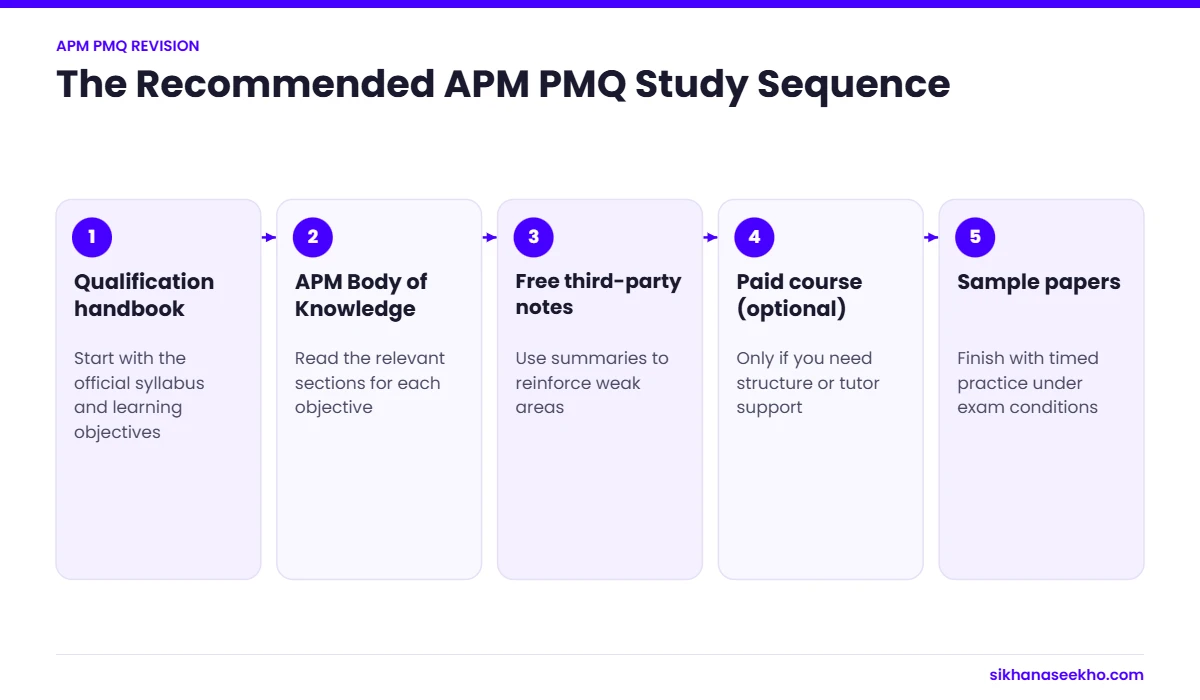
Start with the free official resources and add paid materials only where genuine gaps remain. Here is the recommended sequence:
Use free official resources first, then add paid help only where needed.
1st
Download the PMQ Qualification Handbook and syllabus (free, apm.org.uk). Read the 73 learning outcomes. Highlight everything you cannot currently explain. This becomes your study plan. Free
2nd
Join APM as a member: the £150–£175 annual fee saves £120 on the exam fee and unlocks the full BoK8 digital edition free. On balance, better value than buying BoK8 separately if you are sitting the exam. Paid: pays for itself
3rd
Work through the APM PMQ Study Workbook using the 73 learning outcomes as your chapter checklist. For each outcome: read, check BoK8 for terminology, answer the workbook practice questions. Paid ~£30–£50
4th
Watch Parallel Project Training and Wellingtone YouTube content for any learning outcomes where you need a different explanation or more depth. Use video to reinforce, not to replace, active study. Free
5th
Complete the official sample papers under timed conditions: no notes, strict 150-minute limit. Review every question, especially long-response answers. Identify which outcomes you are still losing marks on. Free
6th
Add a training course if you need structured guidance on long-response technique or want an expert to review your practice answers. This is the highest-value paid investment for candidates who learn better with instructor feedback. Paid £250–£1,400
7th
Add a third-party practice question bank in the final 2–3 weeks for additional timed practice volume. Useful but not essential if you have done sufficient practice using the official sample papers. Paid: optional
What to Skip
What Not to Buy or Use
Old essay-format materials. Any material referencing the "ten essay questions," "three-hour written exam" or "APMP" (the old name) describes the pre-2024 format. Using these for preparation creates confusion about what the exam actually expects and practices skills (long-essay writing) that the current format does not require in the same way.
PMBOK or PRINCE2 study materials. The APM PMQ uses APM terminology aligned to BoK8, not PMI or PRINCE2 language. Studying from PMBOK or a PRINCE2 guide for the PMQ risks importing incorrect terminology that will cost marks on the closed-book exam.
Generic "project management" textbooks not aligned to BoK8. There are many excellent PM books that have nothing to do with the APM PMQ syllabus. They may deepen your PM knowledge but they will not prepare you for the 73 specific learning outcomes the exam tests.
✦
The minimum viable study kit: PMQ Qualification Handbook (free) + APM membership (£150–£175, saves £120 on exam) + Official Study Workbook (£30–£50) + two timed practice sittings using official sample papers (free). Total cost: approximately £200–£225 all-in. A well-prepared candidate with solid PM experience can pass with this kit. Everything else is supplementary.
Ready to Start Your PMQ Preparation?
The complete APM PMQ guide covers the full exam format, study strategy and long-response technique, and the exam tips post has the 10 most important preparation points in one place.
The best free APM PMQ study resource is the PMQ Qualification Handbook, available free from apm.org.uk. It contains the full syllabus with all 24 learning objectives and 73 learning outcomes, the exact blueprint for what the exam tests. The second most valuable free resource is the official APM sample exam papers, also free from apm.org.uk, which show the real question style and format. Together these two free resources, combined with the APM BoK8 digital preview (also free on the website), give a self-study candidate most of what they need to begin preparing effectively.
The APM BoK8 is valuable as a terminology reference but it is not a study guide: its chapter structure does not map to the exam syllabus. Many candidates pass the PMQ without buying the full BoK8. If you join APM as a member (£150–£175/year), full digital access to BoK8 is included free. Given that APM membership also saves £120 on the exam fee (£471.60 member vs £591.60 non-member), membership is better value than buying BoK8 separately at ~£40 if you plan to sit the exam. The official APM PMQ Study Workbook (£30–£50) is a more directly useful study resource than the BoK8 for most candidates.
Yes: candidates with significant PM experience regularly pass the APM PMQ through self-study without attending a formal training course. The APM offers an open online exam specifically for self-study candidates. The key requirements for successful self-study are: working systematically through all 73 learning outcomes using the official syllabus as the checklist, using APM terminology consistently (referencing BoK8 for definitions), practising long-response answers under timed conditions regularly, and completing the official sample papers as full timed exams. The biggest risk in self-study is not covering the long-response technique adequately: without a trainer providing feedback on your written answers, it is possible to develop habits that cost marks without realising it. Supplementing self-study with some YouTube content from accredited providers (particularly for long-response technique guidance) mitigates this risk.
The best APM training provider is the one whose format, pace and teaching style suits how you learn. Well-regarded APM-accredited providers in the UK include Wellingtone (known for exam technique focus and strong PMQ webinar content), Parallel Project Training (one of the longest-established providers with extensive free content and strong online options), and Training ByteSize (competitively priced online self-study with exam included). For corporate training programmes, larger providers including QA, Capita and BCS Learning offer enterprise options with invoicing and volume discounts. Verify that any provider you use is currently APM-accredited and that their materials explicitly reference BoK8 and the current 40-question exam format before booking.
Partially, but with significant limitations. The core PM concepts in the APM PMQ (risk management, stakeholder engagement, governance, benefits management, scheduling, etc.) have not fundamentally changed. So older study materials may still cover the right subject matter. However, the exam format changed dramatically in August 2024: from ten essay questions in three hours to 40 questions of four types including structured long-response questions in 2.5 hours. Practice questions and exam technique advice from before August 2024 are based on a completely different assessment format and should not be used for exam technique preparation. The 2026 syllabus was also updated to align with BoK8, so some learning objective descriptions changed. Use older materials only for conceptual background on topics where you need additional depth, not for exam practice or technique guidance.
Pingback: Best PRINCE2 Online Courses 2026 Compared