
An engagement model in project management is the approach a project uses to involve stakeholders throughout its life cycle through planned, two-way communication, collaboration and transparency. It identifies who needs to be engaged, how much influence and interest they have, and how to move each one from their current level of engagement to the level the project needs.
The engagement model is a project management approach focusing on stakeholder engagement and communication throughout the project lifecycle. The engagement model emphasizes the importance of collaboration, communication, and transparency between the project team and stakeholders. The approach recognizes that effective stakeholder engagement can lead to better project outcomes, including increased project support, improved project quality, and increased stakeholder satisfaction.
The engagement model is a framework that is applied to many projects, including infrastructure projects, software development projects, and organizational change projects. In this article, we will discuss the fundamental principles of the engagement model and how they can be applied to project management.
What are the principles of the engagement model?
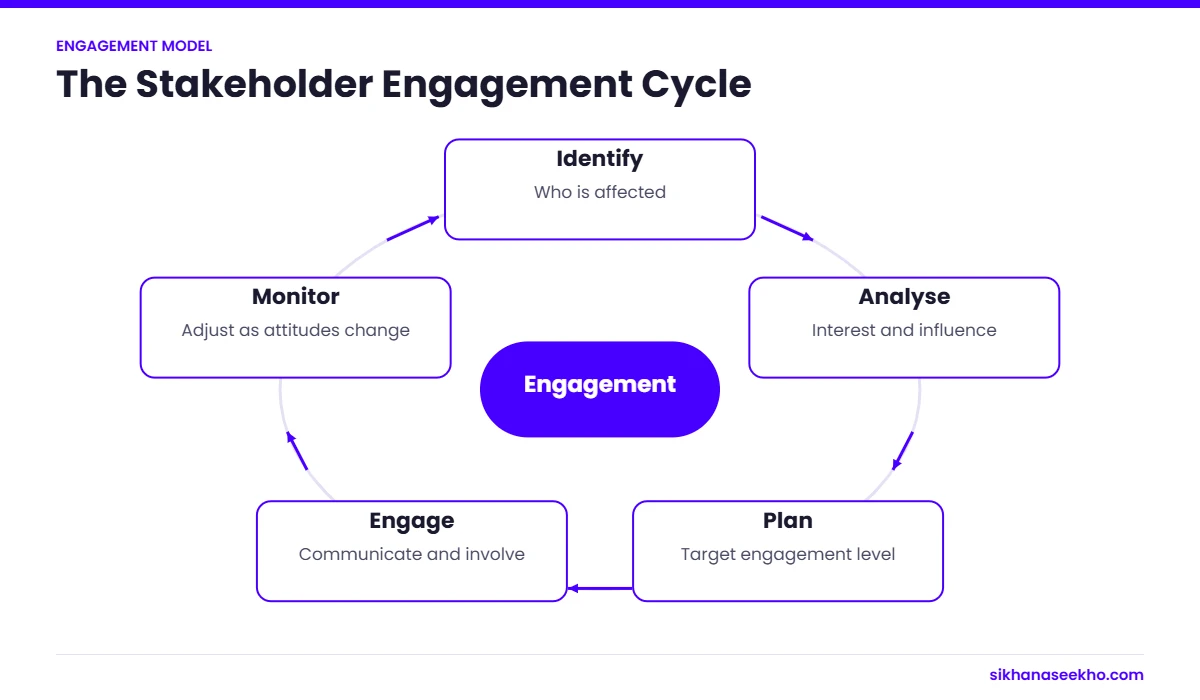
The engagement model is based on four key principles: stakeholder identification, stakeholder analysis, stakeholder engagement planning, and stakeholder communication.
- Stakeholder Identification
The first step in the engagement model is to identify the stakeholders affected by the project. This includes identifying both internal and external stakeholders. Internal stakeholders have project team members and other employees involved in the project. External stakeholders include customers, suppliers, regulators, and other stakeholders affected by the project.
- Stakeholder Analysis
The second step in the engagement model is to analyze the stakeholders and their interests, expectations, and concerns related to the project. Stakeholder analysis is a process of gathering and analyzing information about stakeholders to understand their perspectives, priorities, and potential impacts of the project on them. Stakeholder analysis helps project teams to identify potential risks and opportunities associated with the project and develop strategies to manage them.
- Stakeholder Engagement Planning
The third step in the engagement model is to develop a stakeholder engagement plan. A stakeholder engagement plan outlines how the project team will engage with stakeholders throughout the project lifecycle. The plan should include information about the objectives of stakeholder engagement, the methods and frequency of attention, and the roles and responsibilities of project team members and stakeholders.
- Stakeholder Communication
The engagement model’s fourth step is communicating with stakeholders throughout the project lifecycle. Stakeholder communication involves regular updates about the project, including progress, risks, and opportunities. Effective communication helps to build trust and credibility with stakeholders and can increase project support and stakeholder satisfaction.
How do you apply the engagement model on a project?
The engagement model is also applied to project management in several ways. The following are some examples of how the engagement model is used in practice:
- Infrastructure Projects
Infrastructure projects, such as road construction or water treatment projects, often involve many stakeholders, including local communities, government agencies, and contractors. The engagement model is used to ensure that stakeholders are involved in the project planning and decision-making processes and that their concerns and interests are considered in project design and implementation.
- Software Development Projects
Software development projects involve various stakeholders, including software developers, product owners, and end-users. The engagement model can be used to ensure that stakeholders are involved in the software development process, including requirements gathering, design, testing, and implementation. Effective stakeholder engagement ensures that the software meets the needs of end-users and other stakeholders.
- Organizational Change Projects
Organizational change projects, such as mergers, acquisitions, or restructuring, often involve various stakeholders, including employees, customers, and shareholders. The engagement model can be used to ensure that stakeholders are involved in the change management process and that their concerns and interests are considered in the change management plan. Effective stakeholder engagement can confirm the change is implemented smoothly and with minimal disruption.

The 5 stakeholder engagement levels
| Level | What it looks like | Typical action to move them forward |
|---|---|---|
| Unaware | Does not know about the project or its impact | Brief them early on why it matters to them |
| Resistant | Aware but opposed to the change | Listen to concerns and address the real issue |
| Neutral | Aware but neither supportive nor resistant | Show benefits and invite input |
| Supportive | Aware and supportive of the change | Keep informed and involve in decisions |
| Leading | Actively engaged in making the project succeed | Give visible roles, such as champion or reviewer |
Based on the stakeholder engagement assessment matrix in the PMBOK Guide (PMI).
What are the benefits of the engagement model?
The engagement model has several advantages for project management, including the following:
- Improved Stakeholder Support
Effective stakeholder engagement can lead to increased stakeholder support for the project. By involving stakeholders in the planning and decision-making processes, project teams can build trust and credibility with stakeholders, which can improve their support for the project. This can improve project outcomes, including increased project quality and reduced risk.
- Increased Project Quality
Effective stakeholder engagement can help project teams to identify potential risks and opportunities associated with the project. By understanding stakeholder expectations and concerns, project teams can develop strategies to manage these risks and options, improving project quality. It can lead to increased stakeholder satisfaction and support for the project.
- Improved Stakeholder Satisfaction
Stakeholder engagement can ensure stakeholder expectations are met, and their concerns are addressed throughout the project lifecycle. This can increase stakeholder satisfaction with the project, leading to increased support and improved project outcomes.
- Reduced Project Risk
Effective stakeholder engagement can help project teams to identify and manage project risks. By involving stakeholders in the project planning and decision-making processes, project teams can identify potential risks and develop strategies to manage them. This can reduce project risk and increase the likelihood of project success.
Why does engagement get harder as projects grow?
Every additional stakeholder adds communication paths. The formula is n(n ? 1) ÷ 2. With 10 stakeholders there are 45 possible channels; with 25 there are 300; with 50 there are 1,225. No project manager can manage that many relationships equally, which is why an engagement model prioritises.
The usual tool is the power/interest grid. Stakeholders with high power and high interest are managed closely; high power and low interest are kept satisfied; low power and high interest are kept informed; and low power and low interest are monitored. On a typical project with 30 stakeholders, only 4 or 5 sit in the manage closely box, and they deserve most of your time.
Review the grid at least every 4 weeks and at every phase gate. People change roles, priorities shift, and a neutral stakeholder can become resistant overnight when a decision affects their team.
How do you build an engagement plan?
Start with a stakeholder register listing each person or group, their role, interest, influence and current attitude. Then, for each key stakeholder, record the engagement level you need by the next milestone and the actions that will get them there.
Choose methods that fit each group. Sponsors may want a 1-page summary every 2 weeks and a monthly steering meeting. End users may want demos every sprint and a feedback channel. Regulators may need formal submissions on fixed dates.
Measure engagement. Simple signals include attendance at reviews, speed of decisions, the number of escalations and short pulse surveys. If a key stakeholder stops responding, treat it as a risk and act early.
In 2026, many teams also use collaboration tools to keep engagement visible: shared boards, recorded demos and comment threads let stakeholders in different time zones stay involved without more meetings.
Engagement on the PMP exam
Stakeholder engagement is a major theme in the People domain and in the stakeholder performance domain of PMBOK 7, published in 2021. Expect scenarios where a key stakeholder is resistant or disengaged. The best answers usually involve understanding the stakeholder’s concerns, updating the engagement plan and communicating directly, rather than escalating straight away or ignoring the problem.
Conclusion
The engagement model is a project management approach emphasizing stakeholder engagement and communication throughout the project lifecycle. The model is based on four key principles: stakeholder identification, stakeholder analysis, stakeholder engagement planning, and stakeholder communication. The engagement model can be applied to many projects, including infrastructure, software development, and organizational change projects.
The engagement model has several benefits for project management, including improved stakeholder support, increased project quality, improved stakeholder satisfaction, and reduced project risk. By applying the engagement model to project management, project teams can increase project success and stakeholder satisfaction, improving project outcomes.
Engagement model: common questions
What is the difference between stakeholder management and stakeholder engagement?
Management focuses on controlling expectations; engagement emphasises two-way involvement and building support. Modern PMI guidance uses engagement.
Which tools support an engagement model?
The stakeholder register, power/interest grid, salience model, engagement assessment matrix and communications plan.
How often should engagement be reviewed?
At least monthly and at every phase gate, or whenever a major change affects stakeholders.
Keep learning
- PMBOK Guide 6th Edition Explained
- PMBOK Guide 7th Edition Explained
- The Triple Constraint in Project Management: Scope, Time, Cost and Beyond
- Beginner’s Guide to Earned Value Management (EVM)
- What Are Stakeholders in Project Management?
- PMBOK Process Groups Explained: All 5 with Examples