The 5 Project Management Process Groups
While many confuse them with project "phases," the 5 process groups are the chronological engine of the PMBOK® Guide. Master how Initiating, Planning, Executing, Monitoring, and Closing interact to deliver value.
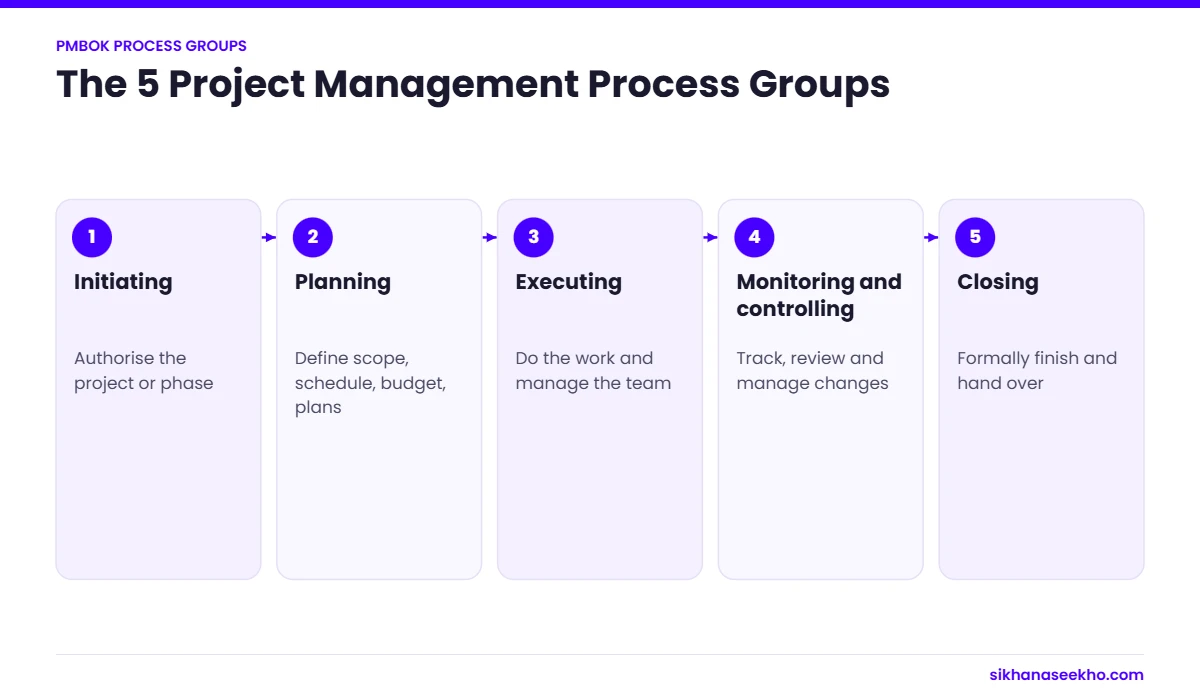
1. Initiating Process Group
Defines the new project or a new phase by obtaining authorization to start.
2. Planning Process Group
Establishes the scope, refines objectives, and defines the course of action required.
3. Executing Process Group
Completing the work defined in the plan to satisfy project specifications.
4. Monitoring & Controlling Group
Tracking, reviewing, and regulating the progress and performance of the project.
5. Closing Process Group
Finalizing all activities across all Process Groups to formally close the project or phase.
By Syed Mujeeb Ur Rehman, PMP · Updated October 2026
The project management process groups are the 5 logical groupings of project management processes in the PMBOK Guide: Initiating, Planning, Executing, Monitoring and Controlling, and Closing. In the 6th edition they organise 49 processes, and they describe how work is authorised, planned, carried out, checked and formally closed.
What are the 5 process groups at a glance?
The 5 process groups in the PMBOK Guide 6th edition
| Process group | Purpose | Number of processes | Key outputs |
|---|---|---|---|
| Initiating | Define and authorise the project or phase | 2 | Project charter, stakeholder register |
| Planning | Establish scope, objectives and the plan | 24 | Project management plan, baselines |
| Executing | Complete the work defined in the plan | 10 | Deliverables, work performance data |
| Monitoring and Controlling | Track, review and regulate progress | 12 | Change requests, work performance reports |
| Closing | Formally complete the project or phase | 1 | Final report, transitioned deliverables |
Source: PMBOK Guide, 6th edition (PMI, 2017). 2 + 24 + 10 + 12 + 1 = 49 processes.
Are process groups the same as project phases?
No, and this is one of the most tested ideas on the PMP exam. Phases describe the life cycle of a specific project, such as design, build and test. Process groups describe the kinds of management work that happen within every phase. A design phase still needs initiating, planning, executing, monitoring and controlling, and closing activities of its own.
Process groups also overlap in time. Monitoring and controlling runs throughout the project, planning is revisited as you learn more, and executing often starts on early work packages while later ones are still being planned. That is why PMI calls them groups of processes rather than steps in a sequence.
How do the process groups work together?
The groups follow the Plan-Do-Check-Act cycle popularised in quality management. Planning is Plan, Executing is Do, and Monitoring and Controlling covers Check and Act, feeding corrective actions and change requests back into planning. Initiating starts the cycle, and Closing ends it for each phase or the whole project.
A useful way to remember the numbers is that Planning has by far the most processes, 24 of the 49, because every knowledge area needs planning. Closing has only 1 process: Close Project or Phase.
What does this look like on a real project?
Take a 6-month office relocation for 120 staff. Initiating: the sponsor issues a charter naming the project manager and setting the move date and budget, and the team identifies stakeholders such as facilities, IT, HR and landlords. Planning: the team builds a work breakdown structure, schedule, budget, risk register and communications plan. Executing: contractors fit out the new floor, IT installs the network and HR briefs staff. Monitoring and Controlling: weekly reviews track progress against the schedule and budget, and a change request is raised when 15 extra desks are needed. Closing: the team hands over to facilities, signs off with the sponsor and records lessons learned.
How do process groups relate to PMBOK 7 and the 2026 exam?
The PMBOK Guide 7th edition, published in 2021, moved away from processes towards 12 principles and 8 performance domains, and the PMP exam has followed a newer content outline since 9 July 2026. Even so, the process groups remain useful: many organisations still structure their methods around them, and exam scenarios regularly test whether you know what should happen first, such as getting a charter approved before detailed planning.
Process groups: common questions
How many process groups are there?
5: Initiating, Planning, Executing, Monitoring and Controlling, and Closing.
How many processes are in each group?
In the PMBOK Guide 6th edition: Initiating 2, Planning 24, Executing 10, Monitoring and Controlling 12, and Closing 1.
Which process group has the most processes?
Planning, with 24 of the 49 processes.
Are process groups still on the PMP exam?
The exam follows a newer content outline, but process group concepts still appear in scenario questions about what to do first or next.
Which processes belong to each group?
Initiating (2): Develop Project Charter and Identify Stakeholders.
Planning (24): Develop Project Management Plan; Plan Scope Management; Collect Requirements; Define Scope; Create WBS; Plan Schedule Management; Define Activities; Sequence Activities; Estimate Activity Durations; Develop Schedule; Plan Cost Management; Estimate Costs; Determine Budget; Plan Quality Management; Plan Resource Management; Estimate Activity Resources; Plan Communications Management; Plan Risk Management; Identify Risks; Perform Qualitative Risk Analysis; Perform Quantitative Risk Analysis; Plan Risk Responses; Plan Procurement Management; and Plan Stakeholder Engagement.
Executing (10): Direct and Manage Project Work; Manage Project Knowledge; Manage Quality; Acquire Resources; Develop Team; Manage Team; Manage Communications; Implement Risk Responses; Conduct Procurements; and Manage Stakeholder Engagement.
Monitoring and Controlling (12): Monitor and Control Project Work; Perform Integrated Change Control; Validate Scope; Control Scope; Control Schedule; Control Costs; Control Quality; Control Resources; Monitor Communications; Monitor Risks; Control Procurements; and Monitor Stakeholder Engagement.
Closing (1): Close Project or Phase.
How do you remember the process groups for the exam?
Many candidates use the order I-P-E-M-C and the numbers 2-24-10-12-1. A helpful pattern is that every knowledge area has at least 1 planning process, almost every knowledge area has a monitoring and controlling process, and only integration management has processes in all 5 groups, including the single closing process.
Watch for verbs. Processes starting with Plan, Define, Estimate, Develop or Identify are usually planning; Manage, Direct, Acquire, Implement and Conduct are usually executing; and Control, Monitor and Validate are monitoring and controlling. This shortcut answers a surprising number of exam questions about which process comes next.
Common mistakes with process groups
- Treating them as phases that happen once in sequence, rather than activities repeated in every phase
- Skipping initiating on small projects; even a 1-page charter prevents scope arguments later
- Thinking monitoring and controlling only happens at the end, when it should run throughout
- Confusing Validate Scope, which gets formal acceptance from the customer, with Control Quality, which checks deliverables are correct
Practise these concepts with our 200 free PMP practice questions, and read the project charter guide to see initiating in action.
How should you use process groups on your own projects?
You do not need to run all 49 processes on every project. Tailor them. A 6-week internal project might need a 1-page charter, a simple schedule, a short risk list, weekly status updates and a brief closure note. A 2-year infrastructure programme will use almost every process in depth, with formal change control and detailed baselines.
A practical approach is to ask 5 questions at the start of each phase. Is the work authorised and are the right stakeholders involved? Do we have a plan that people agree with? Is the work being done as planned? How are we checking progress and handling changes? How will we formally close this phase and capture lessons? If you can answer all 5 clearly, you are applying the process groups well, whatever method your organisation uses.
Download our free project management templates to support each group, from the charter in Initiating to the closure report in Closing.
Key takeaway
The 5 process groups describe the management work that every project and every phase needs: authorise it, plan it, do it, check it and close it. Learn the purpose of each group, the 2-24-10-12-1 distribution of the 49 processes, and the difference between process groups and life cycle phases. Those 3 ideas cover most of what the PMP exam asks about process groups, and they give you a simple checklist for running real projects in any industry, whether you use a predictive, agile or hybrid approach.
Review this page again a week before your exam as a quick refresher.
Applying Process Groups to your Exam?
The PMP exam tests your ability to identify which process group a scenario belongs to. Get our free PMP mapped cheat sheet below.
View PMP Exam GuideKeep learning
- Critical Path Method (CPM): Step-by-Step Guide
- Earned Value Management Formulas, Examples & Calculator
- Project Risk Management Identify, Analyse & Control
- Stakeholder Management Identify, Analyse & Engage
- Project Charter Guide What to Include & How to Get It Approved
- What Is Project Management? Complete Beginner Guide 2026