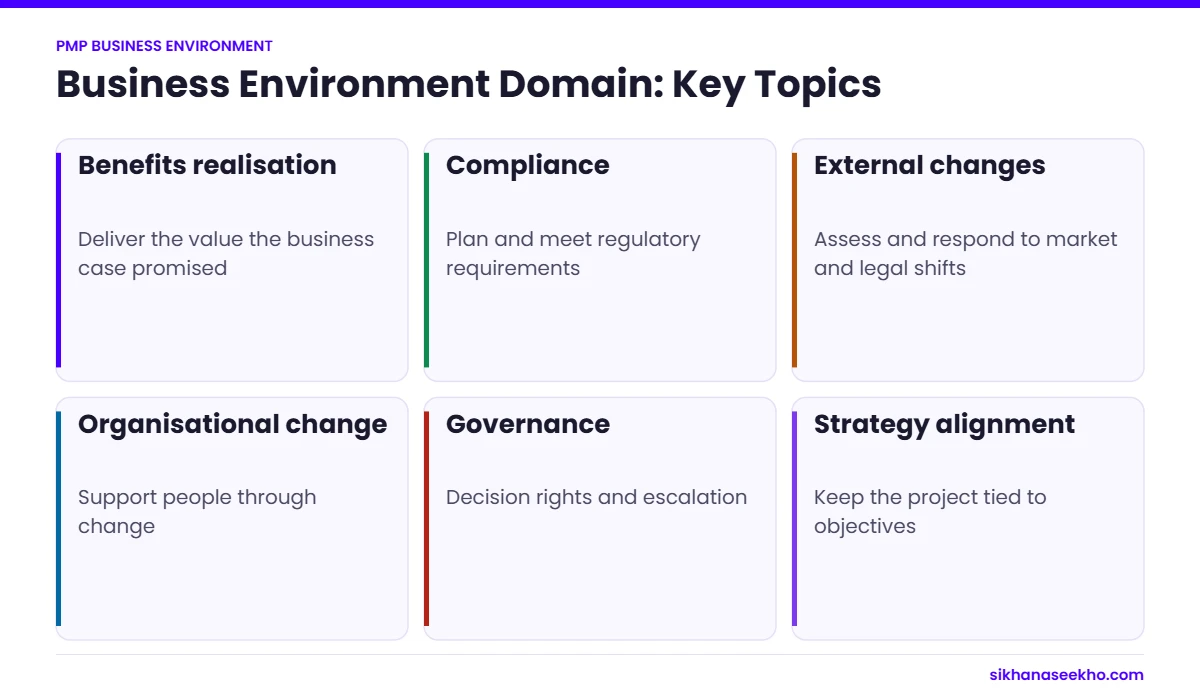
The Business Environment domain covers how projects connect to organisational strategy and deliver genuine business value: benefits realisation, compliance, governance, organisational change management and strategic alignment. It accounted for 8% of the old exam (approximately 14 questions) and has been 26% since the exam changed on 9 July 2026 (approximately 44 scored questions), making it the second-largest domain. Most candidates historically under-prepare here because 14 questions seemed manageable. Under the 2026 ECO, treating this domain as an afterthought will cost you roughly 44 questions. The domain is largely logic-based: understanding the underlying principle that projects exist to deliver business value, not just outputs: is more useful than memorisation.
✦
From my experience: The Business Environment domain is the smallest part of the exam, but I see my students lose easy marks here. It connects the project to the organisation's goals, which is exactly what sponsors cared about on my UAE projects.
Major change: Business Environment tripled in July 2026
The Business Environment domain increased from 8% to 26% of the PMP exam on 9 July 2026. New topics including AI in project management and sustainability are introduced. The four core tasks below come from the previous ECO and still sit at the heart of this domain. If your exam is on or after 9 July: prepare using the expanded content and significantly increase your study time on this domain. Both versions are covered in this guide.
8%
old ECO weighting (−14 questions)
26%
ECO weighting since July 2026 (−44 questions)
4 core tasks in this domain
3×
the domain tripled in size under the new ECO
Of the three PMP exam domains, Business Environment has historically been the easiest to overlook. With only 8% weighting, roughly 14 questions out of 175, many candidates allocate minimal study time here and focus their energy on the large People and Process domains.
The July 2026 exam update changed this calculation entirely. Business Environment tripled to 26%: nearly 44 questions. A candidate who prepares with pre-2026 material will face approximately 30 additional Business Environment questions they did not study for. That alone is enough to fail.
But there is good news: this domain is more intuitive than the others. It does not require formula memorisation like the Process domain or the counter-intuitive instinct reversal the People domain demands. Its core logic is straightforward: every project exists to deliver organisational value, and the PM must keep that purpose front and centre across the entire lifecycle.
Current ECO vs New July 2026 ECO: What Changes for This Domain
Current ECO: Until 8 July 2026
8%
≈14 questions out of 175 scored
Four tasks: plan and manage project compliance, evaluate and deliver project benefits, evaluate and address external business environment changes, support organisational change. Relatively narrow scope: focused on compliance and benefits.
New ECO: From 9 July 2026
26%
≈44 questions out of 170 scored
Expanded task set with new topics: AI in project management, sustainability and ESG in project delivery, data-driven decision making, governance and risk at portfolio level, and deeper coverage of benefits realisation and organisational change. Aligned with PMBOK 8.
The shift reflects PMI's view that project managers are no longer tactical delivery managers. They are strategic business partners who understand how projects contribute to organisational outcomes. A PM who only manages the triangle (scope, time, cost) without understanding business context, governance requirements and value delivery is not operating at the level the certification now tests.
Business Environment is 26% of the July 2026 PMP exam.
02 · The Core ECO Tasks
Business Environment Domain Tasks: The Core Four
The previous ECO defined four tasks within the Business Environment domain. They remain the foundation of the domain in the 2026 exam, which adds the new topics below.
Task 1
Plan and manage project compliance
Confirm project compliance requirements (legal, environmental, regulatory, organisational standards). Classify the compliance categories. Determine potential threats to compliance. Use methods to support compliance. Analyse the consequences of non-compliance. Determine the necessary approach and action to address compliance needs. Measure the extent to which the project is in compliance.
Task 2
Evaluate and deliver project benefits and value
Investigate that benefits are identified. Document the agreement on ownership for ongoing benefit realisation. Verify that the project is producing the benefits that were agreed to. Confirm the benefit measurement system is in place. Evaluate the delivery options to demonstrate value. Appraise stakeholders of the value gain progress.
Task 3
Evaluate and address external business environment changes
Survey changes to the external business environment. Assess and prioritise the impact on project scope or backlog based on changes in the business environment. Recommend options for adapting to the changes. Continually review the external business environment for impacts on the project.
Task 4
Support organisational change
Assess organisational culture. Evaluate the impact of the project on the organisation and determine required actions. Evaluate the impact of organisational change on the project and determine required actions. Address the readiness of the organisation for project outputs.
03 · Benefits Realisation
Benefits Realisation: The Core Concept of This Domain
Benefits realisation is the most frequently tested Business Environment topic. The fundamental insight is this: a project can be delivered on time, within budget and to scope, and still be a failure if the intended business benefits are not realised. The PM is not just accountable for delivering outputs. They are accountable for setting up the conditions for the business to realise value from those outputs.
Benefits are almost always realised after the project closes, when the business actually uses the delivered product or capability. The PM's role is to ensure a benefits realisation framework exists from project initiation onwards and is handed to the business owner at closure.
✦
Initiation
Identify and document expected benefits
The business case defines the expected benefits: financial (ROI, cost savings) and non-financial (customer satisfaction, staff retention, regulatory compliance). Benefits must be specific, measurable and time-bound. "Improved efficiency" is not a benefit: "reduce processing time by 30% within 6 months of go-live" is.
✦
Planning
Establish a benefits realisation plan
The benefits realisation plan defines how and when each benefit will be measured, who owns measurement, what the baseline is (current state before the project), and what KPIs will indicate benefit delivery. This plan is created during planning, not at project closure.
✦
Execution and Monitoring
Track benefit delivery indicators during the project
Some benefits can be tracked during the project, for example, if the project is reducing defect rates, measuring defects during testing gives an early signal. The PM monitors leading indicators of benefit realisation throughout delivery, not just at closure.
✦
Closure
Hand off benefits realisation ownership to the business
At project closure, the PM hands the benefits realisation plan to a named business owner who is responsible for measuring and reporting benefit delivery post-project. The PM confirms this ownership is accepted. Without a named owner, benefits realisation typically does not happen.
✦
Post-Project
Business owner measures and reports benefits
After the project closes, the business owner tracks the KPIs defined in the benefits realisation plan. Benefits reviews (often at 3, 6 and 12 months post-closure) assess whether expected benefits are being realised and identify any corrective actions needed.
✦
The most common exam trap in this area: A question describes a project that was delivered on time and to scope, but the sponsor reports that benefits were not realised months after closure. The question asks what the PM should have done differently. The correct answer almost always involves establishing a benefits realisation plan during initiation and handing it to a named business owner at closure, not extending the project or adding more features.
04 · Compliance
Compliance: What Task 1 Actually Tests
Compliance questions test whether you understand that projects operate within a web of requirements that are non-negotiable: regulatory, legal, contractual, organisational and industry standards. The PM must identify all compliance requirements upfront, monitor compliance throughout and address non-compliance immediately.
Types of Compliance Requirements
Regulatory: government legislation and regulations (data protection, health and safety, financial reporting)
Legal / contractual: requirements defined in contracts with clients, vendors or partners
Environmental: environmental standards and permits for projects with physical impact
Organisational: internal policies, standards and governance frameworks
Industry standards: ISO standards, sector-specific frameworks (e.g. NHS standards, building codes)
The PM's Compliance Responsibilities
Identify all applicable compliance requirements during initiation and planning
Include compliance activities in the project schedule and budget
Monitor compliance continuously throughout delivery
Address compliance gaps immediately: do not defer
Escalate regulatory non-compliance appropriately, the PM does not hide compliance issues
Document compliance status for governance reporting
Consequences of Non-Compliance
Legal penalties, fines or sanctions
Project shutdown or suspension
Reputational damage to the organisation
Contract termination
Harm to end users or the public
PMI's view: compliance is non-negotiable. The PM must never compromise compliance for schedule or cost. If meeting a compliance requirement costs more or takes longer, that is a constraint to be managed, not a reason to skip compliance.
Exam Pattern for Compliance Questions
A scenario describes a compliance issue being discovered, usually mid-project. The question asks what the PM should do. The correct answer always involves:
Addressing the compliance gap immediately
Escalating to the appropriate authority
Never hiding or deferring a compliance issue
Accepting schedule or cost impact as necessary
05 · Organisational Change
Supporting Organisational Change: Task 4
Projects deliver change. A new system, a new process, a new product: all of these require the people who use them to change how they work. The PM is responsible for ensuring the organisation is ready to absorb that change. This is not the same as managing project changes (which is a Process domain topic). Organisational change management is about helping people adapt to project outcomes.
1
Assess organisational readiness
Before delivery, assess how ready the organisation is for the change the project will introduce. Who is affected? What is their current understanding? What resistance is likely? What is the organisational change capacity?
2
Develop a transition and adoption plan
Plan communications, training and support activities that will help affected stakeholders understand and adopt the new way of working. The plan should address the specific concerns and barriers identified in the readiness assessment.
3
Engage change champions and sponsors
Identify key influencers within the affected organisation who can help communicate the benefits of the change and model the new behaviours. The project sponsor plays a critical role in visible change leadership.
4
Deliver training, communications and support
Execute the transition plan: training, communications, user documentation, helpdesk support. Monitor adoption rates and address issues as they emerge. Adjust the plan based on feedback and observed adoption.
5
Sustain the change post-delivery
Handover to operations with clear support plans. Monitor that the change is being sustained after the project team leaves. Ensure that new ways of working are embedded, not abandoned when the pressure of go-live passes.
06 · New Topics from July 2026
New Topics in the July 2026 ECO: What to Study
Since 9 July 2026, the following topics have been part of the expanded Business Environment domain. They reflect PMI's view of how the PM role is evolving.
New topic: July 2026
AI in Project Management
Using AI tools for scheduling (automated critical path updates), risk prediction (pattern-based risk identification), resource optimisation (AI-driven capacity planning) and reporting (automated status dashboards). Managing human-AI collaboration, when to trust AI outputs and when human judgement is required. Ethical considerations in AI-assisted PM decision making.
New topic: July 2026
Sustainability and ESG
Incorporating environmental, social and governance (ESG) factors into project planning and delivery. Environmental impact assessment, carbon footprint of project activities, social value and community impact, and governance transparency. PMI's view: sustainability is not optional CSR. It is a dimension of project success that must be planned and measured.
New topic: July 2026
Data-Driven Decision Making
Using analytics, dashboards and KPIs to make evidence-based PM decisions rather than relying on intuition or authority. Interpreting data from project monitoring tools to assess performance, predict outcomes and identify risks. Understanding the limitations of data and when qualitative judgement supplements quantitative data.
Expanded: July 2026
Portfolio Governance and Risk
Understanding how individual projects sit within a portfolio and programme context. Portfolio-level risk tolerance and how it flows down to project-level risk appetite. Governance frameworks for project approval, funding decisions and strategic alignment reviews. How projects are prioritised and de-prioritised within a portfolio.
✦
How to study the new July 2026 topics: The AI and sustainability topics are conceptual, the exam will not test technical AI knowledge, but will test PM decision-making in AI-assisted environments (when to use AI tools, how to manage AI recommendations, ethical considerations). For sustainability, focus on how ESG factors are incorporated into project planning: scope definition, stakeholder analysis and success metrics. Use AI-powered practice question tools (ChatGPT, Claude) to simulate questions on these new areas if your course materials do not yet cover them.
07 · External Environment Changes
Evaluating and Addressing External Business Environment Changes: Task 3
Projects do not operate in isolation. The external environment: market conditions, regulatory changes, competitive landscape, technology shifts, economic conditions: can change during a project and require the PM to assess the impact and adapt.
Task 3 tests your ability to recognise when an external change affects the project and take appropriate action. Key concepts:
PESTLE analysis: Political, Economic, Social, Technological, Legal and Environmental factors that can affect project viability or approach
Market changes: If a competitor launches a similar product during the project, the business case may need reassessment, the project may need to accelerate, pivot or be cancelled
Regulatory changes: New legislation mid-project requires immediate compliance assessment and potentially a change request to modify scope
Technology shifts: A new technology becoming available during the project may offer a better solution, the PM should assess whether adopting it is in the project's interest
Economic conditions: Budget freezes, inflation, supply chain disruptions: all require reassessment of the project's cost and feasibility
The exam pattern: A scenario describes an external change (new regulation, market shift, technology announcement). The question asks what the PM should do. The correct answer involves assessing the impact on the project, informing relevant stakeholders and recommending options, not ignoring the change or assuming it does not affect the project.
08 · Practice Questions
10 Business Environment Domain Practice Questions
These questions cover all four core tasks plus three questions on the new July 2026 topics. Attempt each before revealing the answer.
Business Environment Domain: 10 Practice Questions
Click "Show Answer" after choosing your response. Read all four option explanations.
Question 01
A project was delivered on time and within budget. All planned deliverables were accepted by the client at closure. However, eight months later, the project sponsor reports that the business has not achieved the cost savings the project was intended to deliver. What should the project manager have done differently?
A. Extended the project duration to monitor benefit realisation before closing the project.
B. Delivered additional functionality beyond the agreed scope to increase the likelihood of benefit realisation.
C. Established a benefits realisation plan during initiation that defined how cost savings would be measured, and transferred ownership of the plan to a named business owner at closure.
D. Included benefit realisation KPIs in the project status report during execution.
Correct Answer: C
Why C: Task 2 (Evaluate and deliver project benefits): benefits realisation requires both a plan (how will benefits be measured and when) and an owner (who is responsible for measuring them after the project closes). If neither exists at closure, benefits will almost certainly not be tracked. Why not A: Extending the project does not cause benefits to be realised: benefits come from business adoption and use of the deliverables, not from the project continuing. Why not B: Gold plating (delivering beyond scope) is always wrong in PMI's view and does not address the root cause. There was no benefits measurement framework. Why not D: Reporting KPIs during execution is helpful but not the root cause fix: without a post-project benefits realisation plan and named owner, KPIs disappear at project closure.
Question 02
Midway through a construction project, new environmental regulations come into force that require additional site survey work before certain activities can continue. The regulations take effect in 30 days. What should the project manager do first?
A. Continue with the planned activities since the regulations have not yet come into force.
B. Halt all project work immediately until the surveys are completed.
C. Assess the impact of the new compliance requirement on the project schedule, cost and risk; raise a change request; and inform the sponsor and relevant stakeholders.
D. Negotiate with the regulatory authority to delay the compliance date until after the project is complete.
Correct Answer: C
Why C: Tasks 1 and 3 (Compliance and external environment changes): new regulatory requirements are non-negotiable compliance obligations. The PM must assess the impact (schedule delay for survey work, additional cost) and follow change control to update the project plan. Stakeholders, including the sponsor, must be informed. Why not A: Continuing activities that will not comply with forthcoming regulations ignores the PM's compliance responsibility, the 30-day window is finite and planning must start immediately. Why not B: Halting all project work immediately is disproportionate, the regulations have a 30-day transition period. Halting all work without assessment is poor project management. Why not D: Attempting to negotiate a compliance delay with a regulatory authority is not within the PM's remit and is unlikely to succeed. Regulatory compliance is not negotiable.
Question 03
A technology project is nearing completion when a competitor launches a similar product with significantly more advanced features. Several key stakeholders are now questioning whether the project will still deliver competitive business value. What should the project manager do?
A. Continue delivering the planned project as the scope and business case were agreed at initiation.
B. Add the advanced features identified in the competitor's product to the project scope to remain competitive.
C. Reassess the business case in light of the market change, present the findings to the sponsor and relevant governance body, and recommend options including continuing, pivoting or closing the project.
D. Accelerate the project delivery to go to market before the competitor's advantage grows further.
Correct Answer: C
Why C: Task 3 (Evaluate and address external business environment changes), when the external environment changes in a way that affects the project's business case, the PM must assess the impact and present options to governance. The project exists to deliver business value: if market conditions have changed such that the original business case no longer holds, the sponsor and governance must be informed and make a decision. Why not A: Continuing to deliver a project whose business case has been undermined by market changes, without informing governance, is a failure of the PM's responsibility to the business. Why not B: Adding competitor features without a change request and business case review is scope creep and does not address whether the project still makes business sense. Why not D: Accelerating delivery is one possible option, but it cannot be decided by the PM alone. It must be assessed and recommended to governance, not unilaterally executed.
Question 04
A project team discovers that a third-party vendor supplying critical data processing services does not comply with the organisation's data privacy regulations. This creates a legal compliance risk for the project. The project delivery date is in 6 weeks. What should the project manager do?
A. Continue with the vendor and resolve the compliance issue after the project is delivered.
B. Remove the third-party vendor's services from the project to eliminate the compliance risk entirely.
C. Escalate the compliance risk to the sponsor and legal counsel immediately, assess options to address the gap, and do not proceed with live data processing until the compliance issue is resolved.
D. Document the compliance risk in the risk register and monitor it as a high-priority risk.
Correct Answer: C
Why C: Task 1 (Plan and manage project compliance), a legal compliance risk involving data privacy is not something the PM can manage alone or defer. Immediate escalation to the sponsor and legal counsel is required. PMI's position is unequivocal: the PM must never sacrifice compliance for schedule. Why not A: Proceeding with a known legal compliance violation is never acceptable, the PM has an ethical and professional obligation to address compliance issues, not defer them until delivery. Why not B: Removing the vendor unilaterally without assessment is a significant scope decision that requires proper change control and governance. It may also not be practically possible in 6 weeks. Why not D: Documenting it in the risk register and monitoring is insufficient for an active legal compliance issue. This is not a hypothetical risk but a confirmed compliance gap requiring immediate action.
Question 05
A project is implementing a new HR self-service system. The system has been delivered and accepted, and the project is closing. Post-implementation surveys show that only 30% of employees are using the system, the other 70% are still using the old manual process. What does this indicate and what should have been done?
A. The project was successful: system delivery was the objective, and the system was delivered on time.
B. The project failed to deliver all required features: additional development is needed to drive adoption.
C. The project lacked an adequate organisational change management plan: without structured change support, adoption was insufficient to realise the intended benefits.
D. The benefits realisation plan should now be initiated to address the adoption gap.
Correct Answer: C
Why C: Task 4 (Support organisational change), a 30% adoption rate for a system that replaces a manual process is a clear organisational change management failure. Delivering a system that people do not use does not realise benefits. Change management activities, communications, training, user support and change champions, should have been planned and executed to drive adoption. Why not A: The project's purpose was to deliver business value through HR efficiency, not just to deliver a system. If 70% of employees are not using the system, the business value has not been realised. Delivery of the system is a necessary but not sufficient condition for success. Why not B: Low adoption is usually a change management issue, not a feature gap. Adding features rarely fixes adoption problems, the root cause is that people were not adequately supported through the transition. Why not D: Initiating a benefits realisation plan at closure is too late. It should have been established at project initiation. Initiating it now to address an adoption problem is a reactive measure that does not address the root cause.
Question 06
At project initiation, the business case identifies that the project will deliver $2 million in annual cost savings by reducing manual processing. The project manager is creating the project management plan. Which artifact should the project manager establish to ensure these benefits are tracked and realised?
A. A risk register entry tracking the risk that benefits may not be realised.
B. A change log to track any modifications to the expected benefit amount during the project.
C. A benefits realisation plan defining how and when the $2 million saving will be measured, the baseline for comparison, and who is responsible for measuring it after project closure.
D. An issue log entry noting that benefits have not yet been realised.
Correct Answer: C
Why C: Task 2 (Evaluate and deliver project benefits), the benefits realisation plan is the specific artifact created to ensure expected benefits are tracked and realised. It defines the measurement approach, baseline, KPIs, timeline and ownership. It is created during planning, not after benefits fail to materialise. Why not A: A risk register entry acknowledges the risk of non-realisation but does not create a framework for ensuring realisation. Risk management is not a substitute for benefits planning. Why not B: A change log tracks changes to project baselines. It is not designed to track benefit realisation performance. Why not D: An issue log entry at initiation is inappropriate, the benefits have not been realised yet because the project has not started. An issue log records current confirmed problems, not anticipated future outcomes.
Question 07
An organisation is implementing a major ERP system. The project manager assesses that several senior managers are resistant to the new system because it will change long-established workflows and reduce their informal authority over data access. Which approach is most appropriate?
A. Proceed with implementation and allow time for managers to adapt to the change after go-live.
B. Redesign the system to retain the managers' existing data access privileges to reduce resistance.
C. Engage the resistant managers to understand their specific concerns, involve them in the solution design where possible, and enlist visible executive sponsorship to signal the importance of the change.
D. Escalate the resistance to HR and request formal authority to enforce compliance with the new system.
Correct Answer: C
Why C: Task 4 (Support organisational change): resistance from influential stakeholders is a predictable change management challenge. The PM's response combines understanding (engaging to hear concerns), involving (giving them a stake in the solution) and sponsorship alignment (getting executive visibility to demonstrate the change is supported at the top). This is the classic change management approach. Why not A: Proceeding without addressing resistance from senior managers risks the change being undermined post-go-live. Senior managers who are resistant to a system can actively discourage its adoption in their teams. Why not B: Redesigning the system to preserve the very behaviours the project is meant to change does not deliver the business case. It accommodates resistance at the cost of project value. Why not D: Escalating to HR to force compliance is a coercive approach that will deepen resentment, not build adoption. PMI never favours forcing as a change management strategy.
Question 08: July 2026 ECO Topic
A project manager is using an AI-powered scheduling tool that automatically recalculates the critical path when tasks are updated. The tool's algorithm recommends crashing a particular activity by 3 days, claiming this will save the project $15,000. The project manager notices that the activity is not on the critical path. What should the project manager do?
A. Accept the AI recommendation, the tool has access to more data than the PM and is likely correct.
B. Reject the AI recommendation and report it as a system error to the tool vendor.
C. Override the AI recommendation: crashing a non-critical-path activity does not shorten the project duration and wastes cost. Investigate why the tool made an incorrect recommendation.
D. Implement the recommendation on a trial basis for one week to test whether it delivers the projected savings.
Correct Answer: C
Why C: AI in project management (July 2026 ECO): AI tools assist PM decision-making but do not replace PM judgement. Schedule compression on non-critical-path activities does not shorten the project end date. This is a fundamental CPM principle. The PM must apply their PM knowledge to evaluate AI recommendations critically, not accept them blindly. Investigating the error helps improve the tool's accuracy. Why not A: Accepting AI recommendations without critical evaluation is a failure of PM judgement. AI tools can produce incorrect recommendations, especially when their algorithms do not fully account for the specific project context. Why not B: Reporting a "system error" immediately is premature, the PM should first understand whether the error is in the algorithm or in how the project data was entered. Why not D: Implementing a recommendation known to be incorrect "on a trial basis" wastes project budget and time with no basis for expectation of success.
Question 09: July 2026 ECO Topic
During project planning for a new warehouse facility, the project manager identifies that the lowest-cost construction option would involve clearing protected woodland. The procurement team argues this is legal in the jurisdiction and within budget. What should the project manager do?
A. Proceed with the lowest-cost option. It meets legal requirements and is within the approved budget.
B. Raise the environmental concern with the sponsor but accept their decision without further escalation.
C. Evaluate the environmental and reputational impact, identify alternative solutions that achieve the project goals without clearing the protected woodland, and present the options to the sponsor for an informed decision.
D. Halt the project until the environmental impact can be fully assessed: construction should not proceed until full certainty exists.
Correct Answer: C
Why C: Sustainability (July 2026 ECO): PMI's view is that project success includes environmental and social responsibility, not just legal compliance. "Legal" is a minimum threshold, not the definition of the right decision. The PM has a responsibility to identify and present the full range of options, including their environmental and reputational implications, so the sponsor can make an informed decision. Why not A: Legal compliance is necessary but not sufficient. Proceeding with an action that destroys protected woodland without evaluating alternatives fails the PM's environmental responsibility, even if it is technically legal. Why not B: Raising the concern but deferring entirely to the sponsor without providing alternatives abdicates the PM's responsibility to present options and recommendations. Why not D: Halting the project entirely without a timeline or clear path forward is not a productive response to an identified concern, the PM should identify and present alternatives, not stop everything indefinitely.
Question 10
A project has been running for 8 months. A portfolio review reveals that the organisation's strategic priorities have shifted significantly, the product the project is building is no longer aligned with the new direction. The project is 60% complete and has spent $800,000 of a $1.2 million budget. What should the project manager do?
A. Continue delivering the project: $800,000 has already been spent and stopping now would waste that investment.
B. Complete the remaining 40% of the project as quickly as possible to minimise further waste.
C. Present the strategic misalignment to the sponsor and governance board with an analysis of the options, including continuing, pivoting the project scope to align with the new strategy, or closing the project, and allow the governance body to decide.
D. Pivot the project scope to align with the new strategic direction and continue delivery.
Correct Answer: C
Why C: Tasks 2 and 3 (Benefits delivery and external environment changes), when a project's strategic alignment changes, this is a governance-level decision that requires escalation to the sponsor and governance board. The PM's role is to present the situation, quantify the options and make a recommendation, not to unilaterally continue or stop the project. Why not A: This is the sunk cost fallacy, the $800,000 already spent is not a valid reason to continue a project that no longer delivers business value. PMI's position is that projects should be continued only if they still justify their future investment, not because of past spending. Why not B: Completing quickly to "minimise waste" still spends $400,000 on a product that no longer aligns with strategy. This is not minimising waste, it is compounding it. Why not D: Pivoting the project scope unilaterally is a major decision that requires governance approval. The PM cannot redirect the project without stakeholder and sponsor agreement through a formal change process.
Complete All Three Domain Guides
You have now covered all three PMP exam domains in depth. Test yourself across all domains with the free practice question bank: 200 questions with full explanations.
The Business Environment domain tests how project managers connect their projects to organisational strategy and ensure genuine business value is delivered. It covers four core areas: compliance management (regulatory, legal, contractual requirements), benefits realisation (ensuring the project delivers its intended business outcomes), responding to external business environment changes (market shifts, regulatory changes, competitive landscape), and supporting organisational change management (helping people adopt the project's outputs). From July 2026, the domain expands significantly to include AI in project management, sustainability and ESG, data-driven decision making and portfolio governance.
The increase reflects PMI's view that the project manager's role has evolved from tactical delivery management to strategic business partnership. Traditional PM focused on the triple constraint: delivering scope on time and within budget. The modern PM is expected to understand organisational strategy, governance, compliance, benefits delivery and increasingly AI-driven tools and sustainability considerations. PMI's thought leadership research found that project success is increasingly defined by stakeholder value and desired outcomes rather than just schedule, cost and scope adherence. The expanded Business Environment domain reflects this shift: PMP holders are expected to be strategic contributors, not just delivery mechanics.
Benefits realisation is the process of ensuring that the business outcomes a project was initiated to deliver are actually achieved and measured. A project benefit is a measurable improvement resulting from the project, for example, cost savings, revenue increase, customer satisfaction improvement, risk reduction or regulatory compliance. Benefits are typically realised after project closure, when the delivered product or capability is being used by the business. The PM's responsibility is to establish a benefits realisation plan during initiation (defining what benefits will be measured, how and when), monitor benefit delivery indicators during execution, and hand off ownership of the benefits realisation plan to a named business owner at closure.
For the July 2026 exam, increase your Business Environment study allocation from roughly 15% to 25–30% of your total study time. The new topics to add are: AI in project management (focus on the PM's role in using AI tools thoughtfully and critically, not the technical details of AI), sustainability and ESG in project delivery (how environmental and social factors are incorporated into project planning and success measurement), data-driven decision making (using analytics and dashboards for PM decisions), and expanded portfolio governance content. The PMI Examination Content Outline for July 2026 is available free on PMI's website: reading it carefully is the most targeted way to understand exactly what the expanded domain covers. Use updated exam prep course materials that cover PMBOK 8 content if your exam is after 9 July.
Project change management (a Process domain topic) refers to the formal process for managing changes to project baselines: scope, schedule and cost changes that go through change control and the Change Control Board. Organisational change management (a Business Environment domain topic) refers to the people-focused activities that help an organisation's employees understand, accept and adopt the changes that a project introduces. When a project delivers a new system, process or product, the affected employees must change how they work: organisational change management encompasses communications, training, stakeholder engagement and change champion activity to support that adoption. A project can successfully deliver all its outputs through rigorous project change management while completely failing at organisational change management: resulting in a product that was delivered but not adopted, and therefore not realising its intended benefits.

Pingback: AI in Project Management 2026: Threat or Opportunity?
Pingback: PMP People Domain 2026: Tasks and Practice Questions
Pingback: PMP Process Domain 2026: Tasks and Practice Questions