The Process domain is the largest domain on the PMP exam: 41% of the exam since 9 July 2026 (approximately 70 scored questions), down from 50% on the old exam. It covers the technical mechanics of managing project delivery: scope, schedule, cost, quality, risk, communications and procurement across predictive, Agile and hybrid approaches. The most important shift in the current exam is that Process questions are no longer purely predictive: roughly half involve Agile or hybrid delivery scenarios. Candidates who prepare only on PMBOK waterfall content will face 40+ Process questions they are unprepared for.
✦
From my experience: The Process domain is where my engineering and construction background helps my students most, because it covers the planning and control work I did every day in the UAE. Work through the practice questions below and read every explanation.
50%
old ECO weighting (−88 questions)
41%
ECO weighting since July 2026 (−70 questions)
17
tasks defined in the ECO for this domain
50%
of Process questions involve Agile or hybrid delivery
The Process domain is where most of the traditional PMBOK knowledge lives: scope, schedule, cost, risk, quality, communications, procurement. These are the topics that PM textbooks have covered for decades. But the current PMP exam does not test the Process domain the way candidates expect.
The exam does not ask you to recite PMBOK 6 process inputs and outputs. It does not ask you to list the steps of the Perform Qualitative Risk Analysis process. What it does ask is: given a realistic project scenario, what would an effective, ethical project manager do next? And critically, the scenario might be Agile, predictive or hybrid.
This guide covers all 17 Process domain tasks, the key technical concepts tested (EVM, risk response strategies, change control, Agile delivery mechanics), and 10 practice questions that reflect the actual exam's mix of predictive and Agile scenarios.
The ECO defines 17 tasks within the Process domain. Every Process question maps to one of these tasks. The tasks span the full project lifecycle from initiation through execution, monitoring and closure.
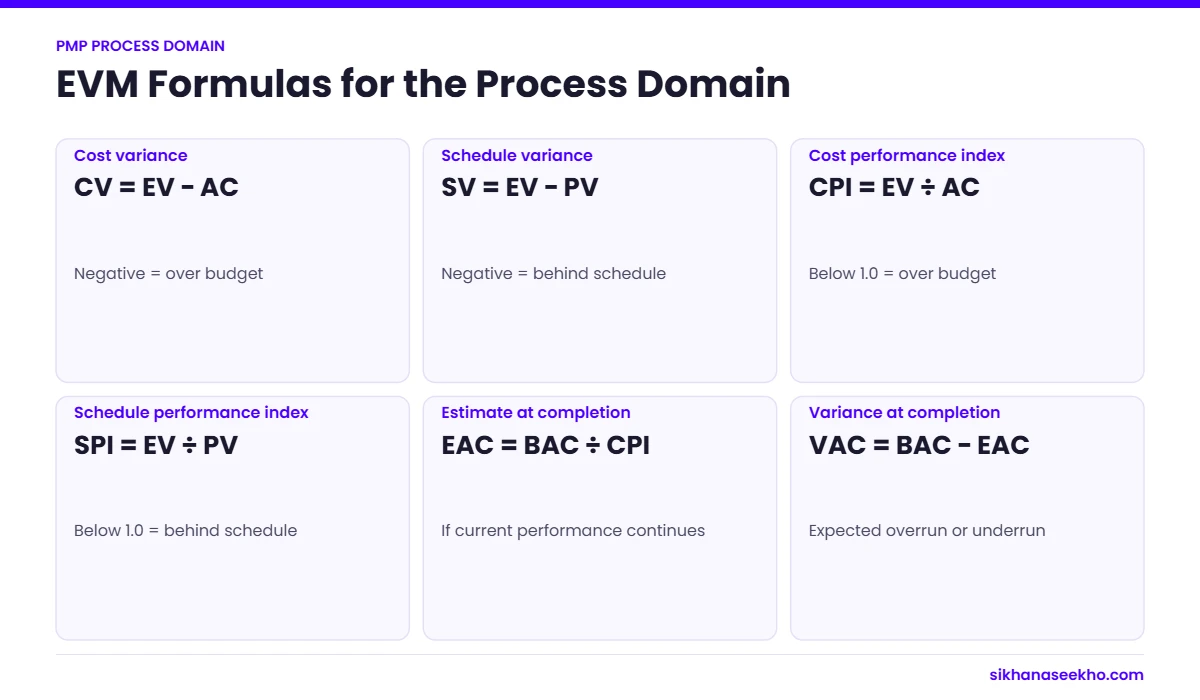
The EVM formulas you need for the Process domain.
Task 1
Execute project with the urgency required to deliver business value
Assess opportunities to deliver value incrementally. Examine the business value throughout the project. Support the team to subdivide project tasks as necessary to find the minimum viable product.
Task 2
Manage communications
Analyse communication needs of all stakeholders. Determine communication methods, channels, frequency and level of detail. Communicate project information and updates effectively. Confirm that information is understood and received.
Task 3
Assess and manage risks
Determine risk management options, iteratively assess and prioritise risks, develop a risk response plan. Continuously monitor and reassess risks throughout the project. Understand the impact of risks on project value.
Task 4
Engage stakeholders
Analyse stakeholders and determine the best way to ensure their engagement. Categorise stakeholders, develop and execute a stakeholder engagement plan. Monitor stakeholder engagement and adjust strategies as needed.
Task 5
Plan and manage budget and resources
Estimate budgetary needs based on scope and lessons learned. Anticipate future budget challenges. Monitor budget variations and work with governance. Plan and manage resources based on project requirements.
Task 6
Plan and manage schedule
Estimate project tasks and determine the critical path. Develop a schedule based on methodology. Maintain schedule by prioritising tasks and continuing to update the plan. Coordinate work with other projects and operations.
Task 7
Plan and manage quality of products and deliverables
Determine quality standard required for project deliverables. Recommend options for improvement based on quality gaps. Continually survey project deliverable quality and maintain focus on continuous improvement.
Task 8
Plan and manage scope
Determine and prioritise requirements. Break down scope. Monitor and validate scope. Apply the change control process to prevent scope creep and manage approved changes.
Task 9
Integrate project planning activities
Consolidate the project or phase plans. Assess consolidated project plans for dependencies, gaps and continued business value. Analyse data collected. Collect and analyse data to make informed project decisions.
Task 10
Manage project changes
Anticipate and embrace the need for change. Determine the strategy for handling change. Execute the change management strategy according to the methodology. Determine a change response to move the project forward.
Task 11
Plan and manage procurement
Define resource requirements and needs. Communicate resource requirements. Manage suppliers and contracts. Plan and manage procurement strategy. Develop a delivery solution.
Task 12
Manage project artefacts
Determine the requirements for managing the project artefacts. Validate that the project information is kept up to date (version control, access management). Continually assess the effectiveness of the artefact management.
Task 13
Determine appropriate project methodology / methods and practices
Assess project needs, complexity and magnitude. Recommend project execution strategy. Use iterative, incremental practices where applicable based on the project and team needs.
Task 14
Establish project governance structure
Determine appropriate governance for a project. Define escalation paths and thresholds. Determine governance cadence and appropriate reporting cadence. Confirm project governance is understood by all relevant parties.
Task 15
Manage project issues
Recognise when a risk has become an issue. Attack the issue with the optimal action to achieve project success. Collaborate with relevant stakeholders on the approach to resolve issues.
Task 16
Ensure knowledge transfer for project continuity
Discuss project responsibilities within the team. Outline expectations for working environment. Confirm approach for knowledge transfers. Capture lessons learned throughout the project.
Task 17
Plan and manage project and phase closure or transitions
Determine criteria to successfully close the project. Validate readiness for transition. Conclude activities to close out the project or phase. Obtain final acceptance of the project deliverables from relevant stakeholders.
02 · Hybrid Delivery
The Hybrid Delivery Imperative: Why It Dominates Process Questions
The single most important thing to understand about the Process domain in 2026 is that it is not a purely predictive domain. The exam consistently presents hybrid scenarios, projects that blend Agile and waterfall approaches, and tests whether you know which approach to apply to which situation.
Predictive (Waterfall)
Use when requirements are stable and known upfront
Detailed project plan created at the start
Scope baseline, schedule baseline, cost baseline
Formal change control (CCB)
WBS-driven task decomposition
EVM for performance monitoring
Sequential phase gates
Agile / Iterative
Use when requirements evolve or value is uncertain
Product backlog with iterative prioritisation
Sprint-based delivery (2–4 week iterations)
Change welcomed through backlog refinement
Velocity, burndown and CFD for tracking
Retrospectives for continuous improvement
Definition of Done gates quality
Hybrid
Use when project has both stable and evolving elements
Predictive governance, Agile execution
Fixed milestones, iterative delivery within them
Formal reporting, self-organising teams
Risk register + Agile risk backlog
Project charter + product backlog
Most common real-world PM environment
✦
The hybrid exam pattern: The exam often describes a project that has elements of both approaches and asks what the PM should do. The correct answer identifies which element of the work is best served by which approach, not picking one methodology and applying it everywhere. A common pattern: formal executive reporting (predictive) combined with iterative sprint delivery (Agile) is not a contradiction. It is correct hybrid practice.
Task 13: Choosing the Right Methodology
Task 13 (Determine appropriate methodology) is one of the highest-frequency tasks in the Process domain. The exam tests the decision logic for methodology selection. The key variables are requirements stability, delivery urgency, team experience, stakeholder tolerance for uncertainty and organisational standards. Here is the core decision pattern:
Evolving requirements, iterative value delivery, innovative product Agile
Stable governance environment with complex, fast-changing delivery hybrid
Regulatory or compliance-driven project with fixed deliverables predictive
Product development in a competitive market with unclear customer needs Agile
03 · Earned Value Management
EVM Formulas: The Complete Reference
EVM calculation questions appear in the Process domain and are among the most predictable question types on the exam: if you know the formulas, you will get them right. There are typically 5–10 EVM questions on the exam. Every formula must be recalled from memory.
All EVM formulas: memorise every one
Planned Value (PV)
PV = Budgeted cost of work scheduled
What you planned to spend by this date
Earned Value (EV)
EV = % complete × BAC
Budgeted value of work actually done
Actual Cost (AC)
AC = Actual cost incurred
What you actually spent: given directly in questions
Cost Variance (CV)
CV = EV − AC
Negative = over budget. Positive = under budget.
Schedule Variance (SV)
SV = EV − PV
Negative = behind schedule. Positive = ahead.
Cost Performance Index (CPI)
CPI = EV ÷ AC
Below 1.0 = over budget. Above 1.0 = under budget.
Schedule Performance Index (SPI)
SPI = EV ÷ PV
Below 1.0 = behind schedule. Above 1.0 = ahead.
EAC (typical: using CPI trend)
EAC = BAC ÷ CPI
Forecast final cost if current CPI continues
EAC (original estimate valid)
EAC = AC + BAC − EV
Forecast final cost if remaining work goes to plan
Estimate to Complete (ETC)
ETC = EAC − AC
How much more the project will cost to complete
Variance at Completion (VAC)
VAC = BAC − EAC
Negative = over budget at completion. Positive = under.
TCPI (to-complete performance index)
TCPI = (BAC − EV) ÷ (BAC − AC)
CPI needed on remaining work to finish on budget. Above 1.0 = must improve.
Use the free EVM calculator to practice with your own numbers. The full formula guide with worked examples is in the EVM Guide.
04 · Risk Management
Risk Response Strategies: Threats and Opportunities
Risk response questions are consistently high-frequency in the Process domain. The exam tests your ability to identify the correct response strategy for a given scenario. There are four strategies for threats and four for opportunities: all eight must be known.
Strategy
Type
What It Means
Use When
Avoid
Threat
Eliminate the threat by changing the project plan: removing the cause entirely
The threat has very high probability or impact and is intolerable
Transfer
Threat
Shift the financial impact to a third party: insurance, fixed-price contracts, warranties
The threat is financial and can be contractually shifted. It is not eliminated, only ownership changes
Mitigate
Threat
Reduce the probability or impact of the threat: take early action to make it less likely or less harmful
The threat cannot be avoided but its probability or impact can be reduced
Accept
Threat
Acknowledge the risk and take no proactive action: passive (do nothing) or active (contingency reserve)
The threat is low priority or the cost of response outweighs the benefit
Exploit
Opportunity
Ensure the opportunity definitely occurs: take action to make it happen with certainty
The opportunity is highly valuable and you want to guarantee it is realised
Share
Opportunity
Allocate ownership of the opportunity to a third party best placed to capture it: joint venture, partnership
Another party is better positioned to realise the opportunity than the project team alone
Enhance
Opportunity
Increase the probability or impact of the opportunity: take action to make it more likely or more valuable
The opportunity exists but has not yet materialised. You want to improve its chances
Accept
Opportunity
Acknowledge the opportunity but take no action to pursue it: passive acceptance
The opportunity is low priority or the cost of pursuit outweighs the benefit
Exam pattern for risk questions: A scenario describes a risk situation. You must identify whether it is a threat or an opportunity, then select the appropriate response strategy based on the context. Common traps: confusing Transfer with Avoid (transfer shifts ownership, avoid eliminates the risk entirely), and confusing Mitigate with Avoid (mitigate reduces probability/impact, avoid eliminates the cause).
05 · Change Control
Integrated Change Control: The Golden Rule
Change control questions are the most consistent pattern in the Process domain. The exam will describe a stakeholder requesting a change, a scope addition being discovered, or a delivery shortcut being proposed, and ask what the PM should do. The answer follows a predictable logic.
1
Never agree to or reject a change immediately
The PM cannot approve changes to scope, schedule or cost without assessment. Agreeing immediately is scope creep. Refusing immediately ignores the stakeholder's legitimate need.
2
Assess the impact on all three constraints
Every change request must be evaluated for its impact on scope, schedule and cost, plus quality, risk and resources. The PM documents this assessment before taking any other action.
3
Submit through the formal change control process
A change request is raised and submitted to the Change Control Board (CCB) or equivalent approval authority. The PM documents the change, impact assessment and recommended action.
4
Implement only approved changes
Once approved, implement the change and update all affected project documents: baselines, project management plan, schedule, budget, risk register and stakeholder register as needed.
5
Communicate the outcome to all affected stakeholders
Whether approved or rejected, the stakeholder who requested the change receives a clear, documented response explaining the decision and the rationale.
The change control exam rule: The correct answer to any change control question is the step that comes next in the process above. If a change request has just arrived: assess the impact. If an impact has been assessed: submit to CCB. If CCB has approved: implement and update the plan. The exam tests your ability to identify where you are in the process and what the next correct step is.
Change control in Agile: In Agile, changes are welcomed through the product backlog, the Product Owner prioritises new requirements, and the team addresses them in a future sprint. The formal CCB process is not used within Agile sprints, but governance reporting and budget changes may still require formal approval in a hybrid environment.
06 · Other Key Concepts
Other High-Frequency Process Domain Concepts
Communications Channels Formula
Formula: n(n−1)/2 where n = number of stakeholders. As teams grow, communication complexity grows non-linearly. A team of 5 = 10 channels. A team of 10 = 45 channels. A team of 20 = 190 channels. The exam tests both the formula calculation and the implication: adding one person to a large team dramatically increases communication complexity.
Quality: QA vs QC
Quality Assurance (QA) is process-focused: auditing the PM processes being used to ensure they will produce quality outputs. It is proactive and happens during the project. Quality Control (QC) is output-focused: inspecting actual deliverables against quality standards. It is reactive and happens after work is done. Gold plating (adding extra features beyond agreed scope) is always wrong in PMI's view. It consumes resources without approved business value.
Critical Path and Float
The critical path is the longest sequence of dependent tasks. It determines the minimum project duration. Tasks on the critical path have zero total float. Delaying a critical path task delays the project end date by the same amount. Non-critical tasks have positive float, the amount of time they can slip without delaying the project end date. See the Critical Path Method guide and the forward and backward pass guide for full calculation walkthroughs.
Schedule Compression
Crashing: Add resources to critical path tasks to shorten the schedule: increases cost. Fast tracking: Overlap tasks that were originally sequential: increases risk. Both techniques are applied to critical path tasks only (adding resources to non-critical tasks wastes money without shortening the project). When asked how to shorten a schedule while controlling cost increase: crashing with the lowest crash cost per day first.
Agile Delivery Mechanics
Sprint velocity: average story points completed per sprint: used to forecast how many sprints are needed to clear the backlog. Burndown chart: shows remaining work declining over a sprint. Definition of Done: the criteria that must be met for a backlog item to be considered complete, not negotiable mid-sprint. Backlog refinement: ongoing process of adding detail, estimates and acceptance criteria to backlog items before they enter a sprint.
Issue vs Risk vs Change
These three are frequently confused on the exam. A risk is an uncertain future event that may affect the project: tracked in the risk register. An issue is a confirmed problem that is currently affecting the project: tracked in the issue log. A change request is a formal request to modify a project baseline: tracked in the change log. When a risk materialises (i.e. it occurs), it becomes an issue. When resolving an issue requires modifying a baseline, a change request is raised.
07 · Practice Questions
10 Process Domain Practice Questions
These questions reflect the exam's mix of predictive, Agile and hybrid scenarios. Attempt each before revealing the answer.
Process Domain: 10 Practice Questions
Click "Show Answer" after choosing your response. Read all four option explanations.
Question 01
A project has a BAC of $240,000. At the status date, 60% of the work has been completed and $160,000 has been spent. What is the Cost Performance Index (CPI) and what does it indicate?
A. CPI = 1.07: the project is slightly under budget.
B. CPI = 0.90, the project is over budget, receiving only $0.90 of value for every $1.00 spent.
C. CPI = 0.67: the project is significantly behind schedule.
D. CPI = 1.50: the project is significantly under budget.
Correct Answer: B
Calculation: EV = 60% × $240,000 = $144,000. AC = $160,000. CPI = EV ÷ AC = $144,000 ÷ $160,000 = 0.90. A CPI below 1.0 means the project is over budget. You are getting less value than you are spending. Why not A: CPI of 1.07 would require EV > AC, the project would have to be under budget, which is not the case here. Why not C: CPI measures cost efficiency, not schedule performance, the 0.67 figure (EV ÷ BAC = 60%) has no EVM meaning as stated. Schedule performance is measured by SPI. Why not D: CPI of 1.50 would mean EV substantially exceeds AC: again, not the case here.
Question 02
A project sponsor calls the project manager and verbally requests the addition of a new reporting module to the system being developed. The sponsor says it is urgent and should be started immediately. What should the project manager do first?
A. Add the reporting module to the current sprint backlog since the sponsor has authority to direct changes.
B. Refuse the request, the scope is baselined and no changes are permitted without a formal process.
C. Assess the impact of the requested change on scope, schedule, cost and risk, then submit a formal change request through the change control process.
D. Implement the change immediately and document it in the change log after the fact.
Correct Answer: C
Why C: Task 10 (Manage project changes), the golden rule of change control is to assess impact before agreeing or refusing, then submit through the formal process. Even a sponsor cannot direct unilateral scope changes outside of change control on a baselined project. Why not A: Adding to the sprint backlog without change control bypasses the formal process and is scope creep, even with sponsor authority. Why not B: Refusing outright without assessment is also wrong, the correct action is to assess and submit, not to refuse. Why not D: Implementing first and documenting after is a serious process violation. It bypasses impact assessment, CCB approval and baseline update.
Question 03
A software development project team is using Agile delivery. During sprint planning, the team realises they have more capacity than usual because a complex technical dependency was resolved early. The Product Owner is not available for the meeting. What should happen?
A. The project manager should select additional backlog items for the sprint based on priority.
B. The team should proceed with the originally planned sprint scope only and report the excess capacity to the PM.
C. Sprint planning should be rescheduled or postponed until the Product Owner is available, as they are responsible for prioritising and selecting backlog items.
D. The Scrum Master should select the additional backlog items on behalf of the Product Owner.
Correct Answer: C
Why C: In Scrum, the Product Owner is responsible for the product backlog: prioritising items and deciding what work has the most value. Sprint planning requires the Product Owner's participation. If the PO is unavailable, the ceremony should be postponed until they can attend, not replaced by the PM or Scrum Master making scope decisions. Why not A: The project manager does not own backlog priorities in Agile, the Product Owner does. The PM cannot substitute for the PO's role. Why not B: Proceeding with only the planned scope when there is additional capacity wastes the team's potential to deliver more value. Why not D: The Scrum Master's role is facilitation and process, not product ownership decisions. The Scrum Master cannot prioritise the backlog on the PO's behalf.
Question 04
A risk identified at project initiation has now occurred. The risk response plan included a contingency budget of $25,000 for this specific risk. The actual impact costs $18,000 to resolve. What is the most accurate description of what has happened?
A. The risk has been transferred to a third party who absorbed the $18,000 cost.
B. The risk has materialised and become an issue; the contingency reserve is being used and $7,000 remains.
C. A change request should be raised for the $18,000 as it was not in the original budget.
D. The project has experienced a cost overrun that must be reported as a variance.
Correct Answer: B
Why B: When a risk occurs it becomes an issue. The contingency reserve was specifically set aside for this known risk, so using $18,000 of the $25,000 contingency is the correct, planned action, not a variance or an overrun. $7,000 contingency remains for this risk. Why not A: Nothing about transferring risk to a third party is described: transfer means contractually shifting financial impact to another party via insurance or a contract. Why not C: A change request is not needed, the contingency was part of the approved project budget specifically for this scenario. Using contingency reserve is not a budget change, it is executing the approved risk response. Why not D: A cost overrun would occur if spending exceeded the approved budget including contingency. Using $18,000 of a $25,000 contingency reserve is entirely within the plan. It is not an overrun.
Question 05
A project is 40% complete. The BAC is $500,000 and the CPI is 0.80. The project manager needs to forecast the Estimate at Completion (EAC) assuming current performance trends continue. What is the EAC?
A. $400,000
B. $500,000
C. $625,000
D. $560,000
Correct Answer: C
Calculation: "Assuming current performance trends continue" means use EAC = BAC ÷ CPI = $500,000 ÷ 0.80 = $625,000. The project is currently over budget (CPI 0.80) and if that continues, the final cost will be $125,000 over the original BAC. Why not A: $400,000 = 0.80 × BAC. This is a misapplication that would mean the project ends under budget, which contradicts a CPI below 1.0. Why not B: $500,000 = BAC. This would only be correct if CPI = 1.0 (exactly on budget), which it is not. Why not D: $560,000 appears to add 12% to BAC, which has no basis in the given EVM formula.
Question 06
A project team is evaluating whether to use a predictive, Agile or hybrid approach for a new enterprise software implementation. The project has fixed regulatory compliance requirements that cannot change, but the user interface and workflow features are still being defined through customer feedback sessions. Which approach is most appropriate?
A. Predictive: all regulatory and user requirements should be fully defined before development begins.
B. Agile, the evolving user requirements require full Agile flexibility throughout the project.
C. Hybrid, use a predictive approach for the compliance requirements (fixed scope) and Agile for the user interface (evolving requirements).
D. Agile, the compliance requirements can be managed as high-priority backlog items.
Correct Answer: C
Why C: Task 13 (Determine appropriate methodology). This is a textbook hybrid scenario. Fixed regulatory compliance requirements (known, non-negotiable scope) are best managed predictively with formal documentation and change control. Evolving UI and workflow features (requirements being discovered iteratively through feedback) are best managed with Agile. A hybrid approach applies the right methodology to each workstream. Why not A: Waiting to fully define user interface requirements before starting is impractical when requirements are still being discovered. This would delay the project significantly and likely produce poor user outcomes. Why not B: Managing fixed regulatory compliance requirements through a purely Agile backlog risks those requirements being de-prioritised in favour of user features: compliance is not optional. Why not D: Same problem as B: treating fixed compliance requirements as backlog items that compete with other features does not reflect their mandatory, non-negotiable nature.
Question 07
A project team is working on a critical deliverable and discovers a technical issue that will take three days to resolve. The deliverable is on the critical path and the project already has no schedule float. What is the best course of action?
A. Request a project extension from the sponsor to absorb the three-day delay.
B. Remove the deliverable from the project scope to maintain the schedule baseline.
C. Assess schedule compression options (crashing or fast tracking) for critical path tasks, evaluate their cost and risk implications, and present options to the sponsor for a decision.
D. Instruct the team to work overtime to recover the three days without changing the project plan.
Correct Answer: C
Why C: Tasks 6 and 9 (Plan and manage schedule, Integrate project planning), when a critical path task is delayed, the PM should assess all available options, quantify the cost and risk of each, and present them to the sponsor for a decision. Schedule compression techniques (crashing, add resources, or fast tracking, overlap tasks) are the standard tools. The sponsor needs to decide whether to approve additional cost, accept additional risk, or accept the schedule slip. Why not A: Requesting an extension is one possible outcome, but the PM should present options, not jump to requesting an extension without first evaluating whether schedule recovery is possible. Why not B: Removing a deliverable from scope is a major scope change that requires formal change control and sponsor approval, the PM cannot unilaterally remove scope. Why not D: Overtime may be part of a crashing option, but "without changing the project plan" is the problem. The plan must be updated to reflect any approved recovery action.
Question 08
A vendor identifies that a key component they are supplying could be delayed by 4 weeks due to manufacturing issues. This risk had been identified at project initiation and the response strategy was to order the component 6 weeks early. The early order has already been placed. What type of risk response was planned?
A. Transfer: the financial risk was shifted to the vendor.
B. Avoid: the risk was eliminated by choosing a different vendor.
C. Mitigate, the probability of the delay impacting the project was reduced by ordering early.
D. Accept: no action was taken to address the risk.
Correct Answer: C
Why C: Mitigation reduces the probability or impact of a threat. Ordering 6 weeks early reduces the probability that a 4-week manufacturing delay will impact the project. There is now a 2-week buffer. The risk has not been eliminated (avoid) or shifted (transfer). It has been made less likely to cause harm. Why not A: Transfer involves shifting the financial impact to a third party through insurance or a contract: nothing about the financial risk being contractually shifted to the vendor is described. Why not B: Avoid would mean eliminating the risk entirely, for example, redesigning the project to not need that component. The component is still being used; the risk still exists but is reduced. Why not D: Accepting means taking no proactive action: ordering 6 weeks early is clearly a proactive action, not acceptance.
Question 09
During a sprint retrospective, the team identifies that a recurring integration testing bottleneck is slowing velocity. This same bottleneck was raised at the previous two retrospectives but has not been resolved. What should the Scrum Master do?
A. Document the bottleneck again in the retrospective notes and add it to the next sprint's improvement backlog item.
B. Assign a team member to resolve the bottleneck independently between sprints.
C. Escalate the impediment using organisational influence to resolve it, since three retrospectives have not resolved it, external action is needed to remove the systemic blocker.
D. Reduce the sprint velocity target to accommodate the recurring bottleneck.
Correct Answer: C
Why C: Task 15 (Manage project issues), an impediment that has survived three retrospectives without resolution is clearly beyond the team's ability to fix internally. The Scrum Master's core responsibility is impediment removal. When an impediment cannot be resolved within the team, the Scrum Master must use their network and escalate to get it resolved externally. Continuing to document it without action is failing the team. Why not A: This is exactly what has happened three times already. It clearly does not work. Repeating the same action expecting different results is the definition of ineffective. Why not B: A systemic integration testing bottleneck is unlikely to be resolved by one team member working independently. It probably requires process or tooling changes that need organisational support. Why not D: Reducing velocity target accepts the bottleneck as permanent and gives up on resolving it, the Scrum Master's job is to remove impediments, not accommodate them.
Question 10
A project manager is planning communications for a project with 8 stakeholders. Three months into the project, 4 new stakeholders are identified and added to the project. How many additional communication channels were created by adding these 4 stakeholders?
A. 16 additional channels
B. 30 additional channels
C. 38 additional channels
D. 44 additional channels
Correct Answer: C
Calculation: Formula = n(n−1)/2. Original: 8 stakeholders → 8×7/2 = 28 channels. After adding 4: 12 stakeholders → 12×11/2 = 66 channels. Additional channels = 66 − 28 = 38. Why not A: 16 = 4 × 4, which incorrectly calculates only the channels between the 4 new stakeholders themselves. Each new stakeholder creates channels to all existing stakeholders, not just to each other. Why not B: 30 miscalculates the formula or uses incorrect values. Why not D: 44 comes from a miscalculation of the before and after totals. The correct method is to calculate total channels before and after, then find the difference.
Ready to Test All Three Domains?
The 200 free practice questions cover People, Process and Business Environment: all in PMP scenario format with full explanations. The EVM Calculator and full guides are also available free.
The Process domain tests the technical mechanics of managing project delivery: scope, schedule, cost, quality, risk, communications and procurement across predictive, Agile and hybrid approaches. It accounts for 41% of the PMP exam since July 2026 (about 70 scored questions), down from 50% on the old exam. Key areas include EVM calculations, risk response strategies, integrated change control, critical path and schedule compression, communications channels formula, quality management (QA vs QC), Agile delivery mechanics (sprints, backlog, velocity), and methodology selection (predictive vs Agile vs hybrid). Approximately half of Process domain questions involve Agile or hybrid scenarios, so candidates cannot prepare on predictive PMBOK content alone.
The PMP exam tests all core EVM formulas: EV = % complete × BAC; CV = EV − AC; SV = EV − PV; CPI = EV ÷ AC; SPI = EV ÷ PV; EAC = BAC ÷ CPI (when current trend continues); EAC = AC + BAC − EV (when original estimate is still valid); ETC = EAC − AC; VAC = BAC − EAC; TCPI = (BAC − EV) ÷ (BAC − AC). All of these must be recalled from memory during the exam. They cannot be looked up. The interpretation rules are: negative CV or CPI below 1.0 = over budget; negative SV or SPI below 1.0 = behind schedule. Practice calculating all formulas until they are automatic.
The correct response to any change request follows a consistent PMI pattern: (1) never agree to or refuse the change immediately. Always assess the impact first; (2) assess the impact on scope, schedule, cost and risk; (3) submit a formal change request through the change control process; (4) implement only approved changes and update all affected project documents; (5) communicate the outcome to the requesting stakeholder. The most common exam trap is an answer that says the PM agreed to implement the change immediately. This is always wrong. Even when the sponsor is requesting the change, formal change control must be followed on a baselined project.
Crashing and fast tracking are both schedule compression techniques applied to critical path tasks. Crashing adds resources to a critical path task to shorten its duration. This increases cost but maintains the original risk profile of the work. Fast tracking overlaps tasks that were originally planned sequentially. This does not add cost but increases risk because tasks are being done in parallel before their predecessors are complete. Both techniques are applied only to critical path tasks: compressing non-critical tasks does not shorten the project end date. When the exam asks how to shorten a schedule while minimising cost increase, the answer is crashing starting with the task that has the lowest crash cost per day. When cost increase is unacceptable, fast tracking is tried first.
In predictive project management, risks are formally identified, analysed (qualitatively and quantitatively), documented in a risk register and responded to with planned response strategies. Risk reviews happen at regular intervals. In Agile, risk is managed more continuously and informally: risks surface in daily standups, sprint retrospectives and backlog refinement sessions. The product backlog itself is a form of risk management (the highest-priority items are delivered first, reducing the risk of delivering low-value work). The risk register still exists in hybrid environments. It is updated more frequently and feeds into sprint planning decisions. The PMP exam tests both approaches and expects you to apply the right risk management style to the right project context.