The most effective way to study for the PMP exam is to replace passive reading with active recall: testing yourself on concepts rather than re-reading them. Most candidates spend 150–200 hours preparing over 10–16 weeks. The highest-leverage techniques are: active recall (self-testing, not re-reading), spaced repetition (reviewing material at increasing intervals), timed practice questions reviewed answer by answer with explanations, and time-blocked study sessions of 50–90 minutes with breaks. The biggest mistake most PMP candidates make is spending 80% of their time reading and 20% doing practice questions. It should be the reverse.
✦
From my experience: I have trained PMP students from more than 20 nationalities, and the pattern is the same everywhere: short, regular study sessions beat long weekend marathons. The schedule below is the one I give my own students.
150–200
typical hours of study needed to pass
80%
of study time should be active recall, not passive reading
50min
optimal focused study session before a break
200+
practice questions minimum before sitting the exam
Most PMP candidates study hard. They read PMBOK, watch video courses, highlight notes. Then they sit the exam and fail, not because they did not put in the hours, but because they studied the wrong way.
The PMP exam is not a memory test. You cannot pass it by reading PMBOK cover to cover and hoping the content sticks. It is a scenario-based judgement exam: 180 questions that test how you would respond to real project situations. That requires a completely different kind of preparation: understanding deeply, practising application and building the decision-making instinct the exam demands.
This guide is not about what to study: the PMP Study Guide covers the full 16-week content roadmap. This guide is about how to study: the techniques, habits, schedule and mindset that turn your study hours into exam readiness as efficiently as possible.
✦
Use this alongside the content roadmap: This guide tells you how to study: the techniques and schedule. The PMP Study Guide tells you what to study, the 16-week topic plan, PMBOK 7 breakdown, Agile content and exam strategy. Read both.
01 · How Many Hours
How Many Hours Does It Take to Study for the PMP Exam?
The honest answer: it depends heavily on your existing PM experience and background. PMI requires 36 hours of PM education as an eligibility prerequisite, but that is training, not exam preparation. Study time for the exam itself typically ranges from 150 to 300 hours depending on experience level.
Active recall and spaced repetition beat passive reading.
100–150
Experienced PM
10+ years PM experience, already familiar with PMBOK and Agile. Mainly needs exam technique and gap-filling.
150–200
Working PM: 3–10 years
Solid PM background but needs to learn PMBOK 7 structure, Agile frameworks and exam-specific scenario thinking.
200–300
Less experienced / career changer
Meeting the minimum experience requirements but PM is not your primary background. Needs full content study plus technique.
Spread over 12–16 weeks at 10–15 hours per week, 150–200 hours is very achievable without burning out. Trying to compress into 4–6 weeks of intensive study is possible but significantly increases the risk of fatigue affecting exam performance.
✦
The hidden variable: quality vs quantity: 200 hours of passive re-reading is worth far less than 120 hours of active recall and practice questions. Candidates who score well on the PMP are not always those who studied the most hours. They are those who used their hours in the right way. The rest of this guide is about making every hour count.
02 · Active Recall vs Passive Reading
Active Recall vs Passive Reading: The Most Important Distinction in PMP Study
Cognitive science research is unambiguous: active recall produces 2–3× better long-term retention than passive re-reading. Yet most PMP candidates spend 70–80% of their study time in passive mode. Understanding this distinction and flipping the ratio is the single biggest improvement most candidates can make.
✦ Passive Learning (Inefficient)
Re-reading PMBOK chapters or course notes
Watching video lectures without pausing to test yourself
Highlighting text while reading
Writing out notes while watching a video
Re-reading your own notes the night before
Reading through flashcards without covering the answer first
Feels productive. Provides familiarity, not retention. You recognise it when you see it but cannot recall it under pressure.
✦ Active Recall (High Retention)
Closing the book and writing everything you remember about a topic
Doing practice questions before reviewing the topic
Explaining a concept aloud as if teaching it (the Feynman technique)
Flashcard testing: cover the answer, attempt recall, then reveal
Self-quizzing after each study session
Writing the EVM formulas from memory, not from a reference sheet
Feels harder. Creates genuine recall pathways under exam conditions, the kind of memory that works when you are tired and stressed in a 4-hour exam.
How to Apply Active Recall to PMP Study
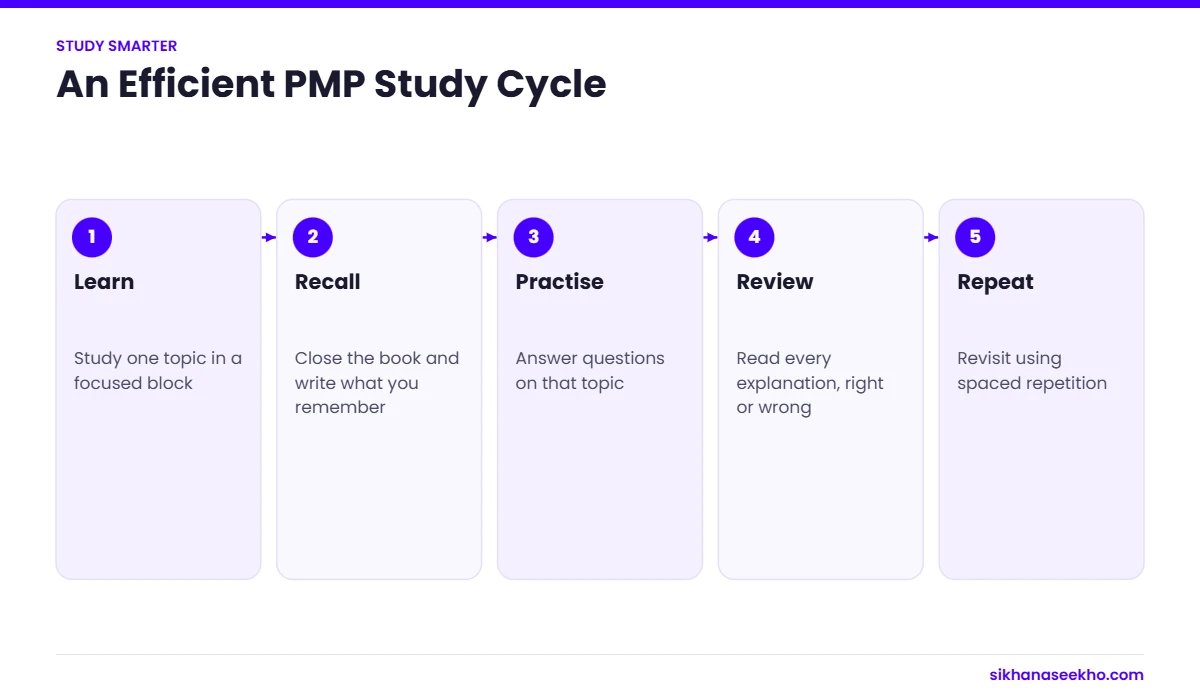
Here is the practical shift. After studying any PMBOK topic or exam domain, instead of moving straight to the next topic:
Close all materials
Write down everything you can remember about what you just studied: processes, artifact names, formulas, key principles
Open your notes and check what you missed
Highlight the gaps. Those are what need more attention, not the things you already recalled correctly
This retrieval practice takes an extra 10 minutes per session but produces dramatically better retention than spending the same 10 minutes re-reading the material.
03 · Spaced Repetition
Spaced Repetition: How to Make PMP Formulas and Concepts Stick
Spaced repetition is the practice of reviewing material at increasing intervals over time, rather than massing all review in a single session. It exploits the spacing effect: memories consolidated over multiple sessions are far more durable than memories formed in a single long session.
For PMP study, spaced repetition is particularly powerful for:
Agile ceremonies, roles and artefacts (Scrum, Kanban)
✦
Practical spaced repetition schedule for PMP formulas: Study the formulas on Day 1. Test yourself on Day 2 (the ones you got wrong go back to the front of the deck). Test again on Day 4. Then Day 7. Then Day 14. Then Day 28. By the time you sit the exam, a formula you first saw 10 weeks ago will be completely solid. Use Anki (free flashcard app with built-in spaced repetition algorithm) or simple handwritten formula cards, the method matters more than the tool.
04 · Weekly Study Schedule
Time-Blocked Weekly Study Schedule: 12 Hours per Week Template
Time-blocking means assigning specific types of study to specific time slots in advance, rather than sitting down and deciding what to do. It prevents the common trap of spending every session on the comfortable familiar content rather than the hard new material.
Here is a template for a 12-hour study week suitable for a working professional preparing over 14–16 weeks. Adjust session lengths up or down based on your available time.
Day
Session Type
Activity
Duration
Monday
New Content
Study new PMBOK 7 topic or ECO domain section. Watch video if using a course. Stop every 20 minutes to do a quick brain-dump recall test.
90 min
Tuesday
Active Recall
No new content. Close all notes. Write everything you remember from Monday's session. Check gaps. Add missed concepts to flashcard deck.
60 min
Wednesday
Practice Questions
20–30 timed scenario questions on this week's topic. Review every answer, right and wrong, with the explanation. Write down the rule behind each wrong answer.
90 min
Thursday
New Content
Study next PMBOK topic or Agile framework section. Same protocol: stop every 20 minutes to recall.
90 min
Friday
Flashcard Review
Spaced repetition flashcard session covering all cards due for review today (Anki handles scheduling automatically). Include EVM formulas regardless of whether they are due.
45 min
Saturday
Longer Practice Block
50-question timed practice exam (simulating exam conditions: no notes, timed). Review all wrong answers in depth. Identify which domain each wrong answer came from to spot pattern weaknesses.
2 hrs
Sunday
Weekly Review
Review the week's topics using only active recall: no notes open. Fill in gaps identified. Plan next week's content using the study guide roadmap. Update weak areas list.
60 min
Total: ~8 hrs core sessions + optional weekend catch-up. Scale up to 15 hrs/week by extending Monday and Thursday to 2 hrs each and Saturday to 3 hrs.
✦
The 50-minute Pomodoro rule for focus sessions: For any session longer than 60 minutes, use the Pomodoro technique: 50 minutes of focused study, then a 10-minute break away from the screen. Research consistently shows focus quality degrades significantly after 50–60 minutes without a break. Two 50-minute Pomodoros with a break beat one unbroken 100-minute session for retention every time. After 4 Pomodoros, take a 30-minute break.
05 to 5 Mistakes to Avoid
The 5 Most Common PMP Study Mistakes: and How to Fix Them
1
Reading PMBOK cover to cover as your primary study method
PMBOK is a reference guide, not a textbook. Reading it linearly produces very low retention and takes 40+ hours that would be better spent on practice questions and active recall. Many first-time failures spent weeks reading PMBOK and very little time doing questions.
Use PMBOK as a reference when a question or gap appears, not as your study backbone. Use a structured exam prep course (Andrew Ramdayal, Joseph Phillips) as the primary content source.
2
Doing practice questions without reviewing wrong answers
Doing 500 practice questions and only checking your score is almost worthless. The learning happens in the review: understanding exactly why the wrong answer was wrong and what rule or principle the question was testing. Candidates who spend 1 minute on each question and 3 minutes on each explanation outperform those who rush through.
Budget at least 2× the time for question review as for the questions themselves. Write the rule behind every wrong answer in a notebook.
3
Studying only PMBOK and ignoring Agile content
The current PMP exam is approximately 50% Agile and hybrid content. Candidates who prepare only on PMBOK predictive content face 90 questions they have barely studied for. The Agile Practice Guide, Scrum Guide and hybrid delivery frameworks are not optional extras. They are half the exam.
Dedicate at least 40% of your study time to Agile: Scrum roles, ceremonies, artefacts, Kanban, scaling frameworks, servant leadership and Agile values.
4
Memorising ITTOs from PMBOK 6 instead of understanding principles
The PMP exam no longer tests ITTO memorisation. The 2021 ECO update shifted to scenario-based questions that test judgement and decision-making. Candidates who spent weeks memorising every process input and output wasted study time that should have gone to understanding why decisions are made the way they are.
Focus on understanding the purpose and outcome of each process and knowledge area. Learn the key artifacts (risk register, stakeholder register, project charter etc.) and when each is relevant.
5
Sitting the exam too soon: before practice scores are consistently above 70%
Many candidates book the exam based on a date (e.g. "I will sit it in 12 weeks") rather than readiness indicators. If practice question scores are still below 70% with 2 weeks to go, sitting the exam on schedule is expensive overconfidence, the PMP retake fee is significant.
Treat exam readiness as score-based, not date-based. You are ready when you are consistently scoring 70%+ on full 180-question practice exams under timed conditions, not when the calendar says so.
06 · Using Practice Questions Correctly
How to Use PMP Practice Questions: The Right Way
Practice questions are the most powerful study tool available for the PMP exam, but only when used correctly. Most candidates use them the wrong way: they treat practice as a test of what they already know rather than a learning tool for what they do not.
1
Do timed practice, not casual browsing. Simulate exam conditions: 1 minute per question average. Time pressure is part of the exam and needs to be trained. Do not pause to look things up mid-practice.
2
Review every question: right and wrong. For correct answers: confirm you understood the reasoning, not just got lucky. For wrong answers: identify the exact rule you missed, not just "I need to study this more."
3
Track wrong answers by domain and topic. After every 50-question block, tally where your wrong answers came from. If 60% of mistakes are in the People domain. That is where your next study session should focus.
4
Learn the "PM thinking" behind the answer, not just the answer. PMP scenario questions almost always follow one pattern: the correct answer is the proactive, ethical, collaborative PM response. The wrong answers include ignoring the problem, escalating prematurely, making unilateral decisions or blaming others. Learn to recognise this pattern.
5
Build up to full 180-question mocks. Start with 20-question blocks in the first month. Build to 50-question blocks. In the final 4 weeks, do at least 3 full 180-question timed mock exams (4 hours each) to build stamina. Exam day fatigue is real.
6
Target 70%+ consistently before booking. A score of 70%+ on a quality 180-question mock (not an easy question bank) under timed conditions is the readiness threshold most PMP trainers recommend. If you are not consistently there, keep studying.
✦
Start with free questions: Our 200 free PMP practice questions cover all three ECO domains with full answer explanations. Use these for your early practice blocks before moving to a paid question bank for volume practice closer to exam day.
07 · Four Study Techniques That Work
Four Study Techniques Specifically Effective for the PMP Exam
✦
The Feynman Technique
Pick a concept (e.g. Earned Value Management, the Agile Manifesto, Risk Response strategies). Explain it aloud in plain English as if teaching a 12-year-old. Where you stumble or vague-out, that is a gap: go back and study that specific part more deeply.
Best for: complex PMBOK concepts, Agile frameworks, EVM interpretation
✦
Anki Flashcards with Spaced Repetition
Create one flashcard per formula, one per artifact name/definition, one per Agile ceremony. Anki's algorithm automatically schedules each card at the optimal interval for long-term retention. 15 minutes of Anki review per day from Week 1 produces remarkable formula recall by exam day.
Best for: EVM formulas, communication channels formula, artifact names
✦
Brain Dump Practice
At the start of the real exam, you get scratch paper. In the first 5 minutes before starting questions, write down every formula and framework you have memorised. This "brain dump" removes the cognitive load of keeping them in working memory during the 4-hour exam. Practise this ritual in your mock exams.
Best for: EVM formulas, channels formula, decision frameworks
✦
Role-Play as the PM in Scenarios
When reading a practice question scenario, pause before looking at the options. Ask yourself: what would an excellent, ethical, senior PM do here? Develop your own answer before reading the options. This builds genuine PM judgement rather than pattern-matching to answer choices.
Best for: scenario questions: People and Business Environment domains especially
08 · Handling PMBOK 7 and Agile Together
How to Study PMBOK 7 and Agile Together Without Getting Confused
The biggest source of confusion for 2026 PMP candidates is managing two overlapping frameworks simultaneously: PMBOK 7's principle-based model and the Agile/Scrum frameworks. They use different vocabulary, different mental models and sometimes seem to contradict each other.
The key insight is that the PMP exam does not ask you to choose between them. It asks you to apply the right framework to the right context. The exam will tell you whether the project is predictive, Agile or hybrid. Your job is to apply the correct thinking for that context.
Hybrid context: Think both, use Agile for the iterative delivery elements, PMBOK governance for the formal reporting and stakeholder management elements
✦
Study Agile as a mindset, not a methodology. The exam tests Agile values and principles, servant leadership, customer collaboration, responding to change, continuous improvement, as much as it tests Agile mechanics. Understanding the Agile Manifesto's four values and twelve principles deeply is more useful than memorising every Scrum ceremony detail. See our Complete Agile PM Guide and Scrum Guide for the full framework context.
Ready for the Content Roadmap?
Now you know how to study, the 16-week study guide tells you exactly what to study, in what order, week by week. Start with the free practice questions to benchmark where you are right now.
Most PMP candidates need 150–200 hours of exam preparation study beyond the 36 hours of required PM training. Experienced project managers with 10+ years of PM practice may pass with 100–150 hours. Those with less PM experience or a non-PM background typically need 200–300 hours. The quality of those hours matters more than the quantity: 150 hours of active recall, practice questions and focused review will outperform 250 hours of passive reading every time. At 12–15 hours per week, 150 hours takes 10–12 weeks of consistent preparation.
The most effective PMP study approach combines three elements: (1) Active recall: testing yourself on concepts rather than re-reading them, using the Feynman technique and flashcards; (2) Spaced repetition: reviewing formulas and concepts at increasing intervals using tools like Anki; and (3) Heavy practice question use: doing 500+ timed scenario questions with deep review of every wrong answer. The PMP is a scenario-based judgement exam, not a knowledge recall test. Candidates who spend 80% of study time on practice questions and active application consistently outperform those who spend most time reading.
Most PMP trainers recommend doing a minimum of 500–1,000 practice questions before sitting the exam, with at least 3 full 180-question timed mock exams in the final 4 weeks of preparation. The exact number matters less than your score. You are exam-ready when you consistently score 70%+ on full timed practice exams under conditions that simulate the real exam (no notes, no pausing, 4 hours continuous). Do not sit the real exam because you have done enough questions: sit it because your practice scores tell you that you are ready.
No: reading PMBOK cover to cover is not necessary and not the most effective use of study time. PMBOK is a reference guide, not a textbook. The most successful approach is to use a structured exam prep course as your primary content source (video-based courses from trainers like Andrew Ramdayal or Joseph Phillips are highly rated), use PMBOK as a reference when you need depth on a specific topic, and spend the majority of your time on practice questions and active recall rather than reading. The Agile Practice Guide is more important to read thoroughly than PMBOK itself for the current exam format.
The key is consistency over intensity. 10–12 hours per week spread across 5–6 days is more sustainable and produces better retention than trying to cram 30 hours into a weekend. Practical strategies include: early morning study sessions (30–60 minutes before work) when willpower is highest; using commute time for Anki flashcard review on a phone; treating Saturday as the main longer study block (2–3 hours); and protecting at least one full day off per week to avoid burnout. Plan for 14–16 weeks at this pace rather than trying to compress into 8 weeks, which risks fatigue and diminishing returns in the final stretch.
A consistent score of 70% or above on full 180-question timed practice exams (using a quality question bank, not an easy one) is the widely recommended readiness threshold among PMP trainers. The emphasis is on "consistent": one good score could be luck, but scoring 70%+ across three separate full mocks under timed conditions is a reliable indicator. Also check that your scores are balanced across all three ECO domains: if you are scoring 80% in Process but 55% in People, more targeted People domain study is needed before the real exam.
The most highly rated PMP exam prep courses in 2026 are Andrew Ramdayal's PMP course on Udemy (known for its scenario-based teaching approach that directly mirrors the exam format), Joseph Phillips' PMP course on Udemy (comprehensive coverage of both PMBOK and Agile content), and PrepCast by Oliver Lehmann (particularly strong on practice question volume and quality). All three are available at heavily discounted prices during Udemy sales. The PMI also offers official preparation resources including the PMBOK Guide (free for PMI members), the Agile Practice Guide and the PMI Learning platform.

Pingback: PMP People Domain 2026: Tasks and Practice Questions
Pingback: 38 ChatGPT and Claude Prompts for PMP Prep (2026)
Pingback: How to Pass the PMP Exam in 2 Weeks: 2026 Study Plan