Does PMP Certification Actually Help You Get a Job? Real Stories and a Job Search Plan
An honest look at PMP and hiring, real stories from people who got hired after certification, and a step by step plan to land your first project management role.
Quick Answer
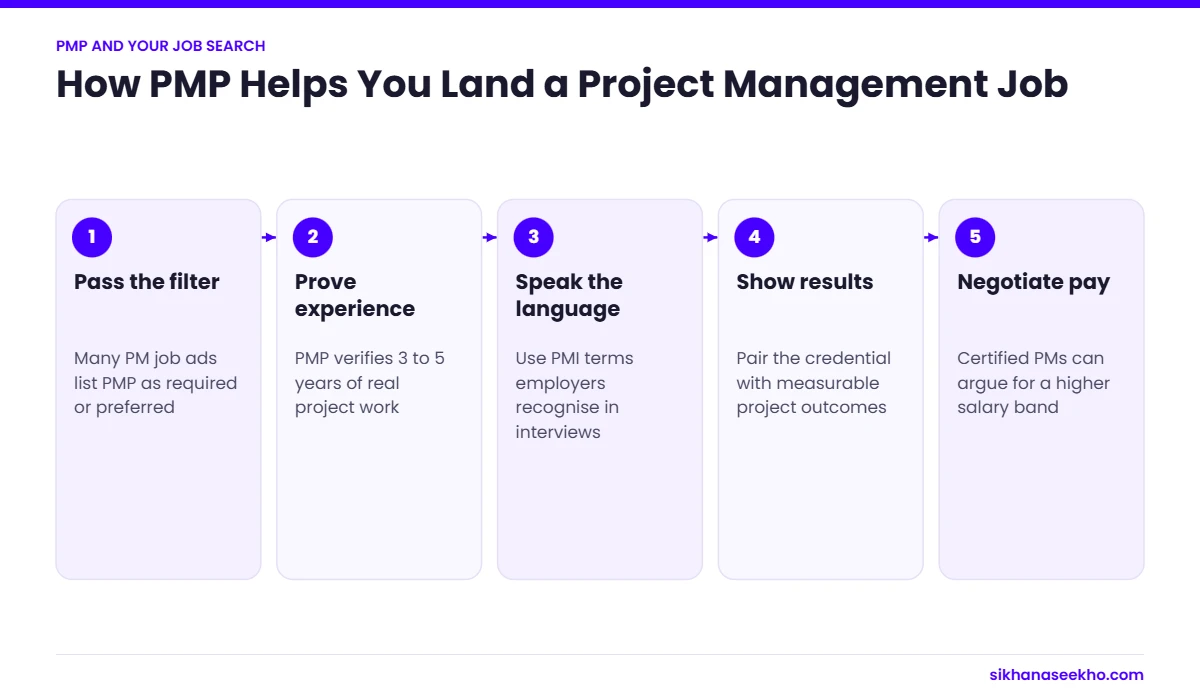
PMP certification does not guarantee a job by itself, but it clearly helps. It gets your resume past applicant tracking filters, it meets the "PMP preferred or required" line in many job posts, and it gives you the vocabulary to explain your experience in interviews. Your results depend on your starting point: people already doing PM work see the fastest gains, career switchers build credibility, and freshers usually need some real project exposure alongside PMP to convert it into a job.
On This Page
I get this question every week. Someone messages me on WhatsApp. They ask the same thing in different words.
"Sir, is PMP worth it?"
"Will I get a job after PMP?"
"Should I spend this much money on PMP certification?"
I understand the worry. The PMP exam fee is not small. Training cost adds more. Study time takes months. So before you spend your money, you want proof. You want to know the return on investment.
Below are the three questions I get asked the most about PMP and jobs. Simple words. Short sentences. Real stories. No fake promises.
01Does PMP Certification Actually Help You Get a Job?
Let me be honest with you first. PMP alone does not get you a job. No certificate does that. Not PMP. Not an MBA. Not even a degree from a big university.
But PMP does something else. It opens the door. It gets your resume noticed. It gets you the interview call.
Here is why that matters. Recruiters get hundreds of resumes for one project manager role. They cannot read every resume in detail. They scan first. They look for keywords. PMP is one of those keywords. When they see PMP on your resume, they stop scrolling. They read more.
Many companies now write "PMP preferred" or "PMP required" in their job posts. This is common in IT, construction, telecom, banking, and government projects. If you do not have PMP, some companies will not even shortlist you. I have seen this happen many times.
What PMP actually does for your job search
- It gets your resume past the first filter, including applicant tracking systems.
- It shows you know the standard PM language used worldwide.
- It proves you can commit to something hard and finish it.
- It gives you talking points in the interview.
That last point matters. When an interviewer asks about risk management or stakeholder communication, PMP gives you the right words to explain your experience. You sound more confident. You sound more professional.
02PMP Certification Worth It? Real Stories From People Who Got Hired
Numbers and theory are fine, but you want real stories. Here are patterns I have seen again and again in my years of training PMP students.
The IT coordinator who moved into project management
I have taught many students who worked as coordinators or business analysts. They were doing PM work already, but nobody called them "project manager." Their job title did not match their real work.
After PMP, this changed. One student updated her resume with PMP added and used PMI language to describe her daily work. Within two months, she got three interview calls and a formal Project Manager title with a salary jump. Her work did not change much. Her title and pay did.
The engineer who wanted to switch careers
Many engineers come to me wanting to move away from pure technical work and into leading projects instead. PMP gave one such student the confidence and vocabulary to make this switch.
He was a mechanical engineer for eight years. He got PMP certified and started applying for Project Engineer and Project Manager roles. He got rejected a few times first. That is normal. He kept applying. After four months, he landed a Project Manager role in a construction firm. His engineering background plus PMP made him a strong candidate.
The fresh graduate who struggled at first
I will not hide this from you. Not every story is smooth. Freshers with PMP and no real project experience often struggle more. Companies want PMP plus experience. PMP alone is a harder sell if you have never managed anything.
One fresh graduate got PMP right after his degree. He applied to many jobs and got few responses at first. What worked for him was different: he took a smaller role first, an assistant project coordinator job, and used that year to build real experience. Then he moved into a proper PM role using his PMP plus his hands on experience. It took longer, but it worked.
What these stories teach us: PMP helps different people in different ways. If you already have PM experience, PMP boosts your resume fast. If you are switching careers, PMP builds your credibility. If you are a fresher, PMP alone may not be enough, and some real project exposure first will help.
03How to Land Your First Project Management Job With PMP Certification
Now the part you came for. You have PMP, or you are planning to get it. Here is the exact strategy I give my students to turn that certificate into a job offer.
- Fix your resume first Do not wait until after the exam. Add PMP as "in progress" if you are still studying, then update it the moment you pass. Use PMI keywords such as stakeholder management, risk register, scope management, and project charter. Show results, not just duties: "led a team of 8 to deliver the project 2 weeks ahead of schedule" beats "managed a team."
- Target the right job titles Do not only search for "Project Manager." Also search for Project Coordinator, Assistant Project Manager, Project Analyst, PMO Analyst, Program Coordinator, and Junior Project Manager. These roles are easier to enter and let you grow into a full PM title.
- Use LinkedIn properly Add PMP to your LinkedIn headline, for example "Project Coordinator | PMP Certified." Recruiters filter LinkedIn searches by PMP. If it is not on your profile, you will not show up. Write a short post about your PMP journey to get visibility with recruiters watching the field.
- Prepare real answers, not textbook answers Do not just repeat PMBOK definitions in interviews. Prepare two or three stories from your own work and use them to answer questions about risk, conflict, communication, and deadlines. Even a small project can be told with confidence.
- Network inside PM communities Join local PM groups and PMI chapter events near you. Connect with other PMP holders on LinkedIn. Many jobs get filled through referrals before they are ever posted publicly.
- Be patient but consistent Job search can take one month or four months. Do not give up after a few rejections. Improve your resume and interview answers after every rejection. Small improvements add up fast.
PMP and Jobs: Frequently Asked Questions
Does PMP certification guarantee a job?
No. PMP does not guarantee a job on its own. It gets your resume past filters and gets you noticed, but you still need a strong resume, interview preparation, and real project experience to convert that attention into an offer.
Is PMP worth it if I am a fresher with no experience?
PMP alone is a harder sell for freshers because most PM roles ask for PMP plus experience. A common path is to take a Project Coordinator or Assistant PM role first, build real experience for a year, then move into a full PM role using PMP and that experience together.
How long does it take to get a job after PMP certification?
It varies by background. People already doing PM work under a different title sometimes see results within one to two months. Career switchers often take three to four months of consistent applying. Freshers may take a year of building experience before landing a formal PM title.
What job titles should I search for after getting PMP?
Search beyond "Project Manager." Also look for Project Coordinator, Assistant Project Manager, Project Analyst, PMO Analyst, Program Coordinator, and Junior Project Manager. These entry points are easier to land and lead naturally into a full PM role.
Do companies actually require PMP for project manager roles?
Many do. It is common to see "PMP preferred" or "PMP required" in job posts across IT, construction, telecom, banking, and government projects. Without PMP, some companies will not shortlist a candidate at all, especially for mid to senior PM roles.
Not sure if you qualify for the PMP exam yet?
Check your eligibility in 30 seconds. Education, experience hours, and training requirements, all checked instantly.
Check PMP Eligibility →