
APM PMQ or PMP, the right choice depends almost entirely on where you work and where you want to work. If you are building a career in the UK, particularly in infrastructure, defence, construction, rail, nuclear, or the public sector, the APM PMQ gives you the stronger credential with a clear pathway to Chartered Project Professional (ChPP) status, the highest professional recognition in UK project management. If you work for a US-headquartered multinational, in technology, or have international career ambitions beyond the UK, the PMP has significantly broader global recognition and is the de facto standard across most of the world outside the UK. If you are serious about project management as a long-term career, the honest answer is that you will likely want both. They complement each other and together make you competitive in almost any market.
- You work in UK infrastructure, defence, rail, nuclear or public sector
- You want a pathway to Chartered Project Professional (ChPP) status
- You value breadth of competency across all PM disciplines
- You are building a long-term career in the UK market
- Your organisation uses APM or has no mandated methodology
- You work for a US-headquartered company or a global multinational
- You are in technology, consulting, financial services or pharma
- You have international career ambitions (US, Middle East, Asia, Canada)
- You want the most globally recognised PM credential
- You have 3–5 years of documented project management experience
This is one of the most-asked questions in UK project management: should I do the APM PMQ or the PMP? The honest answer is that most comparison articles get this wrong. They compare the qualifications as if they were competing for the same audience when in fact they largely serve different markets, different career stages and different sectors.
The APM PMQ is the credential of the UK chartered professional body. The PMP is the credential of the world's largest PM professional body, based in the US. Both are rigorous. Both command genuine respect from employers. But they command that respect in different rooms.
This guide gives you the factual comparison across every dimension that matters for a career decision: eligibility requirements, exam format and difficulty, costs, employer recognition by sector and geography, salary data, and the specific scenarios where each qualification clearly outperforms the other. It also covers the growing case for pursuing both.
APM PMQ vs PMP: Complete Side-by-Side Comparison
| Factor | APM PMQ | PMP |
|---|---|---|
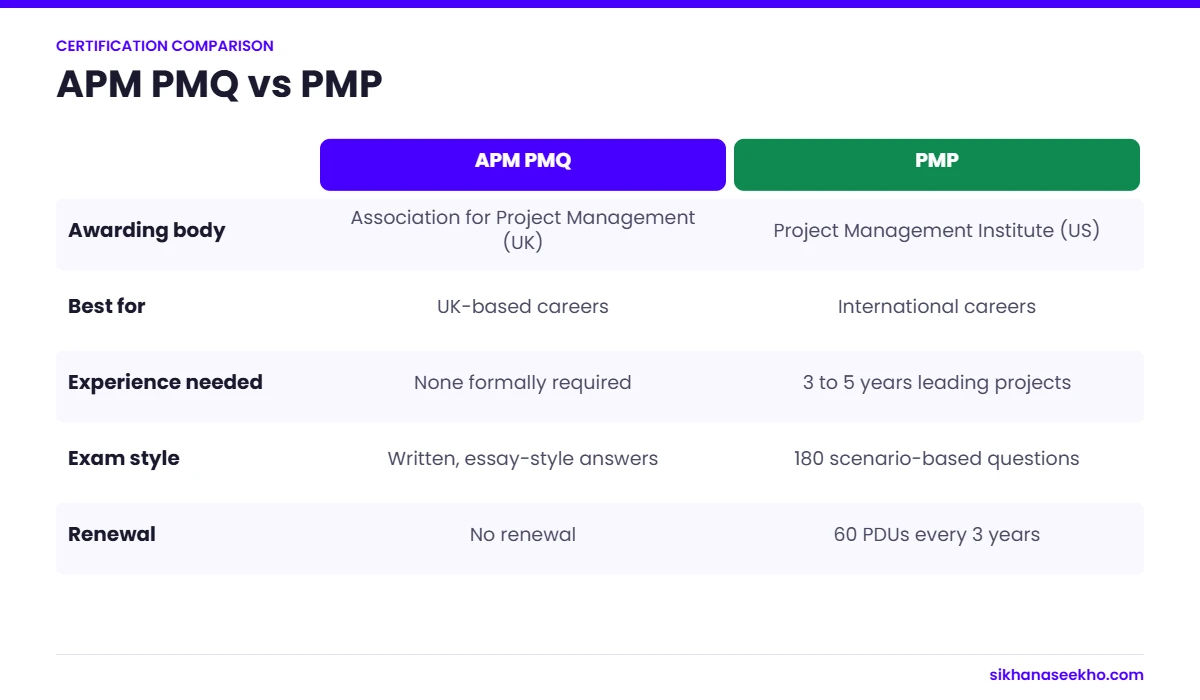
| Issuing body | Association for Project Management (APM), the only Chartered professional body for PM in the UK | Project Management Institute (PMI), the world's largest PM professional body, headquartered in the USA |
| Type of credential | Knowledge-based qualification (no experience requirement enforced) | Experience + knowledge certification (documented experience mandatory) |
| Experience required | 2–3 years recommended: not formally verified | 36 months leading projects (non-degree) or 60 months (no degree): formally documented and audited by PMI |
| Education requirement | None formally required | Secondary diploma/high school diploma minimum; with degree = 36 months experience; without degree = 60 months |
| Training hours required | None mandatory (can self-study) | 35 hours of PM education/training: mandatory and verified |
| Exam duration | 2.5 hours + optional 30-min break | 4 hours (240 minutes) |
| Exam format | 40 questions: mixed: 20 MCQ (1 mark), 5 select-from-list (2 marks), 5 short-response (2 marks), 10 long-response (5 marks) | 180 questions: scenario-based multiple choice, multiple response and matching; no written components |
| Exam style | Closed book. Includes written application elements: tests knowledge AND writing under time pressure | Closed book. Scenario-based MCQ: tests judgement and application in PM scenarios across predictive, Agile and hybrid contexts |
| Pass mark | Variable: modified Angoff method (roughly ~55% working target) | Variable: Above Target, Target, Below Target, Needs Improvement across five performance domains |
| Exam fee (UK) | £471.60 (member) / £591.60 (non-member) inc. VAT | $405 USD (PMI member) / $555 USD (non-member): approximately £320–£440 at current rates |
| Total typical cost (UK) | £600–£2,500 (exam + study route) | £500–£2,000 (exam + 35-hour course + PMI membership) |
| Renewal required? | No expiry: qualification is permanent once awarded | Yes: 60 PDUs every 3 years; $150 renewal fee (member) / $250 (non-member) |
| Global holders | ~20,000 PMQ holders (UK-concentrated) | ~1.2 million PMP holders across 200+ countries |
| IPMA equivalence | Yes: equivalent to IPMA Level D, recognised in 70+ countries | No direct IPMA equivalence |
| Chartered status pathway | Yes: PMQ − PPQ → ChPP (Chartered Project Professional) | CAPM → PMP → PgMP → PfMP: no chartered status equivalent |
| Framework covered | Methodology-agnostic: broad competency across all PM disciplines aligned to APM BoK8 and Competence Framework | PMBOK-aligned: covers predictive, Agile and hybrid delivery; updated every 3–4 years |
| Agile content | Included: Agile, iterative and hybrid lifecycle coverage in syllabus | ~60% of exam questions involve Agile or hybrid scenarios |
| Primary market strength | UK: strongest in infrastructure, defence, rail, nuclear, construction, public sector | Global: strongest in IT, consulting, finance, pharma, US multinationals, Middle East, Asia |
Exam Difficulty: Which Is Harder to Pass?
This is a question without a clean answer. They are hard in different ways. Most candidates who have sat both report that neither is easy, but the challenges are distinct.
What makes it hard: The 10 long-response questions (5 marks each) require structured written answers applying APM terminology to project scenarios under time pressure. Most candidates who fail do so because of poor long-response technique, not knowledge gaps. The time management challenge is real: 5 marks at ~1 minute per mark means 5 minutes per long question with no time for hesitation.
What makes it accessible: The multiple-choice and select-from-list sections are straightforward once you know the terminology. The syllabus is published and the learning outcomes are the precise examination blueprint. If you can answer all 73 learning outcomes, you have covered everything the exam can ask.
What makes it hard: The scenario-based questions require genuine understanding of PMI's "way of thinking": particularly the servant leadership and integrated change control patterns that are counter-intuitive for experienced traditional PMs. The sheer volume of content (all knowledge areas across predictive, Agile and hybrid) and the 4-hour duration are significant challenges. The right answer is often between two equally plausible options.
What makes it accessible: All objective format: no writing required. Every question has a correct answer that can be found through systematic reasoning from PM principles. Extensive practice question banks are available. The exam has been taken by 1.2 million people, meaning the preparation material ecosystem is vast.
Total Cost Comparison: APM PMQ vs PMP in the UK
The hidden cost difference: The APM PMQ has no mandatory renewal and no expiry date. Once you pass, the qualification is permanent. The PMP requires 60 PDUs every 3 years plus a renewal fee of $150 (member) or $250 (non-member). Over a 10-year career, PMP renewal costs add up to approximately £600–£1,000 in fees alone, plus the time investment in sourcing 60 PDUs per cycle. Factor this into the lifetime cost comparison.
Employer Recognition: Where Each Qualification Opens Doors
- UK infrastructure: rail, highways, utilities, water
- UK defence and aerospace: MOD, BAE Systems, Rolls-Royce, Babcock
- UK nuclear: EDF, NDA, Sellafield, Hinkley Point
- UK construction: tier 1 contractors and consultants
- UK public sector: NHS, central government, local authorities, HMRC
- Engineering and professional services firms: Atkins, Mott MacDonald, AECOM, Turner & Townsend
- UK PMOs: enterprise PMOs where APM membership is the professional standard
- US-headquartered multinationals: any UK operation of a US parent company
- Technology and software: global tech companies, SaaS, IT services
- Management consulting: Big Four, McKinsey, BCG, Accenture, IBM Global Services
- Financial services: banks, insurance, asset management (international operations)
- Pharmaceuticals and life sciences: global pharma companies
- Middle East / GCC market: Saudi Arabia, UAE, Qatar (huge PM market)
- Asia-Pacific and North American roles: where APM is largely unknown
Salary Impact: What the Data Shows
Important caveat on salary data: Neither figure tells the complete story. APM salary data reflects UK market rates where APM is the dominant standard, the PM population surveyed is largely UK-based. PMP salary data reflects global figures weighted toward US market rates. The real salary comparison depends on your specific sector, seniority, employer and location. The most important factor in PM salary is usually seniority and experience: certification amplifies career progression rather than directly causing salary increases.
Which Should You Choose?: The Clear Decision Framework
The Case for Doing Both: Why the Best Answer Is Often "APM PMQ Then PMP"
The APM PMQ and PMP are not competing qualifications. They are complementary ones. The PMQ develops broad competency across all PM disciplines using a UK-chartered framework. The PMP adds global recognition, a detailed understanding of predictive, Agile and hybrid delivery, and access to the world's largest PM professional community. A UK PM who holds both is competitive in every market: UK public sector, UK private sector, international organisations and overseas roles.
The suggested sequencing for most UK-based PMs: APM PMQ first (typically more accessible without formal experience prerequisites, directly relevant to the UK market you are currently in), followed by PMP within 2–3 years (once you have accumulated the required 36 months of documented PM leadership experience). The PMQ preparation will reduce your PMP study time, the content overlaps significantly and the PMQ develops the PM knowledge foundation that the PMP builds on.
Some training providers also offer accelerated PMP preparation for APM PMQ holders: recognising that holders already have a strong PM knowledge base and primarily need to top up on Agile/hybrid content and familiarise themselves with PMI's specific scenario-answering approach.
Which Suits Your Learning Style Better?
Beyond sector and career considerations, the exam format itself should factor into your decision: particularly if you have a strong preference in how you are assessed.
Choose APM PMQ if you prefer: Depth over breadth: fewer questions but each requiring a structured written response. Being assessed on how you apply and explain knowledge rather than just which answer you select. A shorter exam (2.5 hours vs 4 hours). No mandatory 35-hour training requirement before booking. A qualification you can study for with excellent self-study materials without attending a classroom course.
Choose PMP first if you prefer: Objective testing with clear right/wrong answers and no writing under pressure. An exam with an enormous existing bank of practice questions and preparation resources. A format where you can pass through systematic reasoning even on topics you are less confident in. The ability to use the same preparation techniques (scenario practice, elimination reasoning) across all 180 questions.
Ready to Go Deeper on Either Qualification?
The full APM PMQ guide covers the complete 2026 exam format, all 24 learning objectives, costs and study strategy. The PMP guide covers eligibility, the July 2026 ECO changes and free practice questions.
Pingback: Top 10 APM PMQ Exam Tips to Pass First Time in 2026
Pingback: PRINCE2 vs APM: Key Differences for UK PMs (2026)