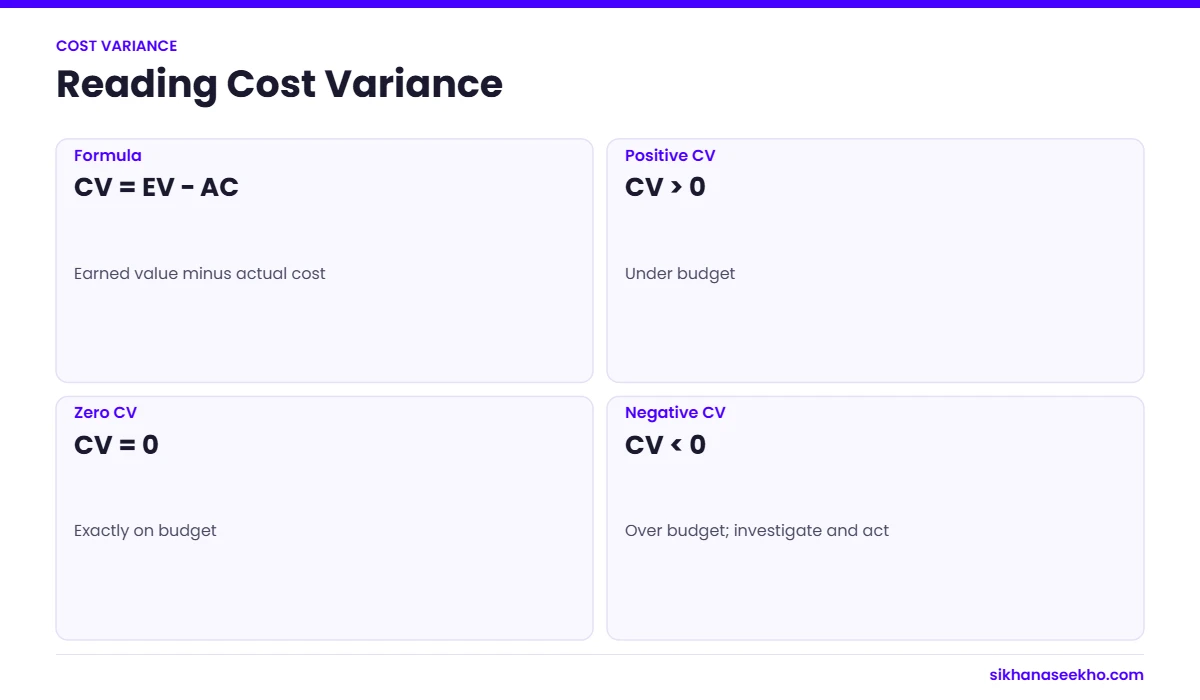
Cost Variance (CV) is an Earned Value Management metric that tells you whether your project is over or under budget at a given point in time. The formula is CV = EV − AC: Earned Value minus Actual Cost. A positive CV means under budget (you have spent less than the value of work completed). A negative CV means over budget (you have spent more than the value of work completed). A CV of zero means you are exactly on budget. CV is expressed in currency, not as a ratio. It tells you the absolute monetary variance, not the efficiency rate (that is the job of CPI).
✦
From my experience: I reviewed cost variance every month on my UAE projects as part of earned value reporting. I teach my students that the number only matters if you can explain what caused it and what you will do about it.
EV−AC
The CV formula: Earned Value minus Actual Cost
+CV
Positive CV = under budget: good
✦CV
Negative CV = over budget: action needed
£/$/€
CV is a monetary value, not a ratio or percentage
You are halfway through a project. You have spent £60,000. Your project is scheduled to have cost £55,000 at this point. But how much work have you actually completed? If you have only delivered £48,000 worth of output, you are £12,000 over budget, even though your team has been busy. If you have delivered £65,000 worth of output, you are actually £5,000 under budget despite spending more than planned.
This is exactly what Cost Variance measures, and why it is more useful than simply comparing planned spend to actual spend. CV tells you the variance between the value of work completed and the cost of completing it. Without the earned value component, you cannot tell whether a budget overspend reflects a real cost problem or simply work being done faster than planned.
This guide covers the CV formula, how to calculate it, how to interpret positive and negative values, how it works alongside CPI, and, most importantly, what to do when your CV is negative.
✦
Part of the EVM framework: Cost Variance is one of ten metrics in Earned Value Management (EVM). If you are new to EVM, read the complete EVM guide first for the full framework context. To calculate CV instantly for your project, use the free EVM calculator: enter PV, EV and AC and get all ten metrics in seconds.
01 · The Formula
The Cost Variance Formula: CV = EV − AC
Cost Variance Formula
CV = EV − AC
Earned Value minus Actual Cost Result is expressed in currency (£, $, €)
CV
Cost Variance
The output. Positive = under budget. Negative = over budget. Zero = exactly on budget.
EV
Earned Value
The budgeted value of work actually completed. Also called BCWP (Budgeted Cost of Work Performed).
AC
Actual Cost
The real money spent to complete the work so far. Also called ACWP (Actual Cost of Work Performed).
How EV Is Calculated
Earned Value is the piece that trips most people up. AC is straightforward. It is your actual spend from the accounts. But EV requires you to measure how much of the planned work is actually complete and multiply that by the budgeted cost of that work:
Pair CV with CPI to see how big the problem is.
EV = % Complete × Budget at Completion (BAC)
For example, if a task has a BAC of £20,000 and is 60% complete, the EV is £12,000. This is the value you have earned: what the work done so far was budgeted to cost, regardless of what you actually spent on it.
✦
The "% complete" problem: EVM is only as accurate as your % complete estimates. A team that says every task is "90% done" indefinitely, a real phenomenon called the 90% syndrome, will produce misleading EV and therefore misleading CV. Use objective completion criteria wherever possible: deliverables accepted, milestones passed, test cases passed, not team member estimates of effort remaining.
02 · Interpretation
How to Interpret Cost Variance: Positive, Zero and Negative
✦ Positive CV
CV > 0: Under Budget
EV > AC: you have completed more work value than you have spent to complete it.
This means the project is currently running under budget. It is generally good news, but investigate why:
Are resources genuinely more efficient than planned?
Has scope been cut or quality reduced without being reported?
Are invoices delayed: will they arrive later and flip CV negative?
Is the % complete over-estimated, meaning EV is inflated?
Action: Verify the % complete estimates are accurate. Report the positive variance to the sponsor. Do not immediately release the budget saving: wait until the trend is confirmed.
✦ Zero CV
CV = 0: Exactly on Budget
EV = AC: the value of work completed equals what you spent to complete it.
The project is performing exactly as budgeted. This is the ideal state, though in practice it is rare, as most projects show some variance in either direction.
Verify this is real performance, not averaging out of two variances
Some tasks over-budget, some under-budget, netting to zero is a warning sign. It means individual tasks are off plan even if the total looks fine
Action: Break down by work package to check for hidden variances that are cancelling each other out.
✦ Negative CV
CV < 0: Over Budget
EV < AC: you have spent more than the value of work completed.
The project is over budget. The size of the negative CV tells you how many currency units you have overspent for the work done to date. This requires investigation and action:
Which work packages are driving the variance?
Is it a rate variance (resources cost more than planned) or efficiency variance (tasks taking more effort)?
Is it likely to continue or was it a one-off?
Will the contingency reserve cover it?
Action: Identify root cause. Forecast final cost (EAC). Report to sponsor. Assess whether contingency is sufficient or a change request is needed.
03 · Worked Example
Cost Variance Worked Example: With Real Numbers
Here is a realistic worked example showing CV calculation across multiple work packages, and how to interpret the results at both work package and project level.
Project: Digital Marketing Campaign: Week 10 Status Report
Project Baseline
Detail
Value
Budget at Completion (BAC)
£120,000
Planned Value at Week 10 (PV)
£65,000
Planned % complete at Week 10
54%
Work Package Performance at Week 10
Work Package
BAC
% Complete
EV (BAC × %)
Actual Cost (AC)
CV (EV − AC)
Status
Strategy & Planning
£18,000
100%
£18,000
£16,500
+£1,500
Under budget
Content Creation
£35,000
80%
£28,000
£31,200
−£3,200
Over budget
Paid Media Setup
£22,000
60%
£13,200
£12,800
+£400
On budget
Analytics & Tracking
£15,000
40%
£6,000
£8,400
−£2,400
Over budget
Reporting Framework
£30,000
10%
£3,000
£2,100
+£900
Under budget
Project-Level Summary at Week 10
Metric
Calculation
Value
Meaning
Total EV
Sum of all work package EVs
£68,200
Value of work completed to date
Total AC
Sum of all actual costs
£71,000
Money actually spent to date
Project CV
EV − AC = £68,200 − £71,000
−£2,800
Project is £2,800 over budget for work done
CPI
EV ÷ AC = £68,200 ÷ £71,000
0.96
For every £1 spent, only £0.96 of value is delivered
EAC (forecast)
BAC ÷ CPI = £120,000 ÷ 0.96
£125,000
Project forecast to finish £5,000 over budget if trend continues
Reading the results: The project has a CV of −£2,800: it is over budget. But the picture is not uniform. Content Creation (−£3,200) and Analytics & Tracking (−£2,400) are the two problem work packages driving the total. Strategy came in under budget (+£1,500). The PM should investigate Content Creation and Analytics now: root cause analysis before the deficit widens. The CPI of 0.96 predicts a final overrun of ~£5,000 if the current efficiency rate continues to project end.
04 · CV vs CPI
Cost Variance vs Cost Performance Index: How They Work Together
CV and CPI both measure cost performance, but they answer different questions. You need both to fully understand your project's cost health.
✦ Cost Variance (CV)
Formula: CV = EV − AC
Answers: How many pounds/dollars are we over or under budget?
Unit: Currency (£, $, €)
Use for:
Reporting the absolute budget variance to stakeholders
Identifying which work packages are over or under by how much
Calculating how much of the contingency reserve has been consumed
Deciding whether to raise a change request for additional budget
Limitation: Does not tell you the efficiency rate, a large project will always have a large absolute CV even if the efficiency is fine.
✦ Cost Performance Index (CPI)
Formula: CPI = EV ÷ AC
Answers: For every £1 we spend, how much value do we get?
Unit: Ratio (e.g. 0.92 or 1.08)
Use for:
Forecasting the final project cost (EAC = BAC ÷ CPI)
Comparing cost efficiency across projects of different sizes
Identifying whether an efficiency problem is structural or one-off
Setting recovery targets (CPI must reach X to hit budget)
Limitation: A ratio alone does not tell you the monetary impact, a CPI of 0.95 on a £10k project is trivial; on a £10m project it is a £500k problem.
✦
Use them together, always: Report CV in your status reports for the absolute monetary picture. Use CPI to forecast final cost and compare efficiency. A project with CV = −£500 and CPI = 0.75 is in serious trouble, the small absolute variance reflects early-stage spend, but the efficiency rate predicts a massive overrun by project end. A project with CV = −£15,000 and CPI = 0.98 is only marginally off on efficiency, the large absolute variance reflects a large project and is not cause for alarm.
05 · When CV Is Negative
What to Do When Cost Variance Is Negative
A negative CV is not a reason to panic. It is a signal to investigate. Here is a structured response process.
1
Identify which work packages are driving the negative CV
Break the project-level CV down to work package level. A negative CV at project level often masks a mix of over and under-budget packages. Find the specific packages where EV < AC and rank them by the size of the negative variance. These are your focus areas.
2
Diagnose the root cause: rate or efficiency?
A cost overrun is caused either by a rate variance (resources cost more per hour than planned) or an efficiency variance (tasks are taking more hours than estimated). Rate variances are often outside the PM's control. Efficiency variances usually indicate estimation errors, scope creep or team performance issues. The cause determines the response.
3
Calculate the Estimate at Completion (EAC)
Use EAC = BAC ÷ CPI to forecast the final project cost if the current efficiency trend continues. Compare EAC to BAC to quantify the projected overrun. This gives you the number to bring to the sponsor, not "we are a bit over" but "we are forecast to finish £X over budget."
4
Check your contingency reserve
Contingency reserve is held for identified risks that materialise. If the negative CV is covered by contingency, and the cause is a known risk event, use the contingency. Document the drawdown. If the overrun exceeds contingency, or is caused by factors outside the original risk register, a change request to the sponsor is needed.
5
Present options to the sponsor, not a fait accompli
Your options typically include: (a) absorb the overrun within contingency; (b) reduce scope to bring cost back in line; (c) accept the overrun and request additional budget through change control; or (d) find efficiency improvements in remaining work to recover the variance. Present these with their trade-offs. The sponsor decides. You facilitate the decision.
6
Increase monitoring frequency on problem work packages
Once you have identified the overrunning packages, increase your check-in frequency from weekly to daily or every two days. Catch further slippage early. Update EV calculations with fresh % complete data. Track whether the CPI is improving or deteriorating week on week.
06 · EVM Context
Where CV Fits in the Full EVM Framework
CV is one of ten EVM metrics. Here is how it relates to the others, use the free EVM calculator to compute all ten simultaneously.
Metric
Formula
What It Measures
Good Value
CV: Cost Variance
EV − AC
Absolute budget variance in currency
Positive (> 0)
SV: Schedule Variance
EV − PV
Absolute schedule variance in currency
Positive (> 0)
CPI: Cost Performance Index
EV ÷ AC
Cost efficiency ratio: value per £ spent
≥ 1.0
SPI: Schedule Performance Index
EV ÷ PV
Schedule efficiency ratio: value vs plan
≥ 1.0
EAC: Estimate at Completion
BAC ÷ CPI
Forecast final project cost
≤ BAC
ETC: Estimate to Complete
EAC − AC
Remaining forecast cost to finish
Context dependent
VAC: Variance at Completion
BAC − EAC
Forecast final budget surplus/deficit
Positive (> 0)
TCPI: To-Complete Performance Index
(BAC−EV) ÷ (BAC−AC)
Efficiency needed on remaining work to hit BAC
≥ 1.0
Calculate CV and All EVM Metrics Instantly
Enter your PV, EV, AC and BAC, get CV, CPI, SPI, EAC, ETC, VAC and TCPI in seconds. Free, no signup.
Cost Variance on the PMP Exam: What You Need to Know
CV is a guaranteed fixture of the PMP exam. Here is exactly how it is tested and the traps candidates most commonly fall into.
The Key Rules the Exam Tests
CV = EV − AC: always EV first, then subtract AC. Not AC → EV.
Positive CV = under budget: good. If you spend less than the value delivered, you are efficient.
Negative CV = over budget: bad. You spent more than the value delivered.
CV is currency, CPI is a ratio: CV tells you how much, CPI tells you how efficiently.
CV does not tell you if you are ahead or behind schedule: that is SV (Schedule Variance = EV − PV).
Classic PMP Exam Scenario
"A project has a BAC of $200,000. At the status date, $90,000 has been spent and the team has completed 40% of the work. What is the Cost Variance?"
Working:
EV = 40% × $200,000 = $80,000
AC = $90,000 (given)
CV = EV − AC = $80,000 − $90,000 = −$10,000
The project is $10,000 over budget. The team has spent $90,000 but only delivered $80,000 of value.
✦
Related PMP exam topics: CV is tested alongside all other EVM metrics: see the full EVM guide for CPI, SPI, EAC, ETC, VAC and TCPI. For scenario-based practice, use our 200 free PMP practice questions: EVM scenarios appear in all three domains.
08 · FAQ
Cost Variance: 7 Questions Answered
Cost Variance (CV) is an Earned Value Management (EVM) metric that measures whether a project is over or under budget at a specific point in time. It is calculated as CV = EV − AC (Earned Value minus Actual Cost). A positive CV means the project is under budget: less has been spent than the value of work completed. A negative CV means the project is over budget: more has been spent than the value of work completed. CV is expressed in currency (pounds, dollars, euros) and gives the absolute monetary budget variance, as distinct from CPI which gives the efficiency ratio.
A negative Cost Variance (CV < 0) means the project is over budget. It means the Actual Cost (AC), what has been spent, exceeds the Earned Value (EV), the budgeted value of work completed. For example, if you have completed £60,000 worth of work but spent £68,000 to complete it, CV = £60,000 − £68,000 = −£8,000. The project is £8,000 over budget for the work done to date. A negative CV requires investigation to identify the cause, forecast the final cost impact and determine whether corrective action is needed.
Cost Variance (CV = EV − AC) and Cost Performance Index (CPI = EV ÷ AC) both measure cost performance but in different ways. CV gives the absolute monetary variance: how many pounds or dollars the project is over or under budget. CPI gives the efficiency ratio: how much value is being delivered per unit of spend. A CPI of 0.92 means for every £1 spent, only £0.92 of value is delivered. Use CV in status reports to communicate the monetary impact. Use CPI to forecast final cost (EAC = BAC ÷ CPI) and compare efficiency across projects. Always report both: CV alone does not tell you whether the efficiency problem is structural, and CPI alone does not tell you the monetary scale of the problem.
Earned Value (EV) is calculated as: EV = % Complete × Budget at Completion (BAC). For example, if a task has a BAC of £30,000 and is 70% complete, the EV is 0.70 × £30,000 = £21,000. For a full project, EV is the sum of EVs across all work packages. The accuracy of EV depends entirely on the accuracy of the % complete estimate, which is why objective completion criteria (deliverables accepted, milestones passed, test cases passed) are preferable to subjective team estimates.
No: Cost Variance and simple budget variance are different. Simple budget variance compares planned spend to actual spend (Planned Value → Actual Cost). It tells you whether you have spent more or less than you planned to at this point in time, but it does not account for how much work you have actually completed. Cost Variance (EV − AC) is more meaningful because it compares the value of work completed against the cost of completing it. A project can be under its planned spend (positive simple budget variance) but still have a negative CV if the work completed is worth less than what was spent on it: meaning it is actually over budget for the output delivered.
A good Cost Variance is zero or positive (CV ≥ 0). Zero means the project is exactly on budget. Positive means it is under budget: spending less than the value of work completed. Most organisations set a threshold for acceptable CV, for example, a CV of up to −5% of BAC might be within tolerance and not require escalation, while a CV of −10% or more triggers a formal corrective action review. The threshold depends on project size, risk appetite and contract type. What matters most is the trend, a CV that is slightly negative but improving week on week is less concerning than one that is slightly negative and deteriorating.
Yes: EVM including CV can be applied to Agile projects, though the implementation differs. In Agile, % complete is typically measured by story points completed versus total story points planned, making EV calculation more straightforward than in traditional projects. Some organisations use Agile EVM, where EV is calculated per sprint based on velocity (story points completed × cost per story point). CV in an Agile context tells the same story: are we delivering more value than we are spending? The PMI Agile Practice Guide and PMBOK 7 both address the use of EVM metrics in hybrid and Agile environments.

Pingback: Parametric Estimating - Critical for Accurate Project Budgeting