Yes: passing the PMP exam in 2 weeks is possible, but only for a specific type of candidate: an experienced project manager with 5+ years of active PM practice, solid Agile knowledge already in place, and the ability to study 6–8 hours per day for 14 consecutive days. For everyone else, a 2-week timeline is a fast path to a failed first attempt and an expensive retake. If that profile fits you, this guide gives you the exact day-by-day schedule. If it does not, a 6–8 week plan is the realistic minimum: the PMP Study Guide has that covered.
Let us be direct from the start: the internet is full of "pass the PMP in 2 weeks" articles that quietly assume you have the background of someone who has been managing large projects for a decade and already lives and breathes Agile. That context matters, a lot.
This guide is not going to pretend 2 weeks works for everyone. It does not. But for the right candidate it absolutely does, and there are real, working project managers who pass after 2 weeks of intensive preparation precisely because they already have the experience the exam tests. The exam is measuring PM judgement, not PM study hours. If that judgement is already well-developed, the preparation time is mainly about learning exam format and filling specific gaps.
This guide tells you honestly whether you are that candidate, and if you are, gives you the exact schedule to execute.
Is 2 Weeks Realistic for You?: The Honest Eligibility Check
Before you commit to this plan, answer these questions honestly. The 2-week path only makes sense if most of the "Yes" column describes you.
- Have 5+ years of active project management experience: leading teams, managing budgets, handling stakeholders
- Already work in an Agile or hybrid environment. You know what sprints, retrospectives and product owners actually are in practice
- Have done the 35-hour PM education requirement and it was recent, not 10 years ago
- Can dedicate 6–8 hours of focused study per day for 14 days: no work commitments, no major life events during this period
- Are not starting from zero on PMBOK concepts. You know what a risk register, stakeholder engagement plan and change control process are
- Are a fast learner comfortable with exam-style scenario questions. You do not need long acclimatisation periods
- Have fewer than 3–4 years of real project management experience, the exam tests judgement that only comes from doing
- Have limited Agile exposure. You would need to learn Agile from scratch in parallel, which is too much in 2 weeks
- Are studying part-time around a full-time job: 6–8 hours per day is not negotiable for a 2-week timeline
- Have not done any PMP study before, even experienced PMs need time to learn the exam's specific vocabulary and question style
- Are prone to exam anxiety: 2 weeks of intensive study followed immediately by a 4-hour high-stakes exam is a stressful scenario
- Need to pass on a specific date regardless of readiness, the retake fee is significant
The PMP exam costs $405 for PMI members and $555 for non-members (2026 rates). A failed attempt means waiting 1 year before retaking at full price. If you sit the exam at the end of 2 weeks of study and your practice scores were not consistently above 70%, you will very likely fail. An extra 2–4 weeks of preparation costs nothing except time. An exam retake costs hundreds of dollars and months of delay. Choose accordingly.
What 2 Weeks Actually Means in Study Hours
Let us put concrete numbers to the timeline so there is no ambiguity about what this commitment involves.
98 hours is enough: if you bring the prerequisite experience to it. A candidate with 8 years of PM experience and strong Agile knowledge needs far fewer hours to reach exam readiness than someone with 3 years and no Agile background. The hours are not the only variable, the experience you bring to them is.
The daily schedule below assumes two 3.5-hour study blocks with a meal break in between. Every session follows this structure: study content → immediate practice questions on that content → review wrong answers. Never a session that is purely passive reading.
What You Need in Place Before Day 1
Do not start the 14-day clock until these are all done. Each one takes time and needs to be sorted before the intensive period begins.
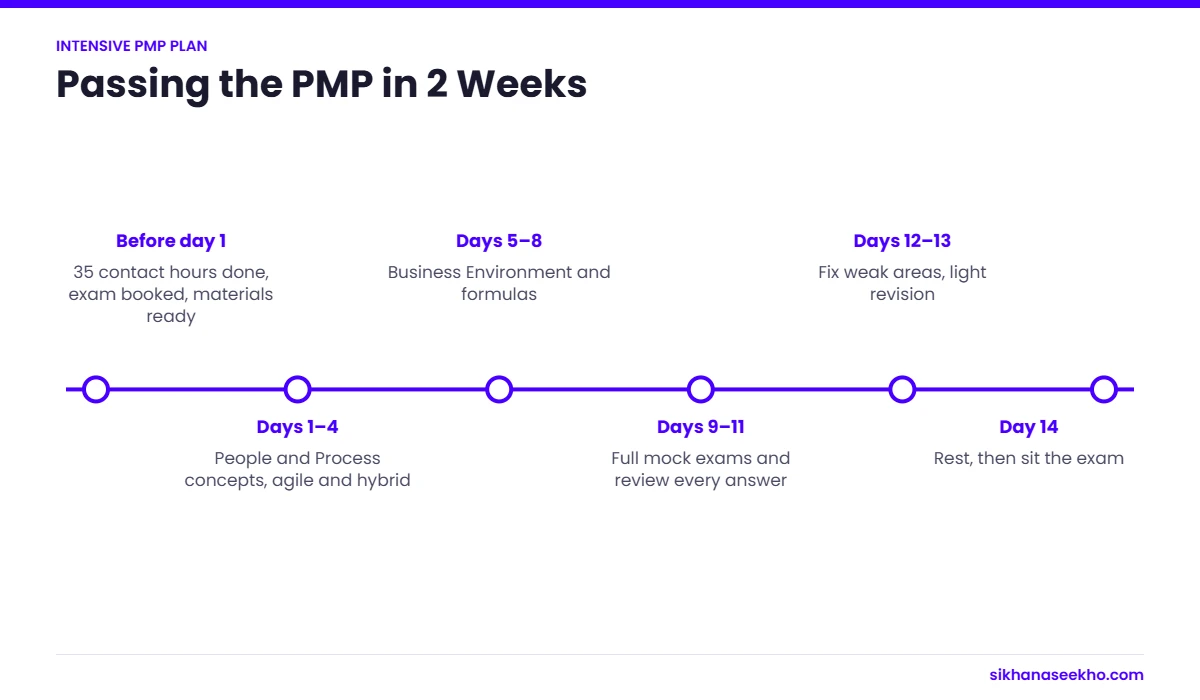
- PMI application approved: the application process takes 5–10 business days. Apply and get approved before you start intensive study. Book your exam slot for Day 15 or 16.
- 35 contact hours completed: if not already done, complete an online course that counts toward the requirement. Choose one that also serves as your study material (Andrew Ramdayal or Joseph Phillips on Udemy both qualify).
- Exam prep course purchased: choose one course and commit to it. Do not buy three courses and bounce between them. One structured course used fully is better than three used partially.
- Quality question bank access: PMI's own question bank, PrepCast, or the question bank included with your course. You will need 500+ questions available.
- Anki installed: free flashcard app for spaced repetition. Set up a PMP deck before Day 1 with the EVM formulas and communication channels formula as a starting point.
- Scrum Guide read: read the Scrum Guide (free, 13 pages) before Day 1 if you are not already thoroughly familiar with it. This is not part of the 14-day budget.
- Study environment prepared: quiet space, no distractions, phone in another room. 7 hours per day of focused study requires an environment that supports focus.
Day-by-Day Study Schedule: 14 Days to Exam Day
Each day follows the same structure: morning block (content + questions), lunch break, afternoon block (questions + review). Never skip the question review. It is where the learning happens.
| Day | Morning Block: Study Focus | Afternoon Block: Questions + Review | Daily Target |
|---|---|---|---|
| Week 1: Content and Foundation | |||
| Day 1 | ECO orientation. All 3 domains and weightings. PMBOK 7 principles 1–6. Take a 20-question diagnostic to establish your baseline score. | 30 scenario questions on PMBOK 7 principles. Review all wrong answers. Add missed concepts to Anki deck. | 50 Qs Baseline score recorded |
| Day 2 | PMBOK 7 principles 7–12. Performance domains overview. Key artifacts: project charter, stakeholder register, risk register, issue log, change log. | 40 scenario questions on principles and artifacts. Identify which principle types feel least natural. Review Anki from Day 1. | 40 Qs |
| Day 3 | Agile deep dive: Scrum roles, ceremonies, artefacts, Definition of Done. Servant leadership principles. Product Owner vs Scrum Master responsibilities. | 40 Agile scenario questions. These should feel familiar if you have Agile experience: identify any gaps. Add Scrum terms to Anki. | 40 Qs |
| Day 4 | Hybrid delivery. When to use Agile vs predictive vs hybrid. Agile Manifesto 4 values and 12 principles. Kanban fundamentals: WIP limits, flow, pull system. | 40 questions mixing Agile, hybrid and Kanban scenarios. Review all wrong answers noting which domain they fall in. | 40 Qs |
| Day 5 | Risk management: identification, qualitative analysis, risk response strategies (all 4 threat responses: avoid, transfer, mitigate, accept; all 4 opportunity responses: exploit, share, enhance, accept). Risk register vs risk report. | 40 risk scenario questions. Risk questions test both knowledge and PM judgement: note the reasoning pattern in correct answers. | 40 Qs |
| Day 6 | EVM formulas: PV, EV, AC, BAC, CV, SV, CPI, SPI, EAC, ETC, VAC, TCPI. Practice calculating all from scratch. Communication channels formula n(n−1)/2. Scope management and WBS. | 30 EVM calculation questions. 20 mixed scenario questions. EVM calculations must be fast and accurate: drill until they are automatic. | 50 Qs EVM formulas memorised |
| Day 7 | Stakeholder management: power/interest grid, engagement levels, stakeholder engagement plan. Change control process: Perform Integrated Change Control, CCB, change request assessment. Common scope creep scenarios. | 50 mixed questions covering stakeholder, change control and scope. Review your wrong answer log: what patterns are emerging across all 7 days? | 50 Qs Week 1 complete: 310 Qs done |
| Week 2: Practice and Exam Readiness | |||
| Day 8 | People domain deep dive: conflict resolution styles, team development (Tuckman's model), motivation theories (Maslow, Herzberg, Theory X/Y, McGregor). Virtual team management. Coaching and mentoring. | 50 People domain scenario questions. People domain is 33% of exam, make sure these feel natural, not academic. | 50 Qs |
| Day 9 | Procurement and contracts: Fixed Price (FFP, FPIF), Time & Materials, Cost Reimbursable (CPFF, CPIF). Who bears cost risk in each. Procurement planning and contract management. Quality management: QA vs QC, cost of quality, gold plating. | 40 procurement and quality questions. These are lower frequency but still appear: build a working knowledge, not deep expertise. | 40 Qs |
| Day 10 | Business Environment domain: benefits realisation, project governance, compliance, organisational change management. Schedule compression techniques: crashing vs fast tracking. Critical path and float concepts. | 40 Business Environment and schedule questions. Review Anki deck: EVM formulas, channels formula, contract types. Identify any remaining weak spots. | 40 Qs |
| Day 11 | Target your weak areas. Look at your wrong answer log from Days 1–10. What topics appear most often in your wrong answers? Spend the entire morning block drilling those, not reviewing what you already know well. | 50 targeted questions on your identified weak areas. If no clear weak areas: mixed domain practice. No new content today: consolidation only. | 50 Qs |
| Day 12 | Exam technique: how PMP scenario questions are structured. The "PM thinking" pattern: proactive, ethical, collaborative responses are correct; reactive, unilateral, blame-shifting responses are wrong. Practise the brain dump ritual (formulas to write in first 5 exam minutes). | First full 180-question timed mock exam. 4 hours. No notes. No pausing. Simulate real exam conditions exactly. Record your score and domain breakdown. Do not review answers yet: rest tonight. | 180 Qs First full mock complete |
| Day 13 | Deep review of Day 12 mock: go through every wrong answer in the morning. Understand the exact rule behind each incorrect response. Group wrong answers by domain and topic. If score was below 65%, consider postponing the exam by 1–2 weeks. | 40 targeted questions on topics where Day 12 mock showed weakness. Light Anki review. No heavy new content: brain needs consolidation. | 40 Qs Mock score assessed: Go / No-Go decision |
| Day 14 | Second full 180-question timed mock. Morning only. Different question bank from Day 12 if possible. Same conditions: 4 hours, no notes. | Review first 30 wrong answers from Day 14 mock only, do not try to review all 180. Light Anki review of formulas. Stop studying by 4pm. Rest, sleep well. Exam tomorrow. | 180 Qs Final mock complete: exam day tomorrow |
Exam Day Protocol
When to Sit: and When to Postpone
After Day 13's mock review, you need to make an honest call. Do not let the exam booking commit you to sitting before you are ready.
- Both full mock exams scored 68% or above: ideally 70%+
- No single ECO domain scored below 60% on either mock
- EVM calculation questions are consistently correct
- You feel confident distinguishing Agile from predictive scenarios
- Your wrong answer log shows improvement day over day. You are getting stronger, not plateauing
Your Day 12 mock scored below 65%. Any single domain scored below 55%. EVM calculation questions are still inconsistent. You are still confused by basic Agile scenario patterns. The PMI exam booking can be rescheduled at no cost up to 2 days before the exam, use that option rather than sitting with a score profile that predicts failure. An extra week of targeted preparation almost always closes a 65%→70% gap.
Need a Longer Runway?
If 2 weeks is not the right fit, the 16-week study plan gives you a structured, manageable preparation path without the intensity. Start with 200 free practice questions to benchmark where you are today.
Pingback: PMP Certification Cost in Pakistan: What You Need to Know
Pingback: 33 Amazing Chat GPT Prompts for PMP Exam Preparation