If PMP study material feels overwhelming, start here: the PMP exam tests scenario-based judgement, not encyclopaedic knowledge. You do not need to know everything. You need to know the right things deeply. The priority order is: (1) understand the three ECO domains and their weightings, (2) learn Agile and Scrum fundamentals, (3) study the core PMBOK 7 principles and key artifacts, (4) do practice questions from Day 1, not after you finish studying. Most candidates feel overwhelmed because they try to read everything before starting questions. Flip that approach and the mountain shrinks immediately.
✦
From my experience: Almost every student I train starts out overwhelmed by the amount of material. The ones who pass pick one main resource, follow a fixed plan and use practice questions to find their gaps.
250+
pages in PMBOK 7 alone
180
questions in the real PMP exam
60%
of the exam is Agile and hybrid content
3
ECO domains: the actual exam framework
You have just registered for the PMP exam. You open PMBOK 7, see the table of contents, then google "PMP study materials" and discover you also need the Agile Practice Guide, the Scrum Guide, the ECO framework, a 35-hour course, a question bank and apparently six months of your life.
This feeling is completely normal. Almost every PMP candidate goes through it. And it leads to the most common preparation mistake: trying to read everything before starting practice questions: spending weeks passively consuming material in the hope that comprehensiveness will eventually produce confidence. It does not. It produces more overwhelm.
This guide cuts through the noise. It tells you exactly what the exam actually tests, what you do not need to study, what to tackle in what order and how to go from paralysed to productive in the next four weeks.
✦
This guide is about getting unstuck. Once you have a clear priority order, the PMP Study Guide gives you the full 16-week content roadmap. The PMP Study Tips guide covers the techniques: active recall, spaced repetition and practice question strategy. Read this one first.
01 · What the Exam Actually Tests
The Honest Truth About What the PMP Exam Tests
Most candidates approach the PMP like an academic exam, read everything, retain everything, answer factual questions. That is not what the PMP is.
Start small, focus on high-yield topics and practise early.
The PMP exam in plain English
The PMP exam is 180 scenario-based multiple-choice questions testing what an experienced, ethical project manager would do in real situations. It is not testing whether you have memorised PMBOK. It is testing whether you have the judgement to make good PM decisions across predictive, Agile and hybrid environments.
You are not trying to memorise a textbook. You are trying to develop PM decision-making instincts. That comes from doing practice questions and understanding the reasoning behind each answer, not from reading more pages.
The exam is built around the PMP Examination Content Outline (ECO): a free document from PMI defining exactly what the exam covers across three domains:
People (33%): leading teams, servant leadership, conflict resolution, stakeholder engagement, coaching
Process (41%): managing scope, schedule, cost, quality, risk, procurement and communications across predictive and Agile approaches
Business Environment (26%): benefits realisation, compliance, organisational change, strategic alignment
Those percentages tell you exactly where to spend your time. The ECO is the actual exam blueprint: study it, not PMBOK.
✦
Download the ECO first: Search "PMP ECO 2021 PDF" on PMI's website. It is free. At 30 pages, it lists every task the exam tests by domain. Reading it once at the start of preparation is more valuable than the first 100 pages of PMBOK.
02 · What to Skip
What You Do NOT Need to Study: Clear the Noise First
Before deciding what to study, decide what to stop worrying about. Much of what feels overwhelming does not appear meaningfully on the exam.
Things that will not meaningfully improve your PMP score
✗Memorising every PMBOK 6 ITTO. The exam no longer tests ITTO recall.
✗Reading PMBOK 7 cover to cover as your primary study method. It is a reference, not a textbook.
✗Memorising all PMBOK 7 artifact category names as lists. Understand what each is, do not memorise lists.
✗Deep study of niche knowledge areas in isolation. Focus on integration and application.
✗Studying all scaling frameworks in depth (SAFe, LeSS, DA, Nexus). Know the basics: deep expertise is not tested.
✗Memorising PMI definitions word for word. The exam tests understanding, not definition recall.
✗Looking for trick question patterns. There are none, only right and wrong reasoning.
✗Re-reading your notes as your main review strategy. Passive re-reading produces very little retention.
03 · Priority Study Order
What to Study in What Order: The Priority Stack
Start at the top. Do not move to the next level until you have a working understanding of the current one.
1
Week 1: Start Here
The ECO: Understand the Exam Blueprint
Read the PMP Examination Content Outline (free PDF from PMI). Understand the three domains, their weightings and the tasks under each. This is your map. Everything you study should anchor to one of these tasks. Time: 2–3 hours.
Without the map, all study feels equally important. With it, you know what matters most.
2
Weeks 1–3: Non-Negotiable
Agile Fundamentals: Scrum, Kanban and Agile Values
About 60% of the exam is Agile and hybrid. Read the Scrum Guide (free, 13 pages). Know the three roles, five ceremonies, three artefacts and the Definition of Done. Understand the four Agile Manifesto values and twelve principles. Learn Kanban basics. Time: 15–20 hours.
Most candidates under-prepare here. Half the exam questions test this content.
3
Weeks 2–6: Core Content
PMBOK 7 Principles and Key Artifacts
Learn the 12 PMBOK 7 principles. Understand the 8 performance domains. Know the key artifacts: project charter, risk register, stakeholder register, issue log, change log, lessons learned register, communications plan, the three baselines. Use a structured course, not the PMBOK text. Time: 20–30 hours.
The backbone of the Process domain: 41% of the exam.
4
Weeks 2–16: Every Study Day
Practice Questions: Start Immediately, Never Stop
Do 10–20 practice questions every single study day from Week 1: before you feel ready. You will get many wrong. That is the point. Every wrong answer reviewed carefully is worth 30 minutes of reading. Aim for 500+ questions total before exam day.
This is where exam readiness is actually built, not in reading, but in applying, failing and understanding why.
Once your foundation is solid, add depth in the most-tested areas. EVM formulas (CV, SV, CPI, SPI, EAC, ETC). Servant leadership principles. Risk response strategies. Contract types. Communication channels formula n(n−1)/2. Time: 15–20 hours.
These are the depth layers that separate 60% scorers from 75%+ scorers.
04 · The 80/20 of PMP Content
What Is Most Heavily Tested
Not all topics are equally tested. Here is how to allocate your study time based on ECO weightings and candidate experience.
Topic Area
Frequency
Key rule to know
Servant leadership and team empowerment
Very High
Empower the team, do not do it for them. The PM facilitates, not controls.
Agile ceremonies and Scrum roles
Very High
~60% of questions involve Agile or hybrid. Know Scrum roles, ceremonies and artefacts cold.
Stakeholder engagement and conflict resolution
Very High
Engage early, resolve conflicts at the lowest level, involve the right people.
Change control process
High
Correct answer is almost always: assess impact, raise a change request, go through CCB.
Risk identification and response strategies
High
Know all four threat responses and four opportunity responses. Risk register is the working document.
EVM formulas (CV, SV, CPI, SPI, EAC)
Medium-High
5–10 calculation questions. Memorise all formulas. They cannot be looked up in the exam.
Communication and information management
Medium
Channels formula n(n−1)/2. Who needs what information and when.
Benefits realisation and business value
Medium
The project exists to deliver value: anchor decisions to business outcomes.
Contract types and procurement
Medium
Fixed price vs T&M vs cost reimbursable: know who bears cost risk in each.
Quality management (QA vs QC)
Medium-Low
QA = process focus, QC = output focus. Gold plating is always wrong.
Critical path and schedule
Medium-Low
Critical path concept and float. Forward/backward pass. Schedule compression techniques.
Resource management and team development
Medium-Low
Tuckman's model, RACI, motivation theories (Maslow, Herzberg, Theory X/Y).
05 · Breaking It Into Manageable Pieces
How to Break the PMP Into Manageable Pieces
The material only feels like a mountain when you try to see it all at once. Stop looking at the mountain and start looking at today's one kilometre.
1
Topic at a time
Study one ECO domain task per session. Not a chapter: one task. Understand it, then do 10 practice questions on it before moving on.
1
Week at a time
Plan one week ahead, not the whole 16 weeks. Planning the entire journey at once produces anxiety. Planning this week produces action.
50
Minutes at a time
Study in 50-minute focused blocks with a 10-minute break. Breaks are not weakness. They are when memory consolidation happens.
✦
The 10-question daily minimum: On any day you study, even if you only have 20 minutes, do 10 practice questions and review each explanation. This single habit builds scenario-based judgement faster than any amount of reading.
06 · Four-Week Quick Start
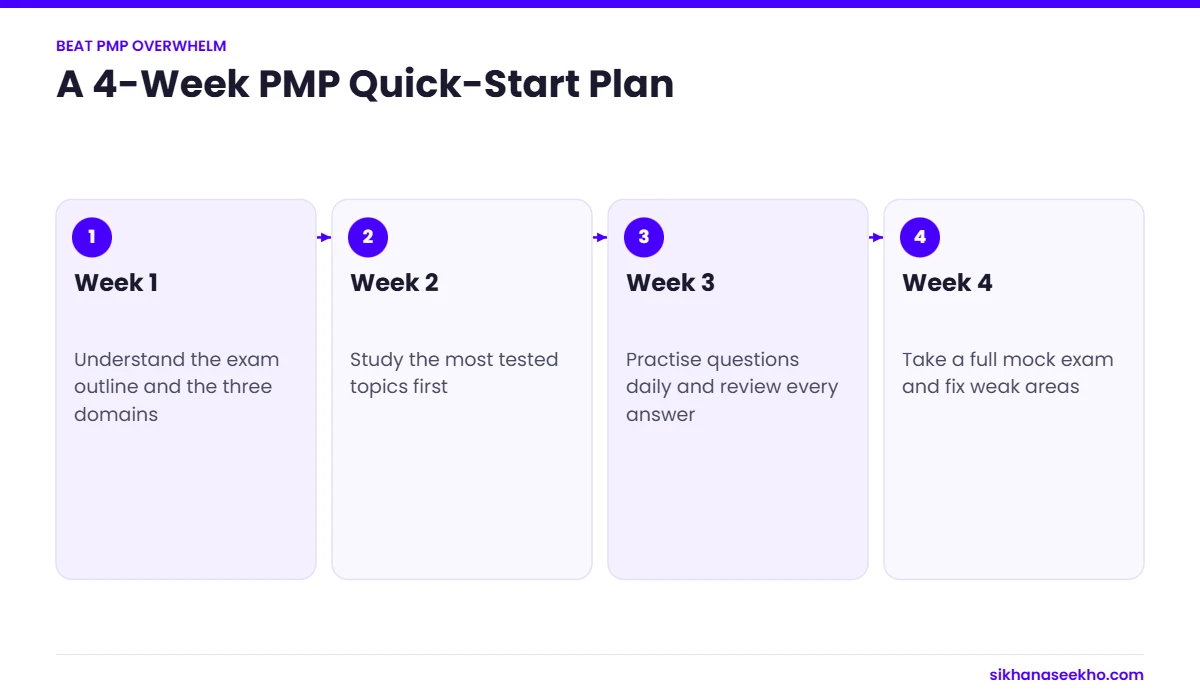
4-Week Quick-Start Plan for Overwhelmed Beginners
If you do not know where to begin, follow this. It builds the foundation everything else sits on.
Week 1: Orientation and Agile Basics
Day 1: Read the PMP ECO. Map the three domains and understand the task list.
Days 2–4: Read the Scrum Guide (free, 13 pages). Learn all roles, ceremonies and artefacts.
Days 5–6: Read the Agile Manifesto. Memorise the 4 values and 12 principles. Understand servant leadership.
Every day: 10 practice questions. Do not worry about the score: review every explanation.
End of Week 1 goal: You can explain Scrum from memory. 70+ practice questions done.
Week 2: PMBOK 7 Principles and Core Artifacts
Days 1–3: Study the 12 PMBOK 7 principles through your exam prep course. Understand each in plain English.
Days 4–5: Learn the key artifacts: project charter, risk register, stakeholder register, issue log, change log, baselines.
Day 6: EVM basics: PV, EV, AC, CV, CPI. Write the formulas from memory.
Every day: 15 practice questions. Track which domain your wrong answers come from.
End of Week 2 goal: You know all 12 PMBOK 7 principles and core artifacts. 140+ total questions done.
Week 3: Process Deep Dive
Days 1–2: Change control, the correct PM response is always "assess impact and go through CCB."
Days 3–4: Risk management: all four threat responses and all four opportunity responses.
Days 5–6: Communication management, stakeholder engagement, channels formula n(n−1)/2.
Every day: 20 practice questions. Do a 30-question timed block on Saturday with no notes.
End of Week 3 goal: Solid on change control, risk and communications. 250+ total questions done.
Week 4: People Domain and Gap Filling
Days 1–2: Servant leadership in depth: Scrum Master vs traditional PM. Emotional intelligence and conflict resolution.
Days 3–4: Team development (Tuckman's model), motivation theories, virtual team management.
Days 5–6: Review your wrong answer log. Drill the topics that keep appearing, not ones you already know well.
Saturday: First full 180-question timed mock. No notes. 4 hours. Record the score and domain breakdown.
End of Week 4 goal: First mock score recorded. Clear picture of weak domains. Ready to move into the full study plan.
After these four weeks, you have covered the highest-priority content, built a daily practice habit and have a mock score to anchor the rest of your preparation. Move into the full 16-week study plan from this foundation: not from scratch.
Ready for the Full Roadmap?
You now know where to start and what to prioritise. The 16-week PMP Study Guide gives you the complete week-by-week content plan from this foundation to exam day.
Start with the PMP Examination Content Outline (ECO), a free PDF from PMI's website. It lists exactly what the exam tests across three domains: People (33%), Process (41%) and Business Environment (26%). Reading the ECO first gives you a map of what matters before you pick up any study material. After that, prioritise: (1) Agile and Scrum fundamentals: about 60% of the exam; (2) the 12 PMBOK 7 principles and key artifacts; (3) practice questions from Day 1, do 10 every study day regardless of how early you are in your preparation.
No. Reading PMBOK cover to cover is one of the least efficient ways to prepare for the PMP exam. PMBOK is a reference guide. It describes PM concepts comprehensively, but the exam tests your ability to apply judgement in scenarios, not recall definitions. Use a structured video-based exam prep course as your primary content source, use PMBOK as a reference when you need depth on a specific topic, and spend the majority of your time on practice questions with careful answer review. Most successful first-time passers spent less than 20% of their study time reading PMBOK directly.
Yes, and it is the recommended approach. Start practice questions from Day 1 of your preparation, even before you feel ready. Getting questions wrong early is valuable: it shows you exactly what you do not understand and forces active engagement rather than passive consumption. Candidates who wait until they finish studying before starting questions consistently perform worse than those who interleave questions throughout. The goal of practice questions is not to test what you already know. It is to build the PM judgement and scenario-reading skills the exam demands.
PMI's 2026 exam outline puts about 60% of the PMP exam in Agile or hybrid approaches. This does not mean 60% pure Scrum questions. It means more than half of all scenarios will either be set in an Agile context, require Agile thinking, or present a hybrid situation. Candidates who prepare only on PMBOK predictive content will face roughly 90 questions they are poorly prepared for. Agile fundamentals, Scrum roles, ceremonies, artefacts, servant leadership and the Agile Manifesto, must be a priority from the very start.
PMBOK 6 organised project management into 49 processes within 10 knowledge areas, each with specific inputs, tools and outputs (ITTOs). PMBOK 7 replaced this with 12 principles and 8 performance domains, plus a catalog of artifacts. The current PMP exam blends both. You need PMBOK 7's principle-based approach and key artifacts, but PMBOK 6 knowledge area concepts still appear in scenario questions. Practical advice: do not memorise PMBOK 6 ITTOs, but understand the purpose of each knowledge area process as context for scenarios. Focus on the ECO domains, not on the PMBOK edition differences.
Forgetting is normal, the issue is almost always passive learning. If you are primarily reading and re-reading material, your brain is not storing it durably. Switch to active recall: after each study session, close all materials and write down everything you can remember. Use Anki flashcards with spaced repetition for formulas and artifact names. Do practice questions on each topic the same day you study it. These techniques create the kind of memory that survives the weeks between study and exam day.
The most reliable indicator is your performance on full 180-question timed practice exams. When you are consistently scoring 70% or above under timed conditions, 4 hours, no notes, you are ready. Check that scores are balanced across all three ECO domains. Also confirm wrong answers are decreasing week on week. Do not book based on a calendar date alone: readiness is a score, not a schedule. The PMP retake fee is significant, so extra preparation weeks are always worth it if practice scores are not consistently at 70%+.

Pingback: PMP Business Environment Domain 2026 Explained