The best books for aspiring project managers in 2026 span four categories: foundational PM methodology (PMBOK Guide, Project Management Absolute Beginner's Guide), Agile and Scrum (Scrum: The Art of Doing Twice the Work in Half the Time, Agile Project Management with Scrum), leadership and stakeholder management (The Deadline, Stakeholder Engagement), and soft skills (Crucial Conversations, The Coaching Habit). Start with PMBOK + one beginner's guide if you're new, or go straight to Agile titles if you're working in a software or product environment.
12
Books reviewed and ranked for 2026
4 categories
Foundational, Agile, Leadership, Soft Skills
1 must-read
PMBOK Guide is non-negotiable for PMP candidates
~6 months
Realistic time to work through the full list
Project management is one of the few careers where reading the right books genuinely changes how you perform on day one. Unlike many fields where theory stays abstract, PM books are packed with frameworks, checklists, and worked examples that you can apply to a real project the same week you read them.
The challenge in 2026 is not finding books. It is knowing which ones are actually worth your time. There are hundreds of project management titles in print. Many repeat the same ideas with different diagrams. A handful are genuinely transformative. This guide identifies those books, explains exactly what each one teaches, and tells you when to read it in your PM career.
We have organised the list into four categories that mirror how a project manager's skills actually develop: foundational methodology first, then Agile and iterative delivery, then leadership and stakeholder dynamics, then the soft skills that separate average PMs from exceptional ones.
✦
Who this list is for: Aspiring project managers with 0–3 years of experience, career changers entering the PM profession, and practitioners preparing for the PMP certification or CAPM exam. More experienced PMs will find the leadership and soft skills sections most useful. If you are looking for the fastest path to exam readiness, jump to the PMP exam books section below.
01 · Reading Paths
Which Books Should You Read First? Two Starting Paths
Not every aspiring PM should start with the same book. Your starting point depends on your work environment, predictive (waterfall) or Agile, and your immediate goal: general PM competence or PMP exam readiness. Here are the two most common paths.
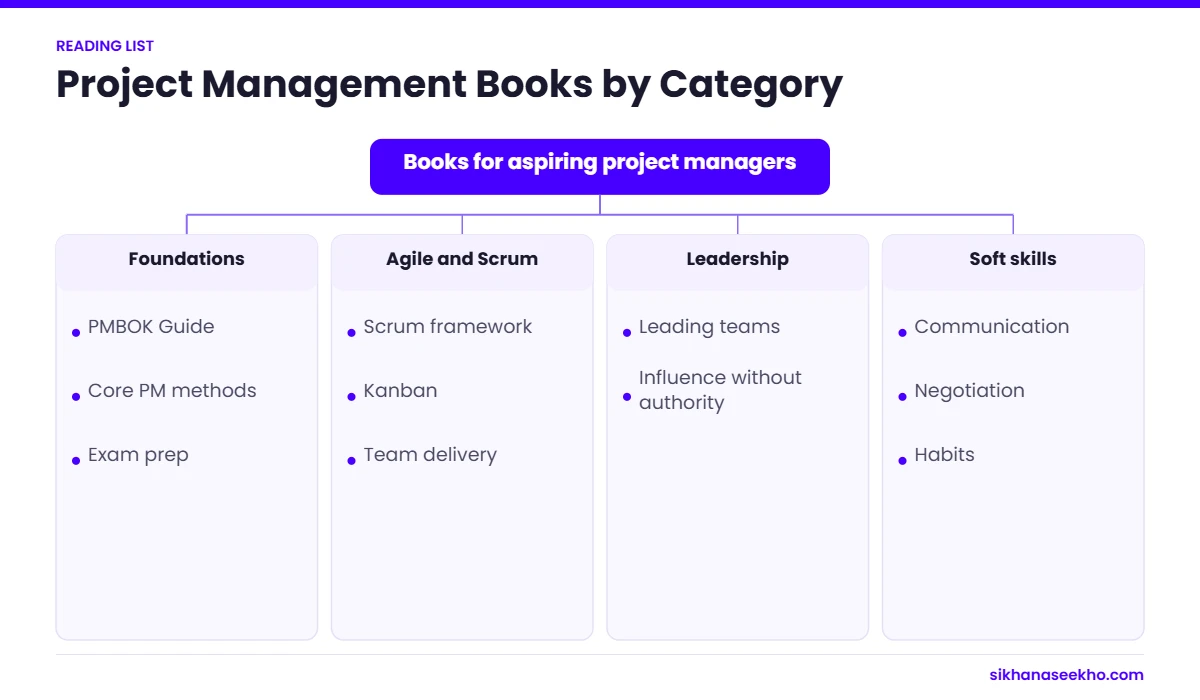
The four groups of books covered in this guide.
✦ Path 1: Traditional / PMP Track
Start here if: you work in construction, government, finance, or any field that uses waterfall delivery, or if you are targeting the PMP exam within 12 months.
Start here if: you work in software, product management, or any team that runs sprints, or if you have no PMP plans and want to be effective fast.
First: Scrum: The Art of Doing Twice the Work in Half the Time
Second: Agile Project Management with Scrum
Third: The Coaching Habit
Then: Making Things Happen (for scale)
02 · Foundational Books
Foundational Project Management Books
These are the books that establish your vocabulary, your mental models, and your structural understanding of how projects work. Every project manager, regardless of methodology, should read at least two of these before managing their first major project.
✦
PMBOK / Exam
A Guide to the Project Management Body of Knowledge (PMBOK Guide): 7th Edition
Project Management Institute (PMI) · 2021
The canonical reference for project management. The 7th edition made a significant shift from process-based guidance (the ten knowledge areas of earlier editions) to a principles-based framework built around eight performance domains. It is no longer a step-by-step how-to manual. It is a philosophy of what good project management looks like. For PMP exam candidates, this is mandatory reading, but it works best alongside a companion exam prep guide rather than as a standalone.
PMP ExamWaterfallCAPMReference
✦
Beginner
Project Management Absolute Beginner's Guide
Greg Horine · 5th Edition, 2022
The best on-ramp into professional project management for someone with zero formal training. Horine takes the full PM lifecycle, initiation, planning, execution, monitoring, closure, and explains it in plain language with practical examples. The 5th edition incorporates both predictive and Agile approaches, making it relevant whether your team runs Gantt charts or sprints. Read this before PMBOK, not after. It gives you the context that makes PMBOK's abstract principles land.
BeginnersLifecyclePMP Prep
✦
Classic
Making Things Happen: Mastering Project Management
Scott Berkun · Revised Edition, 2008
Berkun spent years as a program manager at Microsoft and distils that experience into the most readable, human, and practical PM book on this list. Where PMBOK gives you frameworks, Berkun gives you judgement: how to run meetings that produce decisions, how to manage ambiguous requirements, how to keep teams motivated when things go wrong. This is the book that bridges PM theory and actual human behaviour on a project. Particularly valuable for software PMs and anyone managing knowledge workers.
ExecutionLeadershipSoftware PM
✦
PMP / Exam
The Fast Forward MBA in Project Management
Eric Verzuh · 6th Edition, 2021
If PMBOK is the reference manual, Verzuh's book is the textbook: structured for learning, not just looking things up. It covers the complete PM methodology including WBS construction, schedule network diagrams, risk registers, earned value management and stakeholder management in an accessible format. The 6th edition adds Agile content, making it a genuinely hybrid-friendly read. Strongly recommended for PMP candidates as a primary study text that complements (rather than replaces) the official PMBOK Guide.
PMP ExamEVMRiskWBS
✦
Going deeper on the frameworks: Once you have read the foundational books, you will want to apply what you have learned. The critical path calculator and Earned Value Management guide are the natural next steps, the tools that take the concepts from these books and put them to work on a real schedule.
03 · Agile Books
Best Agile and Scrum Books for Project Managers
Agile is no longer a niche methodology for software teams. It is the dominant delivery approach in technology, product, and increasingly in non-tech industries. Any project manager entering the field in 2026 who cannot speak fluent Agile is already at a disadvantage in the job market. These three books cover the theory and practice from beginner to advanced.
✦
Agile / Scrum
Scrum: The Art of Doing Twice the Work in Half the Time
Jeff Sutherland · 2014
Sutherland co-created Scrum and this book is his case for why it works. Written as a narrative rather than a textbook, it is the most persuasive and readable introduction to Agile thinking available. Beyond explaining sprints and backlogs, Sutherland builds a compelling argument for why sequential, waterfall planning is fundamentally inefficient for complex work. Read this to understand the why of Agile before you dive into the mechanics. It changes how you think about planning under uncertainty, which is every project.
ScrumAgile MindsetBeginners
✦
Agile / Scrum
Agile Project Management with Scrum
Ken Schwaber · 2004 (still definitive)
Schwaber, the other co-creator of Scrum, takes a more technical and process-oriented approach than Sutherland. This book is about implementation: how to actually run a Sprint, conduct a Sprint Review, manage a Product Backlog and deal with the organisational resistance that Agile adoption always encounters. Despite being published in 2004, it remains the most precise technical reference for Scrum practitioners. Read it after Sutherland's book for the mechanics that follow the mindset.
Scrum MasterSprint PlanningBacklog
✦
Agile
Agile Estimating and Planning
Mike Cohn · 2005
One of the most practical Agile books ever written, focused entirely on the hardest problem in Agile delivery: estimating and planning under uncertainty without the comfort of a fixed Gantt chart. Cohn introduces story points, velocity, release planning and iteration planning in a way that is immediately applicable. If you have ever heard "Agile means no planning" and instinctively knew that was wrong, this book is the detailed rebuttal. Essential for any PM running Agile teams in environments that still need roadmaps and release forecasts.
Story PointsVelocityRelease Planning
04 · Quick Reference
All 12 Books at a Glance: Experience Level and Focus
Book
Author
Category
Best For
Level
PMBOK Guide 7th Ed.
PMI
Foundational
PMP exam, reference
All levels
Absolute Beginner's Guide
Horine
Foundational
Career changers, new PMs
Beginner
Making Things Happen
Berkun
Foundational
Software/tech PMs
Beginner–Mid
Fast Forward MBA in PM
Verzuh
Foundational
PMP study, methodology
Beginner–Mid
Scrum: Art of Doing Twice
Sutherland
Agile
Agile mindset, beginners
Beginner
Agile PM with Scrum
Schwaber
Agile
Scrum mechanics, practice
Beginner–Mid
Agile Estimating & Planning
Cohn
Agile
Estimation, roadmaps
Intermediate
The Deadline
DeMarco
Leadership
Management fiction, teams
All levels
Stakeholder Engagement
Bourne
Leadership
Complex stakeholder maps
Intermediate
Crucial Conversations
Patterson et al.
Soft Skills
Conflict, negotiation
All levels
The Coaching Habit
Bungay Stanier
Soft Skills
Team leadership, delegation
All levels
Thinking, Fast and Slow
Kahneman
Soft Skills
Decision quality, bias
Intermediate
05 · Leadership Books
Project Management Leadership Books
The most common reason projects fail is not poor scheduling or inadequate risk registers. It is human factors. Stakeholder conflicts, team dynamics, sponsor disengagement, and communication breakdowns account for the majority of project failures. These books address that reality directly.
✦
Leadership
The Deadline: A Novel About Project Management
Tom DeMarco · 1997
The most unusual book on this list, a management novel that teaches PM principles through fiction. DeMarco, one of the greatest writers on software management, tells the story of a project manager who must deliver multiple simultaneous software projects in an unfamiliar country. Every chapter introduces a new management principle: about estimation, people, risk, and what actually makes projects succeed. Do not dismiss it because it is fiction: it teaches concepts that dry textbooks cannot, and many experienced PMs cite it as the most memorable PM book they have ever read.
Team DynamicsEstimationManagement Novel
✦
Leadership
Stakeholder Engagement: The Game Changer for Program Management
Lynda Bourne · 2015
Stakeholder management is consistently the highest-weighted domain in PMP exam questions, and consistently the most underdeveloped skill in working project managers. Bourne's book is the most practical, structured treatment of stakeholder analysis and engagement available. It introduces the Stakeholder Circle tool, covers stakeholder mapping in depth, and provides actionable communication strategies for each stakeholder tier. If you have ever had a project derailed by a disengaged sponsor or a hostile senior stakeholder, this book shows you how to prevent and recover from that.
StakeholdersCommunicationPMP Domain
Recommended Reading Order by Career Stage
Stage
Role / Situation
Books to Read First
Time Investment
Stage 1
Considering a PM career, no experience
Absolute Beginner's Guide → Scrum (Sutherland)
~6 weeks
Stage 2
First PM role, waterfall environment
PMBOK → Fast Forward MBA → Making Things Happen
~12 weeks
Stage 3
First PM role, Agile environment
Scrum (Sutherland) → Agile PM with Scrum → Agile Estimating
Tip: Do not try to read all 12 books before starting your first project. Read 2–3 that match your current stage, apply them, then move to the next tier. Active application accelerates learning far faster than passive reading.
06 · Soft Skills Books
Soft Skills Books Every Project Manager Should Read
Technical PM skills get you hired. Soft skills determine whether you thrive. The ability to navigate difficult conversations, make good decisions under pressure, and develop your team's capability are the differentiators between PMs who plateau and PMs who advance to programme director and beyond.
✦
Soft Skills
Crucial Conversations: Tools for Talking When Stakes Are High
Every project manager eventually faces conversations they dread: telling a sponsor their deadline is unrealistic, confronting a team member about missed deliverables, pushing back on scope creep from a senior stakeholder. Most PMs either avoid these conversations or handle them badly. Crucial Conversations gives you a concrete, repeatable framework for navigating high-stakes dialogue without destroying the relationship. The 3rd edition updates the research base and adds coverage of virtual and remote communication. One of the highest-ROI books on this entire list, the skills apply in every meeting, every project, every day.
CommunicationConflictNegotiationRemote Work
✦
Soft Skills
The Coaching Habit: Say Less, Ask More & Change the Way You Lead Forever
Michael Bungay Stanier · 2016
The failure mode of most project managers is doing too much themselves and not developing the team around them. Bungay Stanier's book is a 200-page argument for asking better questions instead of jumping to solutions, and it gives you seven specific questions that transform how you run 1:1s, team check-ins, and problem-solving conversations. This is not a heavy read; it is a habit-forming toolkit. PMs who apply even three of the seven questions report measurably better team engagement and decision quality. Read it in a weekend, apply it the following Monday.
Team DevelopmentDelegation1:1s
✦
Soft Skills
Thinking, Fast and Slow
Daniel Kahneman · 2011
Project managers make dozens of high-stakes decisions every week: estimates, risk assessments, resource allocations, go/no-go calls. Kahneman's Nobel Prize-winning research reveals the systematic cognitive biases that corrupt those decisions: planning fallacy, optimism bias, availability heuristic, anchoring. Understanding how your brain produces bad estimates is the first step to producing better ones. This is the least obviously "PM" book on the list, but experienced practitioners consistently rate it among the most impactful, because it explains why projects feel hard even when everything looks fine on the schedule.
Decision MakingEstimation BiasRisk Thinking
07 · How to Use This List
How to Get Maximum Value From PM Books
1
Pick one book per category: not one from each at once
Reading three books simultaneously slows retention dramatically. Pick one book from the category most relevant to your current situation, finish it, then move to the next. Completions build momentum and confidence.
2
Apply one idea from each chapter before moving on
The best PM readers treat books as action plans, not entertainment. After each chapter, identify one specific thing to apply on your current project, a new template to build, a conversation to have, a risk to add to the register. Application cements retention far more than re-reading.
3
Use PMBOK as a reference, not a cover-to-cover read
The PMBOK Guide is 370 pages of structured reference material. Reading it linearly is inefficient. Read the Principles section (Part 1) cover to cover, then use Part 2 (Performance Domains) and the Appendices as lookup references when you need to understand a specific concept or prepare for an exam topic.
4
Pair books with free tools to make concepts tangible
Books explain concepts; tools make them real. After reading PMBOK or Verzuh on critical path and EVM, use a critical path calculator on a live project to see the theory in action. After reading Cohn on Agile estimation, try calculating velocity with your actual team data. The combination of reading and applying creates expertise.
5
For PMP exam prep, add a dedicated question bank
Books build knowledge. Passing the PMP also requires exam technique: understanding how PMI frames questions, how to eliminate wrong answers, and how to apply concepts under time pressure. After reading PMBOK and Verzuh, supplement with at least 500 practice questions before sitting the exam. The pattern recognition from practising questions is as important as the content knowledge itself.
✦
Build a reading habit, not a reading list. 20 minutes of focused reading per day, on a commute, at lunch, before bed, gets you through one PM book every 3–4 weeks. At that pace you cover this entire list in 9 months, which is realistic even with a demanding job. The worst PM readers are those who buy all 12 books at once and read none of them.
Ready to Apply What You Read?
Books give you the concepts. Free tools let you practise them on real projects: from identifying your critical path to calculating schedule variance with EVM.
For a complete beginner, the best starting book is Greg Horine's Project Management Absolute Beginner's Guide (5th edition). It covers the full PM lifecycle in plain language, introduces both waterfall and Agile approaches, and builds the vocabulary you need before tackling the PMBOK Guide. Read it before PMBOK, not after, the context it gives makes PMBOK's principles far more accessible. If you work in a software or product environment, Jeff Sutherland's Scrum: The Art of Doing Twice the Work in Half the Time is an equally good starting point for an Agile-first grounding.
Yes: reading the PMBOK Guide is essential for PMP exam preparation, but it should not be your only study resource. The 7th edition is a principles-based framework rather than a detailed how-to guide, so most candidates pair it with a more comprehensive study text like Verzuh's Fast Forward MBA in Project Management. The PMBOK Guide's Principles section (Part 1) should be read cover to cover; the Performance Domains section can be used as a reference. Supplementing with 400–600 practice questions is also strongly recommended, as the PMP exam heavily tests application of concepts in scenario-based questions, not just recall of definitions.
This list covers both approaches explicitly. The Agile section, Sutherland, Schwaber, and Cohn, is entirely focused on iterative and Scrum-based delivery. The foundational books (Horine, Verzuh, PMBOK 7th edition) all incorporate Agile content in their latest editions. The soft skills and leadership books are methodology-agnostic, the ability to run difficult conversations, develop your team, and make better decisions under pressure applies equally in Agile sprints and waterfall stages. If you work purely in an Agile environment, you can safely skip deep dives into PMBOK's more predictive content and focus on the Agile section plus the soft skills titles.
At an average reading speed of 250 words per minute, the full list of 12 books represents approximately 80–100 hours of reading. That sounds daunting, but spread over 6 months at 20 minutes per day, it is entirely achievable. Practically speaking, you do not need to read all 12: select the 4–6 most relevant to your current stage and goals. The foundational + one Agile title + one soft skills book is a highly effective starter set of roughly 20–25 hours of reading. Save the rest for when you hit specific gaps in your PM practice.
Yes. Most public library systems offer digital lending through apps like Libby (OverDrive), which gives free access to Kindle and audiobook versions of most titles on this list including Crucial Conversations, The Coaching Habit, Thinking Fast and Slow, and Scrum. The PMBOK Guide is available free to PMI members: if you are sitting the PMP exam, a PMI membership pays for itself quickly. Audible and Blinkist subscriptions provide access to summarised or audiobook versions of nearly all these titles. For the foundational technical texts like Verzuh, purchasing a physical or Kindle copy is recommended as they are reference books you will return to repeatedly.
Yes, but limit yourself to 2–3 books before starting, not the full list. Read the Absolute Beginner's Guide and one Agile title before your first day. These give you the vocabulary and mental models to understand what is happening around you and contribute meaningfully from week one. Reading 10 books before starting a role delays the real learning, which only happens on a live project. The most valuable reading happens concurrently with work, when you can immediately connect what you read to real situations. The rest of the list is most useful when you hit a specific challenge, stakeholder conflict, estimation problems, team motivation, and need a structured framework to address it.
Pingback: Risk Tolerance in PMP: Definition, Types and Best Practices (2026) - Sikhana Seekho