
The APM PMQ exam has one critical insight that separates those who pass first time from those who resit: the 10 long-response questions are worth 56% of your total marks, and most candidates who fail lose those marks, not through lack of knowledge, but through poor answer structure and time management. Master the long-response technique (Point → Expand → Apply), use APM's own terminology throughout, answer exactly what the question asks rather than everything you know, and protect your time for the 5-mark questions. These four principles, combined with a systematic study approach against the 73 published learning outcomes, are what first-time passes are built on.
The APM PMQ changed significantly in August 2024. The old three-hour, ten-essay format, which many candidates found more a test of typing speed than project management knowledge, was replaced with a modernised mixed-format assessment. These tips are written specifically for the current 2026 exam format.
What has not changed is what the exam actually tests: the ability to apply project management knowledge to realistic scenarios using APM terminology, structured thinking and clear written communication. The candidates who pass first time are rarely the ones who have "done the most reading." They are the ones who prepared most specifically: studying what the exam tests, practising how the exam assesses it, and walking in with a clear strategy for managing their time and marks.
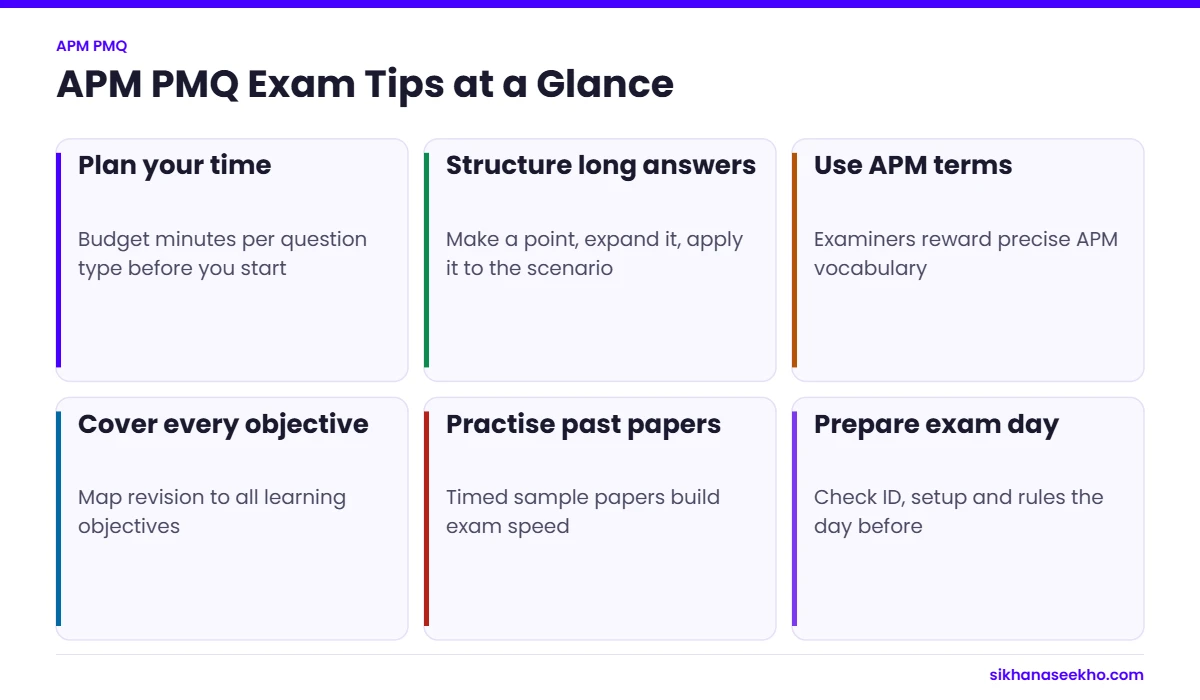
Top 10 APM PMQ Exam Tips for 2026
The APM Body of Knowledge (BoK8) is a comprehensive reference text. It is not your exam syllabus. The PMQ exam tests a specific set of 24 learning objectives and 73 learning outcomes drawn from the APM Competence Framework, not the entire BoK. Candidates who try to read the BoK cover to cover spend time on content the exam will never test, while missing the specific depth required on the 73 outcomes that it will.
Download the PMQ syllabus document from apm.org.uk. Print it or save it as your primary study guide. For each of the 73 learning outcomes, ask three questions: Can I explain this concept clearly? Can I apply it to a project scenario? Can I distinguish it from related concepts that might appear as wrong-answer options? Only when you can answer yes to all three should you consider a learning outcome fully prepared.
The 10 long-response questions are worth 5 marks each, a total of 50 marks, representing 56% of the entire exam. There are only two ways to pass the PMQ: either perform exceptionally on the multiple-choice sections and adequately on long-response, or perform solidly across both. There is no way to pass while struggling with long-response. Most first-time failures happen here.
The APM marker can only award marks for what is explicitly written. They cannot infer what you meant. They cannot award marks for knowledge you demonstrated earlier in the answer but did not apply to this question. Every mark must be earned by a specific piece of evidence in your response.
Use the Point → Expand → Apply structure for every long-response answer:
This is the single most common reason competent project managers lose marks they should have earned. The APM exam is marked by APM-trained assessors against APM-specific mark schemes. When APM uses "stakeholder engagement," writing "stakeholder management" may not score the mark, even though the concepts are closely related. When APM describes the "project management plan," writing "project plan" or "project initiation document" signals PRINCE2 thinking, not APM thinking.
Some terminology to embed before the exam:
- APM uses stakeholder engagement: not stakeholder management
- APM uses project management plan: not project plan or PID
- APM uses benefits management: not benefits tracking
- APM uses linear, iterative and hybrid lifecycles: not waterfall, Agile and hybrid
- APM uses governance in a specific sense: understand the APM definition
- APM uses issue to mean a risk that has materialised: not a general problem
- APM uses risk response strategies: avoid, reduce, transfer, accept (for threats)
Your primary terminology reference is the APM Body of Knowledge 8th Edition (BoK8). Every technical term you use in the exam should come from this source. If you are unsure whether the APM uses a term, check the BoK8 glossary.
This sounds obvious. In an exam, it is harder than it sounds. When a candidate knows a topic well, they are tempted to write everything they know about it regardless of what the question specifically asks. The APM marker can only award marks for relevant content: content that answers the actual question. Irrelevant additional knowledge wastes time and earns no marks.
The two most common forms of this error on the PMQ:
- "Describe two benefits of X" candidates write about what X is, how it works, and then eventually get to two benefits in the last paragraph. Only the benefits earn marks. The description earns nothing.
- "Explain how a project manager should respond to Y" candidates explain what Y is in detail before describing the response. APM already knows what Y is, the question is asking about the response.
Before you start writing each long-response answer, underline the key instruction word (describe, explain, identify, justify, compare) and the specific aspect being asked about. Then write only about that.
The APM PMQ is 150 minutes for 90 marks. That is 1 minute and 40 seconds per mark. Time management is not optional. Candidates who spend too long on early questions run out of time for the high-value long-response questions at the end, the section worth over half the exam.
| Section | Questions | Marks | Time Budget | % of Exam |
|---|---|---|---|---|
| Multiple response (1 mark each) | 20 | 20 | ~25 minutes | 22% |
| Select-from-list (2 marks each) | 5 | 10 | ~12 minutes | 11% |
| Short response (2 marks each) | 5 | 10 | ~15 minutes | 11% |
| Long response (5 marks each) | 10 | 50 | ~75 minutes | 56% |
| Review buffer | : | : | ~23 minutes | : |
| Total | 40 | 90 | 150 minutes | 100% |
The implication is clear: the long-response section needs approximately 75 minutes: half the exam. If you find yourself spending 4–5 minutes on a 1-mark multiple-choice question, you are eating into the marks budget that matters most. On multiple-choice questions, if you do not immediately know the answer, make your best selection, mark it for review, and move on. Do not let individual questions hold you hostage.
APM publishes official PMQ sample papers on their website: free to download. These are the closest available representation of the real exam's style, difficulty and question format. Many candidates read them. Far fewer do what actually builds exam readiness: completing them in full, under timed conditions, with all notes closed, as a genuine simulation of the real exam.
The first time you sit under timed conditions should not be in the real exam. Every candidate who has sat a timed practice paper before the real exam reports that the experience of managing time pressure, making decisions under uncertainty and writing structured answers to a clock is a skill that must be practised separately from subject knowledge.
Ideally, complete at least two full timed practice attempts in the final two weeks of preparation: one to identify gaps, and one closer to the exam date to build confidence and calibrate your time management.
More words do not mean more marks. A 5-mark long-response question that asks for two examples needs two well-structured Point → Expand → Apply answers, not six examples with shallow coverage. The APM mark scheme rewards completeness and relevance over volume.
The practical rule: once you have made your point, expanded it and applied it to the scenario, you have earned the available marks for that point. Stop and move to the next point. Do not add more description, additional examples that were not asked for, or caveats that dilute a clear answer. Each additional sentence that earns no marks is time taken from questions that could earn marks.
This is especially important for short-response questions (2 marks). A short-response question wants two specific pieces of information: one point per mark. Two clear, focused sentences will outscore a paragraph of vague prose on the same topic.
The PMQ exam presents questions in a project scenario context. A scenario description is given (typically 50–150 words about a specific project, organisation or situation) and the questions refer back to it. Many candidates read the questions without fully absorbing the scenario, and then write generic textbook answers that miss the specific context.
The application part of every long-response answer (the A in Point → Expand → Apply) must reference the specific scenario. Generic application earns fewer marks than scenario-specific application. "The project manager should conduct risk identification workshops" scores less than "Given that the scenario involves a multi-vendor implementation in a regulated environment, the project manager should conduct risk identification workshops with representatives from each vendor and the compliance team to identify interface risks and regulatory constraints."
The APM PMQ allows an optional break of up to 30 minutes between Part 1 and Part 2. This break is in addition to the 2.5-hour exam time. Two important rules most candidates do not know:
- Once you submit Part 1, you cannot return to it. Review Part 1 thoroughly before submitting, particularly if you flagged any questions for review. Once submitted, it is locked.
- The break does not reset the clock. Your 150 minutes of exam time continues excluding the break period. Use the break if you genuinely need mental reset, not because you have spare time.
When is the break worth taking? If you are feeling overwhelmed, struggling to concentrate, or your typing accuracy is declining, a short break can meaningfully improve Part 2 performance. If you are in good flow and well within your time budget, consider skipping it to protect maximum thinking time.
The APM PMQ is taken online under remote proctoring: from your home or office. This creates practical risks that a physical exam centre does not: technical failures, internet interruptions, background noise violations, unauthorised material in view of the webcam, and distractions from other people. None of these should happen. With preparation, none of them will.
Complete the technical setup and system check well in advance, not the morning of the exam. Ensure your computer, webcam, microphone and internet connection all meet the proctoring requirements. The exam provider will send specific system requirements, check these at least one week before your exam date.
APM PMQ Exam Day Checklist
The 5 Most Common APM PMQ Mistakes: Avoid These
Ready for the Full APM PMQ Picture?
The complete APM PMQ guide covers the full exam format, all 24 learning objectives, costs, the APM vs PMP comparison and the study plan.
Pingback: Free and Paid APM PMQ Study Materials for 2026
Pingback: Top APM Accredited Training Providers You Should Know